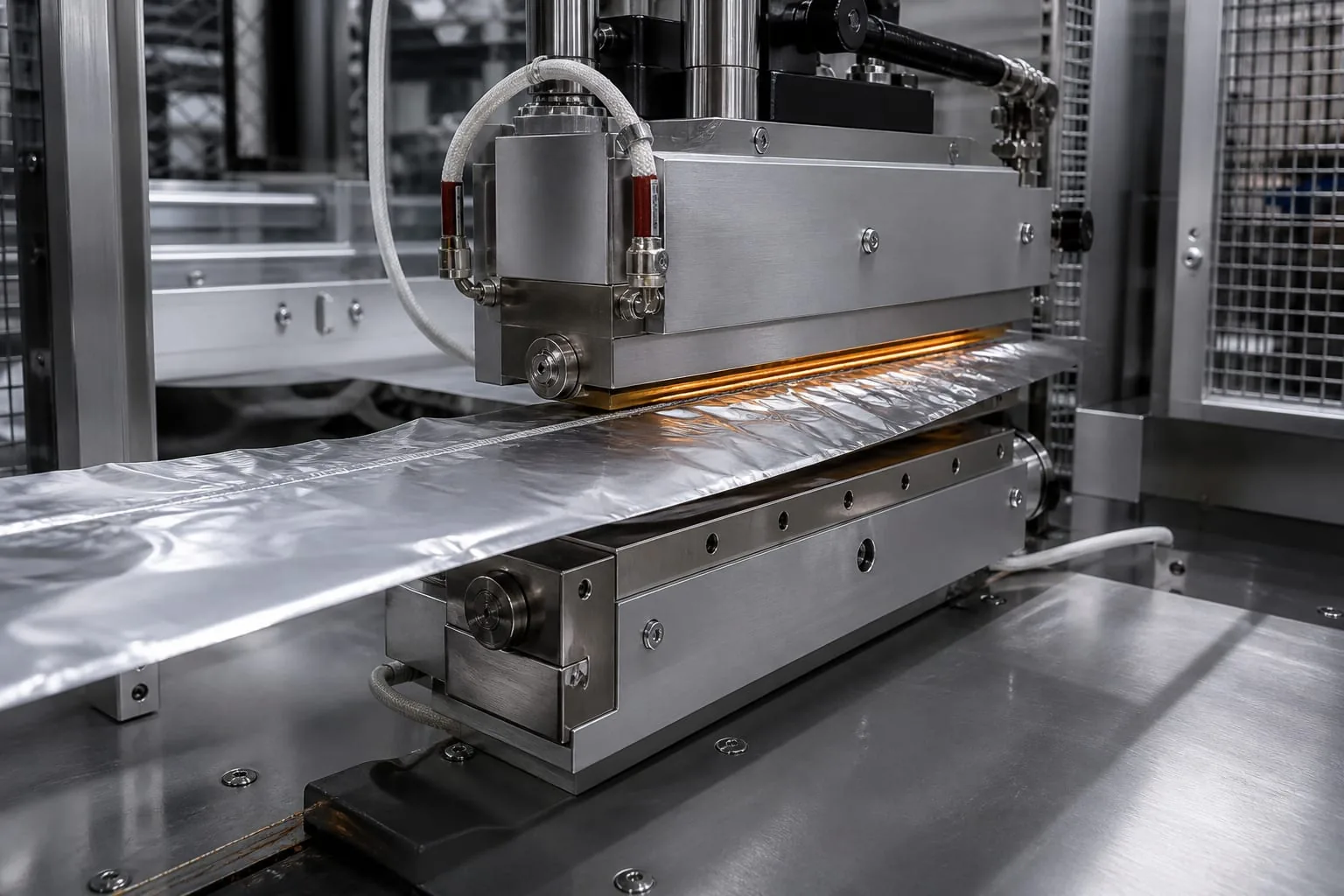
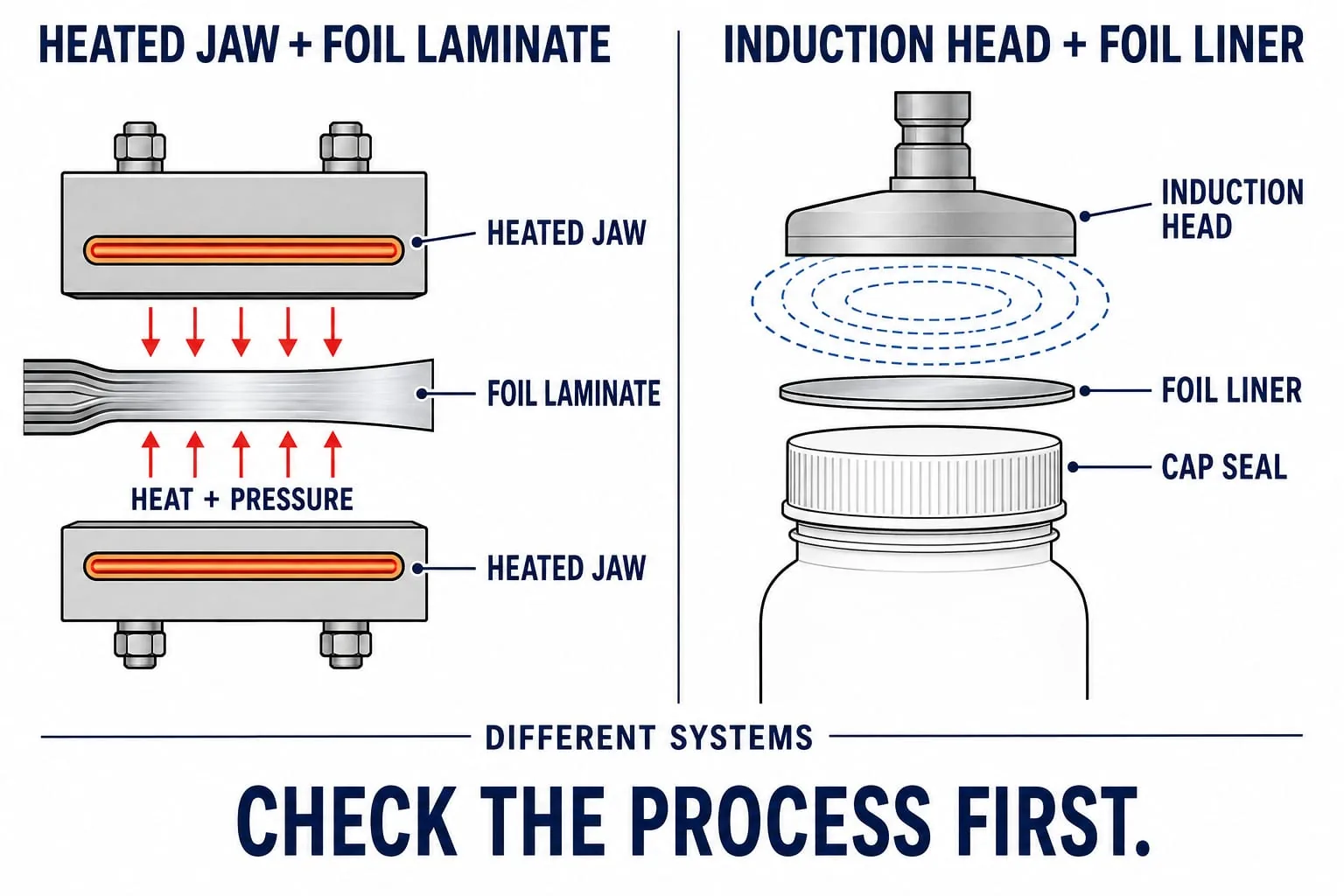
An automatic aluminum foil sealing machine can describe more than one process. In a flexible-packaging line, heated bars or jaws can close a foil laminate by applying heat and pressure across a defined seal area. In a container line, an induction head can activate a foil liner beneath a cap. Both applications involve aluminium, but the parts, controls and replacement questions are different.
Start by identifying the package format and the heat source before ordering anything. A machine that seals a foil-laminated web or pouch may need a resistance element, sealing jaw, support, terminal assembly or PTFE cover. A cap sealer needs a compatible induction head and liner arrangement, which is outside the confirmed Heat Seal Components offer. The practical answer is to document the process first, then match the component to the actual station.
What an automatic aluminum foil sealing machine actually seals
Foil laminate web or pre-made pouch
A foil laminate is a flexible structure in which an aluminium layer is combined with other layers. The heat-seal surface, total thickness, printed area and seal width affect how the packaging responds to the heated interface. PAC Machinery’s guide to heat sealers distinguishes constant-heat equipment used for foil laminates from impulse bar sealing, where the heating element is energised during the heat cycle. That distinction is useful when tracing a replacement part, but it does not provide a universal temperature or element specification.
For an automatic foil sealing machine, record whether the material arrives as a web, premade pouch or another flexible format. Note where the seal is made, how the web is guided, whether both jaws are heated and whether a cooling or hold phase follows the heat step. These details tell a supplier whether the enquiry concerns a continuous band, a formed jaw, a resistance strip or a cover surface.
Induction foil liner is a separate process
Induction sealing normally creates a closure under a cap rather than a flat flexible-film seam. Enercon explains that the liner, closure geometry, head style and working gap all influence the application. Do not order a heated jaw or heat-seal element because a search result uses the word foil. Confirm whether the package has a cap and liner, or a flexible foil laminate presented between opposing sealing surfaces.
Components in a heated-jaw foil sealing station
Once the process is confirmed as heated-jaw sealing, inspect the complete contact stack rather than the visible heater alone. The working result depends on the heat source, the jaw faces, the support or pressure path, the non-stick cover and the electrical connections. A replacement that fits the length but changes the working profile can still create an uneven seal or damage the film.
Heating element and resistive path
The heating element converts the machine’s electrical input into heat along the intended seal length. When replacing a part, compare the heated length, overall length, cross-section or profile, terminal arrangement, fixing method and position in the jaw. A resistance value should be checked against the machine documentation or the original part under a safe, isolated test condition; it should not be guessed from colour or appearance. Heat Seal Components supplies made-to-fit heat seal elements and wires, so the useful enquiry contains dimensions and photographs rather than only the machine’s marketing name.
Sealing jaws, support and pressure
The jaws or bars bring the package surfaces together and help maintain contact while the seal is formed. Check the working face, parallelism, mounting holes, travel, support pad and any alignment features. The relevant replacement may be a complete jaw, a sealing bar, a support or a component fitted inside the assembly. A bent carrier, loose fastener or worn pressure surface can imitate an electrical fault because the element is no longer contacting the package evenly.
PTFE cover and release surface
A PTFE cover or heat-seal tape protects the contact area and helps the packaging release from the heated surface. Inspect it for thinning, creasing, splits, adhesive lift, contamination and exposed metal. The replacement width, thickness, overlap and fixing method should follow the machine arrangement. If you need a cover replacement, compare the current surface with the available PTFE heat-seal tape specification instead of assuming that any tape of the same width is equivalent.
Compatibility checks before ordering
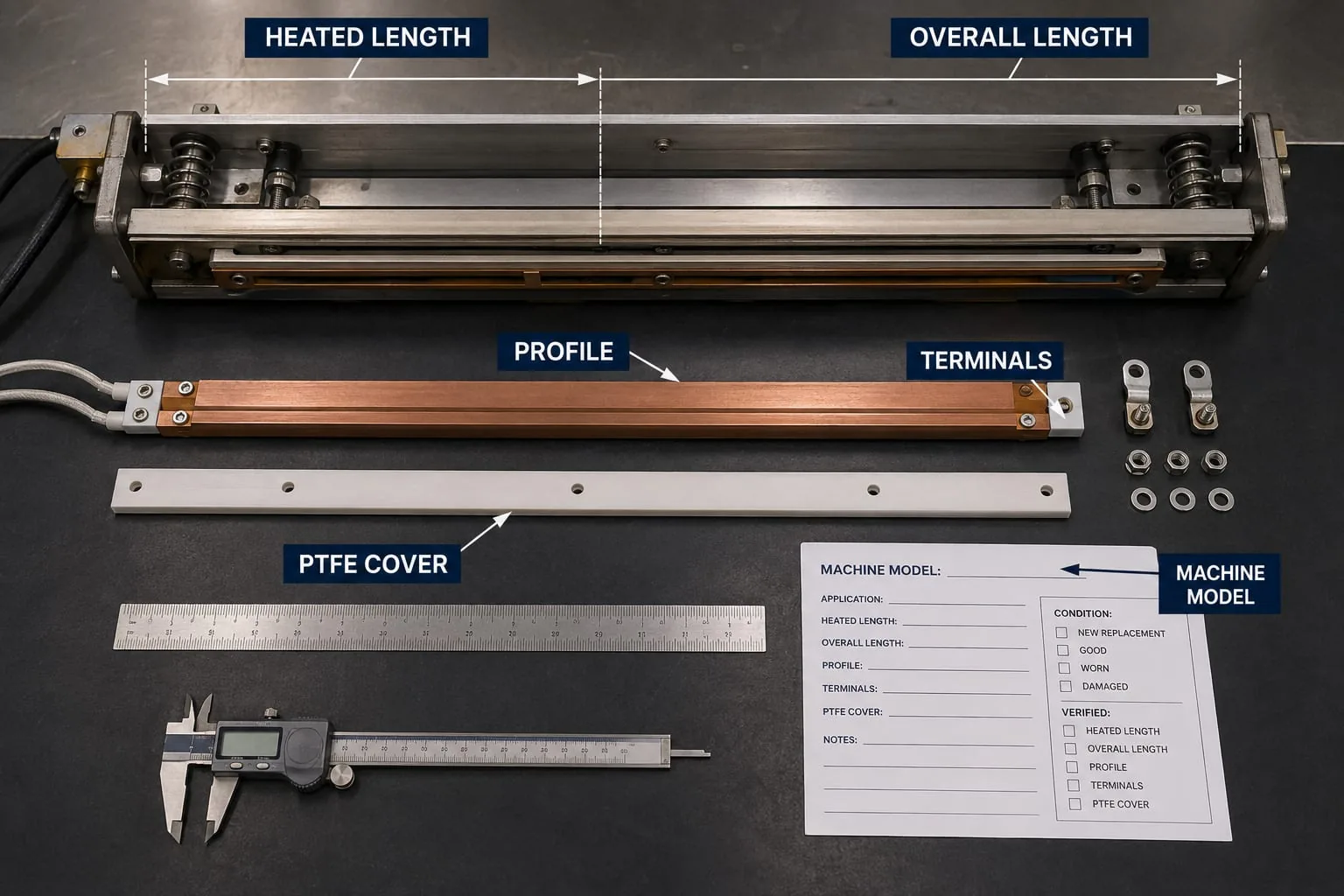
A reliable component review starts with evidence from the installed station. Photograph the jaw in place, the removed part beside a scale, both terminal ends and the working face. Keep a representative good seal and a rejected seal where your quality system permits. This record reduces the risk of copying a worn dimension or confusing a heated flexible-film station with an induction cap sealer.
Use the following fields as a minimum record. If a field is unknown, mark it as unknown rather than filling the gap with a catalogue assumption.
- Machine make, model, serial number and the exact sealing station.
- Package format, foil-laminate construction, seal position and required seal width.
- Heated length, overall length, profile, mounting points and terminal layout.
- PTFE cover width, thickness, fixing method and visible condition.
- Known temperature, dwell, pressure, cooling or hold settings, plus the material lot when relevant.
- Photographs and descriptions of a normal seal, the failure mode and when the fault began.
Measure the right length
Heated length is not always the same as overall part length. Measure from the actual heat-producing section, then record the complete carrier or jaw length separately. Include the location of terminals, end returns, cut-outs, mounting holes and any unheated margin. A ruler and calliper photograph is more useful than a rounded dimension copied from a listing.
Confirm profile, terminals and mounting
The cross-section determines how the element sits in the jaw and how heat is presented to the foil laminate. Record the profile from the end or from a clean section of the removed component. Photograph terminal posts, washers, insulators, lead exits and mounting points. If the part is custom or no longer available as a direct replacement, a custom impulse heat-seal element review can use this evidence to clarify what must be matched.
Record film structure and seal width
Ask the film or pouch supplier for the construction and recommended sealing window. Record the target seal width and the distance from the seal to product, print, gusset or other features. A jaw can be mechanically correct but unsuitable for the available seal land. If the line uses several materials, keep samples and settings associated with each material rather than treating the phrase automatic foil sealing machine as one fixed recipe.
How to set and check the sealing process
Seal quality is a process result, not a temperature-display result. Audion’s Lamino documentation shows why model-specific settings such as temperature, time, seal length and material compatibility must be read together. Its listed figures describe that model only; they are not a specification for your machine. Use the machine maker’s approved settings and the packaging supplier’s guidance as the starting point.
Temperature, dwell and pressure work together
Change one controlled variable at a time and record the result. Too little heat or dwell can leave an incomplete seal; too much heat, time or pressure can distort the laminate, squeeze out the sealant or mark the package. Check that the jaws close squarely and that the package is supported across the complete seal width. If the controller is stable but the seal varies across the width, inspect alignment, pressure distribution, element seating and the cover before changing the recipe.
Check the seal rather than the display
Inspect the full seal for an even appearance, continuous contact and the absence of wrinkles, channels, contamination or overheated edges. Test representative samples using the method required by your quality system. Separate machine variation from material variation by keeping the machine, settings, material identification and sample result together. A repeatable defect in one side of the seal often points to contact or alignment; a defect that follows the material lot may need a packaging-material review.
Maintenance for consistent foil seals
Planned maintenance protects both seal quality and the people working around the station. HSE maintenance guidance recommends planned work based on the manufacturer’s instructions, suitable competence and appropriate tools. For a heated-jaw station, the maintenance record should cover the element, terminals, leads, insulation, jaws, supports, PTFE cover, fasteners, guards and any product build-up.
Isolate energy before inspection
Follow the machine’s isolation procedure and allow hot parts to cool before opening the work area. Prevent unexpected jaw movement and account for stored pneumatic, electrical or mechanical energy where present. HSE packaging-machinery guidance highlights guarding and safe systems around machinery hazards. A continuity check or resistance measurement is only useful after the part is safely isolated and the test method is suitable for the equipment.
Common signs of component wear
Replace or investigate a component when you see a split or lifted PTFE cover, exposed conductor, loose terminal, discoloured element, damaged jaw face, uneven pressure mark or repeated seal failure in one area. Clean the contact surfaces using the machine maker’s approved method. Do not scrape a coated surface with a tool that can change its profile. If the defect persists after the surface and alignment are corrected, capture fresh samples before ordering a replacement.
Use samples as process evidence
A good sample and a rejected sample help separate a component fault from a process or material fault. Label the samples with date, machine station, material, settings and observed defect. The record can show whether the problem is a gradual loss of seal strength, a sudden open circuit, a new wrinkle after a cover change or a defect that appears only at one speed.
Questions to ask before replacing a foil sealing component
The correct part is the one that matches the working interface and the process evidence, not necessarily the one with the closest product title. Before requesting a quote, confirm the machine arrangement, the package construction and the exact component to be replaced. A photo of the full station prevents a supplier from interpreting a flat foil seam as a cap-liner application.
What makes a useful enquiry
Include the machine information, application photographs, measured dimensions, terminal details, PTFE cover condition, film or pouch information and representative seal evidence. State whether the part is a heater, element, jaw, bar, support or cover, but keep the old part available until the interface has been checked. If you are replacing a part in a line that uses multiple formats, identify the exact format and station for each sample.
What a component review can and cannot confirm
A component review can clarify which measurements and interfaces need to be matched and whether the reported symptom is consistent with the element, jaw, cover, support or contact condition. It cannot approve a process window, replace the machine maker’s risk assessment or guarantee a package’s legal or shelf-life performance. Those decisions remain with the equipment, material and quality teams responsible for the line.
Practical FAQs
Is an automatic foil sealing machine the same as an induction sealer?
No. A heated-jaw system applies heat and pressure directly to a flexible laminate or film interface. An induction sealer uses an induction head to activate a foil liner under a closure. Confirm the package format, sealing head and liner or laminate arrangement before selecting a replacement.
Can I replace only the heater element?
Sometimes, but first inspect the carrier, terminals, cover, jaw alignment and support. A new element cannot correct a distorted jaw or a damaged PTFE surface. Compare the measured working assembly with the machine documentation and the removed part before deciding whether the heater alone is the correct service item.
What should I send for a quotation?
Send the machine make and model, station photographs, package and foil-laminate details, the target seal, measurements, terminal and mounting photographs, known settings and good and rejected seal samples. Include the exact component location and the date the issue started. This gives a supplier enough context to identify the next compatibility check without inventing missing dimensions.
Contact Heat Seal Components for a compatibility review
If you need a replacement heat seal element, wire, sealing jaw, bar or PTFE cover for a foil-laminate application, send the evidence from the installed station. Heat Seal Components can review the component interface and advise on the next practical check. The company supplies replacement components and custom heat-sealing parts; it does not present this guide as a complete-machine specification. Use the contact page to start the enquiry, and include the machine and material details in the first message.