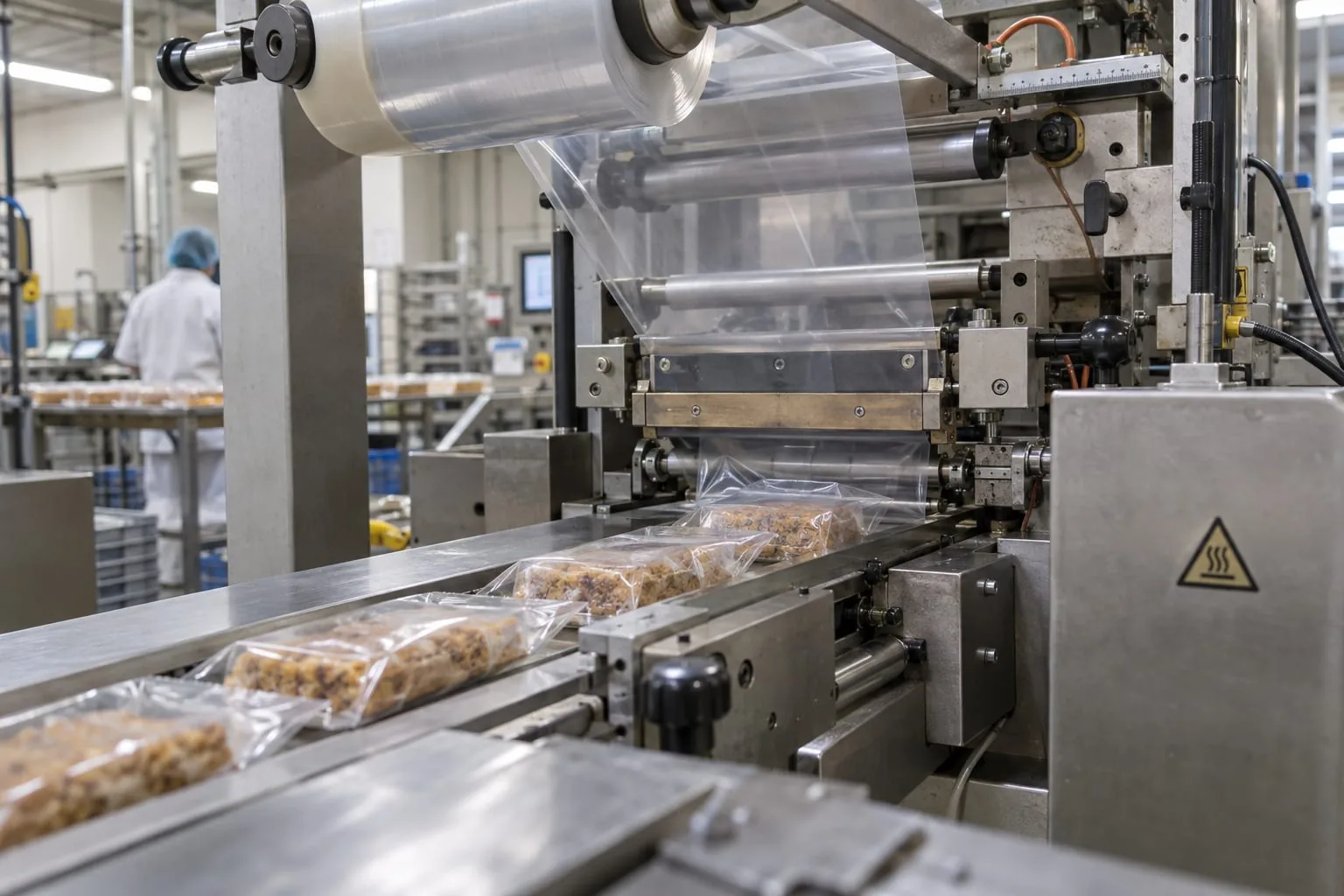
A commercial food sealing machine is only as reliable as the interface between its heated component, packaging material, pressure surfaces and process controls. A replacement part that looks similar can still produce leaks, film pick-up, wrinkles or uneven seals when its profile, mounting or electrical specification does not match the fitted assembly. This guide explains what to record before ordering and how to check the line after a component change.
Heat Seal Components supplies replacement components and technical guidance for packaging equipment. It does not supply complete food packaging machines. The useful enquiry is therefore tied to a real sealing station, a known packaging material and evidence from the installed part.
What a commercial food sealing line actually needs
Heat, pressure, time and a stable surface
Heat sealing is a controlled contact process. The active element or band transfers heat into the sealable layer. A jaw, bar, roller or support surface applies pressure. The packaging material then needs enough contact time and cooling support to form a continuous bond without sticking, scorching or distorting. The settings and the mechanical condition of the station work together.
The fitted part may be a round wire, flat ribbon, formed element, endless band, heated jaw or a replaceable surface covering. Heat Seal Components can review compatible heat-seal elements when the original part, dimensions, connections and application are documented. The replacement should be matched to the assembly, not selected by a broad machine name.
The surrounding parts matter too
A new element cannot correct a bent support, uneven pressure, damaged insulation, poor tracking or an incorrect film path. The release surface can also change how heat reaches the package and whether film sticks to the working face. Check the complete interface before deciding which part is responsible for the defect.
Match the component to the packaging process
Horizontal flow-wrap and continuous sealing
A horizontal flow-wrap line carries a film web around the product and uses longitudinal and end-seal areas. The sealing path may involve continuous bands, heated bars, guides and pressure rollers. Record the direction of travel, the band or jaw route, the active width and the way the package is supported. A replacement that fits one part of the path may still track poorly or sit outside the intended contact area.
VFFS and intermittent jaw assemblies
Vertical form-fill-seal equipment often uses paired jaws or formed sealing tools. These parts may create a cross seal, a longitudinal seal or both, depending on the machine arrangement. Confirm whether the requirement is a heated element, a complete jaw component, a PTFE cover or a support part. The jaw profile, terminal arrangement and working clearance are part of the specification.
Tray, lidding and flexible-to-rigid interfaces
Tray and lidding applications present a different interface from a free pouch. The rim or flange must be supported while the film and seal layer meet the tool evenly. Record the substrate, sealable coating, flange geometry, tool contact profile and support arrangement. Do not assume that a component suitable for flexible film alone will suit a rigid-to-flexible pack.
Record the component specification before ordering
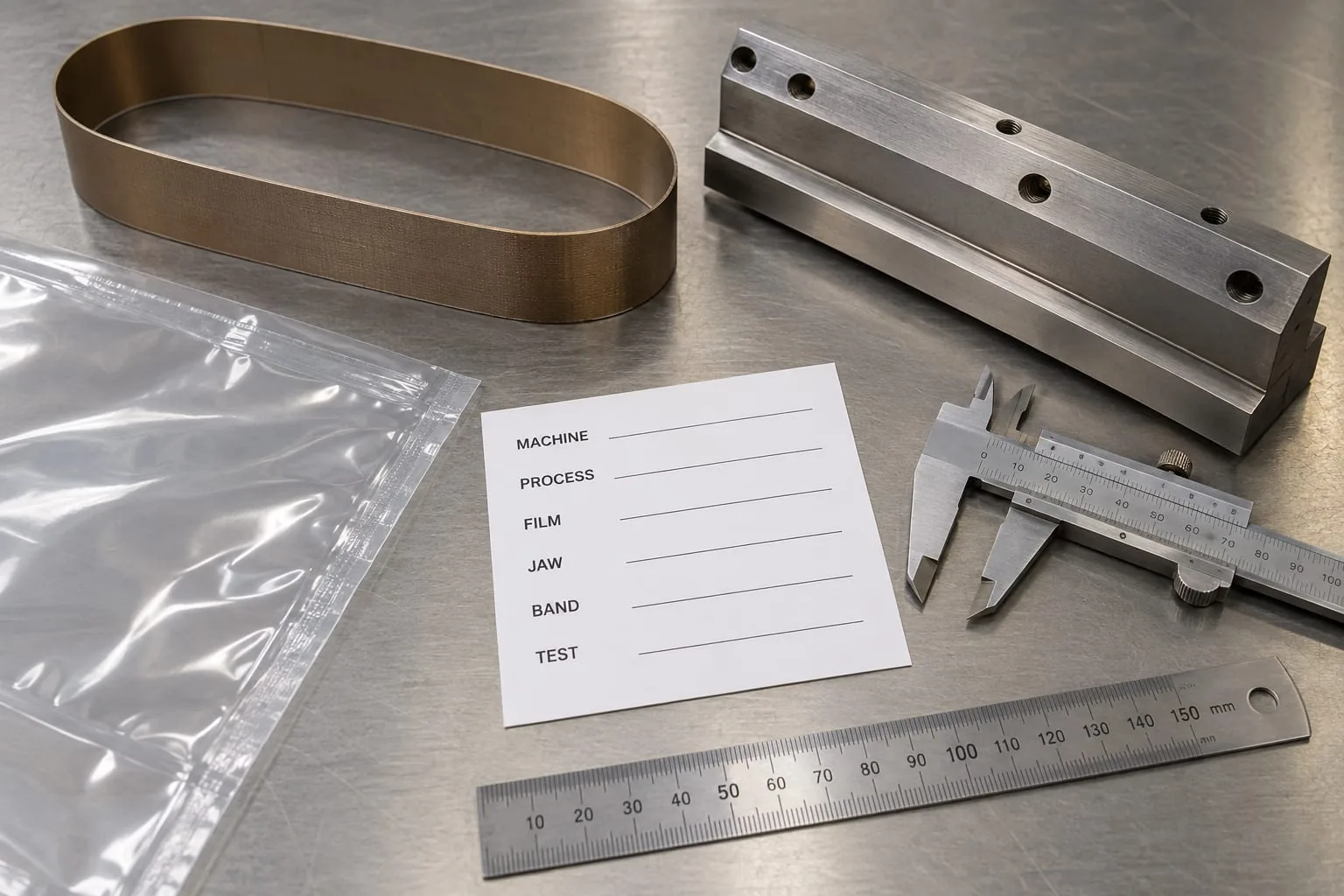
Before removing a part, isolate the equipment and allow hot surfaces to cool. Photograph the component in position and record the details that control fit, heat transfer and serviceability. A short specification pack is more useful than a machine name on its own.
- Machine make, model, sealing station and direction of package travel
- Packaging format, film construction, sealable layer and product presentation
- Heated length, overall length, width, thickness, profile and fixing positions
- Terminal style, connection route, insulation, cover arrangement and support surface
- Band loop dimensions, tracking route, tension points and guide arrangement where applicable
- Photographs of the old part, the complete tool and the defect on a failed pack
Measure from an undamaged reference where possible. If an element has stretched, broken or been modified by an earlier repair, measure the jaw, supports and fixing points as well. Include a scale in photographs and mark which dimensions are measured, estimated or taken from a drawing.
A component record also helps separate a replacement requirement from a control problem. If the failure follows the film path, pressure surface or support, replacing the heated part alone may not address the cause.
Check food-contact and cleanability requirements
Packaging materials and machine surfaces must be considered together. The UK Government’s food labelling and packaging guidance covers the use of suitable food-contact packaging, storage, cleanliness and declarations of compliance for certain materials. Use the packaging and component information supplied for the actual application. A component supplier can identify a replacement part, but the food business remains responsible for the complete pack, its intended use and its compliance assessment.
Keep the sealing area free from product residue, loose fibres and damaged surface material. A scored jaw, lifted cover or contaminated support can create channels or local non-seals. Record the cleaning method approved for the machine and packaging material, and do not introduce a surface treatment or tape without checking that it is suitable for the process.
Treat release surfaces as working parts
PTFE cover tape and PTFE-coated surfaces can protect the active component and help control release. They are not automatically interchangeable. Width, thickness, backing, fixing method and condition can change clearance and heat transfer. Review the required PTFE heat-seal tape specification with the element or jaw rather than adding another layer by appearance alone.
Maintain the station and isolate it safely
The HSE’s maintenance guidance emphasises planned maintenance, competent people, safe isolation and control of stored energy. Before inspecting or replacing a component, follow the site procedure for electrical, pneumatic, hydraulic and thermal hazards. Lock off the equipment where required, release stored pressure, secure moving parts and allow heated surfaces to cool.
- Photograph the installed arrangement before disturbing the component.
- Confirm isolation and check that heat, pressure and movement have been controlled.
- Inspect the element, band, jaw, cover, terminals, guides and support surfaces.
- Compare measured parts with the recorded specification before ordering or fitting.
- Log the work, the replacement part, the settings and the post-maintenance check.
Keep the old component for comparison until the new part has been checked and the line has completed its approved release process. A short maintenance record makes recurring wear easier to diagnose and gives the next technician a reliable starting point.
Check seal quality after a component change
After fitting a replacement, run a controlled trial with the intended packaging material and the approved product condition. Inspect the complete seal rather than one convenient section. Look for an open channel, uneven width, film sticking, scorch marks, wrinkles, distortion or a seal that lifts during handling.
Use the site’s approved leak, peel or seal-strength method where one is available. ASTM F88/F88M describes a quantitative seal-strength test for flexible barrier materials and explains why consistent test technique matters. It is a test-method reference, not a universal acceptance value for every food pack. Follow the specification for the actual package, material and process.
- Record the component identity, film or substrate reference and machine settings.
- Check samples from the start, middle and end of the trial rather than one sample only.
- Compare the result with a known-good pack and note the failure mode, not just pass or fail.
- Change one variable at a time so the effect of the replacement can be understood.

When to request a custom component review
A custom review is sensible when the original element is formed, the mounting points are unusual, the band path is non-standard or the machine has been modified. Include a drawing or marked photograph, measured dimensions, terminal details, the packaging application and the failure evidence. The team can then establish whether a standard part, a custom element or a wider component review is appropriate.
Heat Seal Components can review custom impulse elements, sealing jaws and bars and compatible heat-seal bands when the application is clear. The requirement should describe the replacement component and its machine interface, not request a complete packaging machine.
Contact Heat Seal Components with a useful brief
If you need a replacement part for a commercial food packaging line, use the Heat Seal Components contact page and send the machine details, packaging material, component measurements, photographs, failure pattern and quantity required. Include the part that needs review and any known settings or test records. That gives the engineering team a practical basis for compatibility checks and quotation.