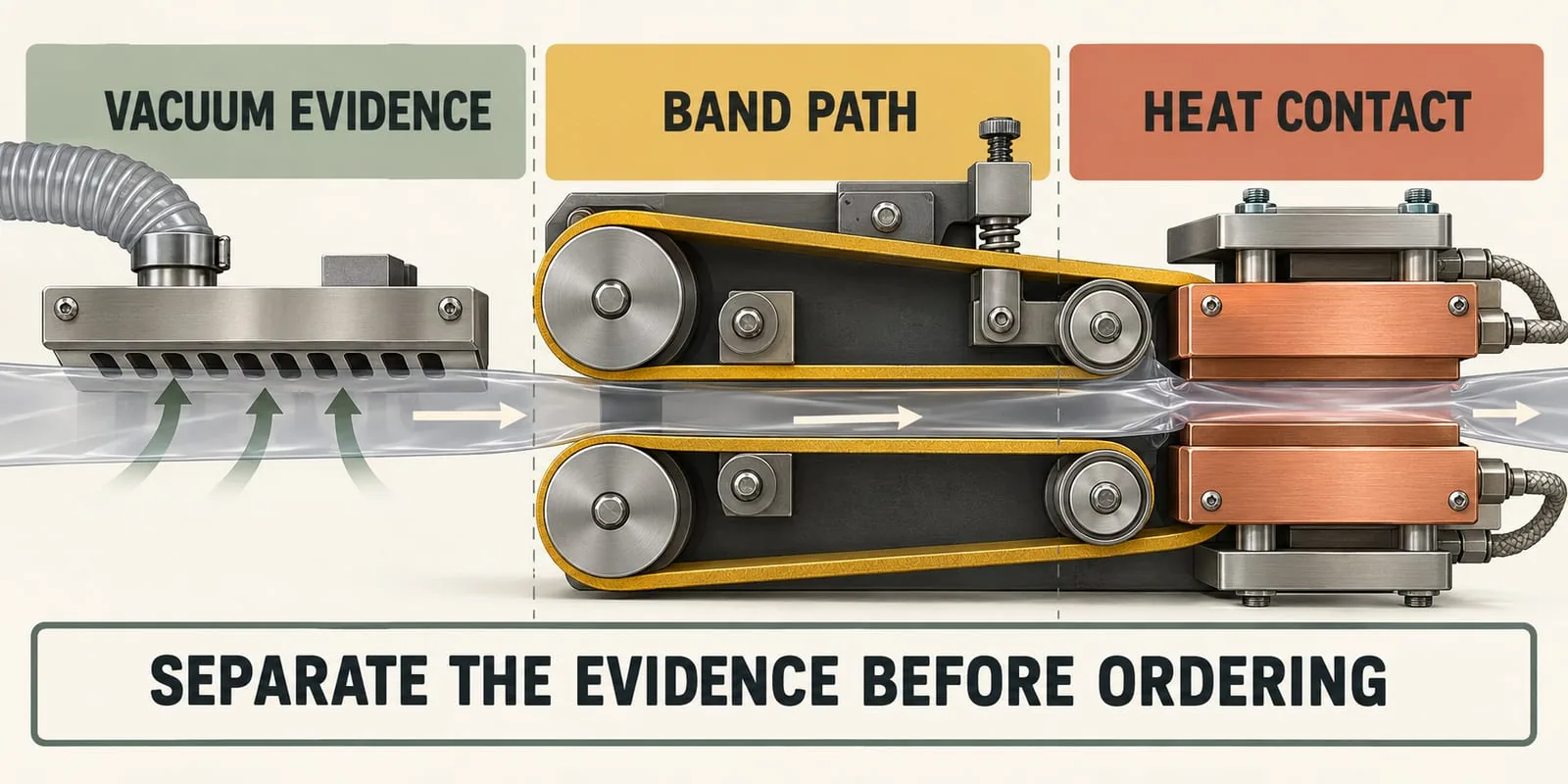
Continuous band sealers with vacuum are often discussed as if the phrase identifies one standard machine and one replacement part. It does not. A vacuum function, a continuous band route and a heated sealing contact may sit in the same production setup, but they still need to be specified from the fitted assembly and the machine application.
This guide shows how to separate those facts before ordering. Heat Seal Components supplies heat-seal bands, elements, PTFE products, jaws and bars, together with compatibility guidance. It does not sell complete vacuum or band-sealing machines, vacuum pumps, bags or general machine repair services.
What the query should tell you before ordering
A machine name is not a part specification
The phrase continuous band sealer with vacuum is a useful starting point for a conversation. It is not enough to identify a band, heated element or replacement assembly. Similar words can describe different layouts, products and sealing stations.
Start with the part that is fitted, not the part that appears in a search result. Ask for a clear image of the sealing station, the machine plate or model information, and the component removed from the machine. If you cannot remove it safely, photograph it in place with the guard closed.
The heat-seal bands service is relevant when the endless band itself is the item being replaced. A band route, guide arrangement or joint detail can change the part needed, even when two machines are described with similar names.
Separate the functions in the request
- What creates or records the vacuum condition?
- What carries the film or package through the continuous sealing route?
- What supplies or transfers heat at the sealing contact?
These questions do not assume that the same supplier or component answers every part. They simply stop a vacuum-related requirement from being treated as proof of a band profile or heating element.
Map the continuous band sealing assembly
Identify the fitted band and route
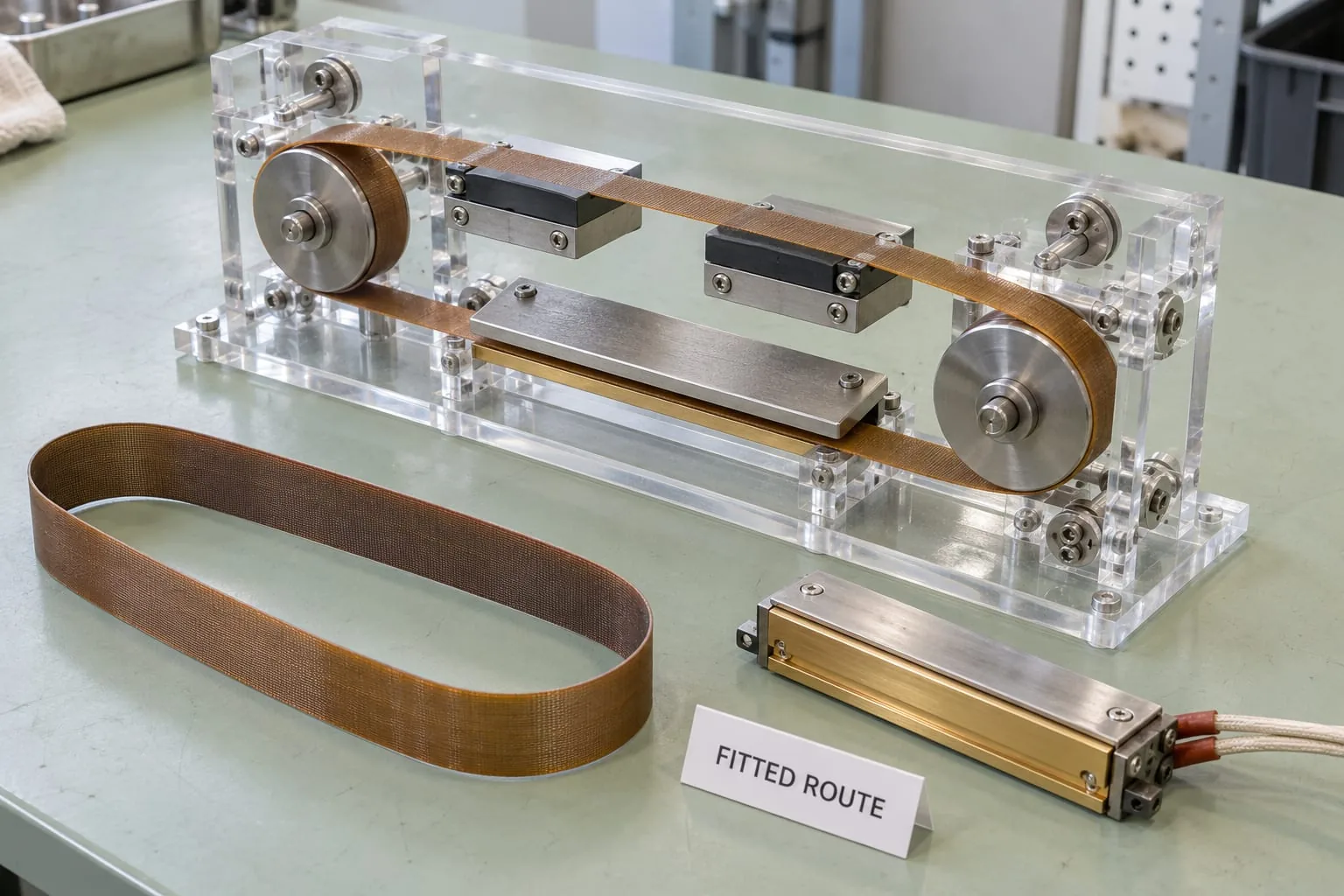
Trace the band from the first roller or guide to the last point where it leaves the sealing zone. Record whether it runs as an endless loop, how it is supported, and where it changes direction. Note any tracking feature, guide slot, tension arrangement or joint that is visible on the fitted part.
Do not copy a generic band drawing and assume it represents the installed route. A component that looks similar can run at a different position or use a different support relationship. The useful evidence is the route on the machine, the removed part and the manufacturer information together.
Record guide, support and heated contact
The band is only one part of the sealing path. Record the guide blocks, support surfaces, heated contact, cover materials and any nearby sealing jaw or bar. Photograph the order of the parts before removal where the machine instructions allow it.
Heat Seal Components also supplies heat-seal elements. That does not mean an element is interchangeable with a band. The element, band, support and control arrangement must be matched to the actual station and the supplied evidence.
Record vacuum and sealing evidence separately
Evidence from the vacuum side
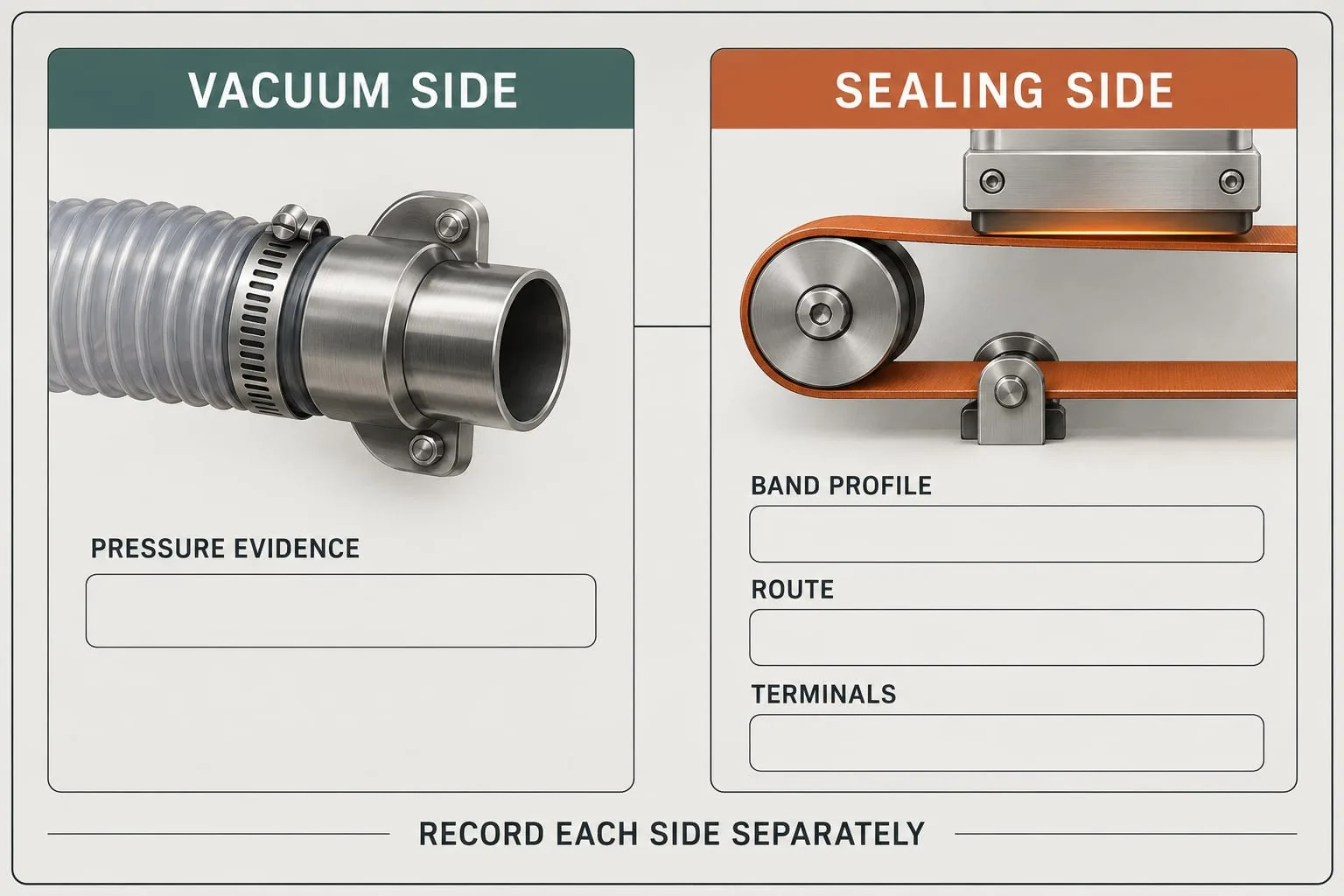
Record the information that relates to the vacuum function in its own part of the enquiry. This could include the connection shown on the machine, the station name, the manufacturer’s description and any approved inspection or test record available to the site team.
Do not invent a vacuum level from the product name. Do not treat a hose, gauge or vacuum instruction as a band dimension. If the vacuum side is supplied or maintained by another part of the machine, say so clearly in the request.
Evidence from the sealing side
For the continuous band assembly, record the fitted band material or construction if known, band width and thickness if measured, route, guide relationship, support surface, heated contact and terminal or connection details. Measurements should be taken from the correct part, not from the cover or a nearby carrier.
If the sealing face uses tape or a cover layer, identify its position and condition. The PTFE heat-seal tape service can be relevant to a cover-tape requirement, while the PTFE coating service may be relevant where a supplied component needs a coating specification. These are different requests and should not be merged without evidence.
Check component compatibility with the application
Send the machine and station details
A useful compatibility request should include:
- machine manufacturer and model, if available
- the sealing station or head position
- product or film information that affects the sealing interface
- fitted part photographs from more than one angle
- measured dimensions, with the measurement point identified
- connection, terminal and support details
- any change made to the machine since the original part was fitted
If the machine has a manual, parts drawing or previous order record, include the relevant page or reference. A document can clarify the intended part, but it should still be checked against what is fitted now.
Choose the component type from the evidence
Use the evidence to decide whether the request is for an endless band, a heat-seal element, PTFE tape or coating, or a sealing jaw or bar. Heat Seal Components’ sealing jaws and bars service is relevant when the contact assembly is the item being specified.
The company can help with component compatibility for vacuum packers, impulse sealers, VFFS and flow-wrap equipment. It should not be assumed that a part for one application will fit another because both use heat. The dimensions, materials, support and machine interface still need to agree.
Inspect after isolation and cooling
Use a safe system of work
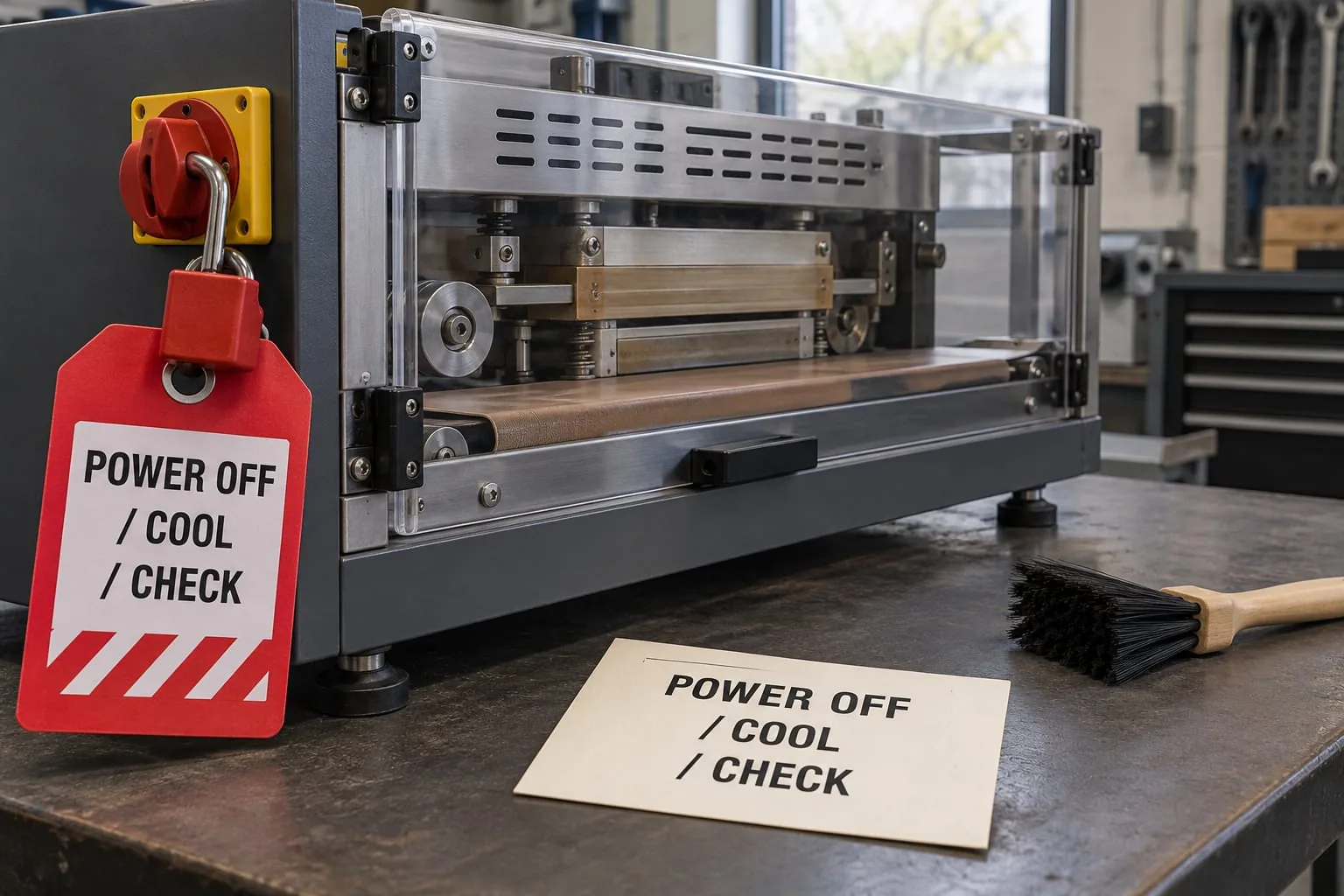
HSE advises that maintenance is planned, carried out by competent people and performed with moving plant stopped and energy sources isolated. Its maintenance guidance also says machines should be locked off where they could be switched on again and that hot components should be allowed to cool.
PUWER guidance covers suitable equipment, maintenance, guarding, training, hot surfaces and isolation from power sources. Read the HSE PUWER overview alongside the machine manufacturer’s instructions and your own site risk assessment.
Never reach into a moving band route or exposed heated contact to identify a part. If the equipment has electrical, pneumatic, hydraulic or stored mechanical energy, the responsible competent person should follow the site’s isolation procedure. HSE’s machinery safety guidance highlights risks from rollers, belts, trapping points, hot parts and missing safeguards.
Inspect the band path for change
After isolation and cooling, check the band for fraying, edge damage, distortion, contamination, a changed joint or unusual tracking marks. Inspect the guide and support surfaces for wear, looseness, damage or residue. Check the heated contact and cover layer for uneven contact or visible deterioration without assuming that a visual mark identifies the cause.
The inspection interval should be based on risk, use, deterioration and the manufacturer’s advice. HSE’s inspection guidance says inspections should focus on safety-related parts and that the frequency should be determined through risk assessment. Keep a useful record of what was inspected, what changed and which part was fitted afterwards.
HSE also warns that packaging machinery can contain in-running nips and trapping points, particularly where moving and fixed parts meet. Its packaging machinery guidance says a formalised safe system of work should be in place for routine cleaning of conveyors.
When custom component support is useful
A measured sample is better than a generic description
Custom support is useful when the fitted band, element, tape, jaw or bar does not match a standard description. Send the removed part or a clear set of photographs, the measurement points, the station details and the intended application. Explain which side of the request relates to vacuum evidence and which side relates to the sealing component.
That gives a supplier a factual starting point without asking them to guess from a machine name. It also creates a record that can be checked by maintenance, engineering and procurement teams before an order is approved.
Build a procurement record
Keep the final specification with the machine model, fitted-part images, measurements, material or coating requirements, connection details and the date of inspection. Note any uncertainty instead of filling the gap with a guessed dimension or performance claim.
For a component review based on a sample or machine information, contact Heat Seal Components with the evidence available. The team can then advise whether the enquiry is best treated as an endless band, element, PTFE product, sealing jaw or bar, subject to the details supplied.