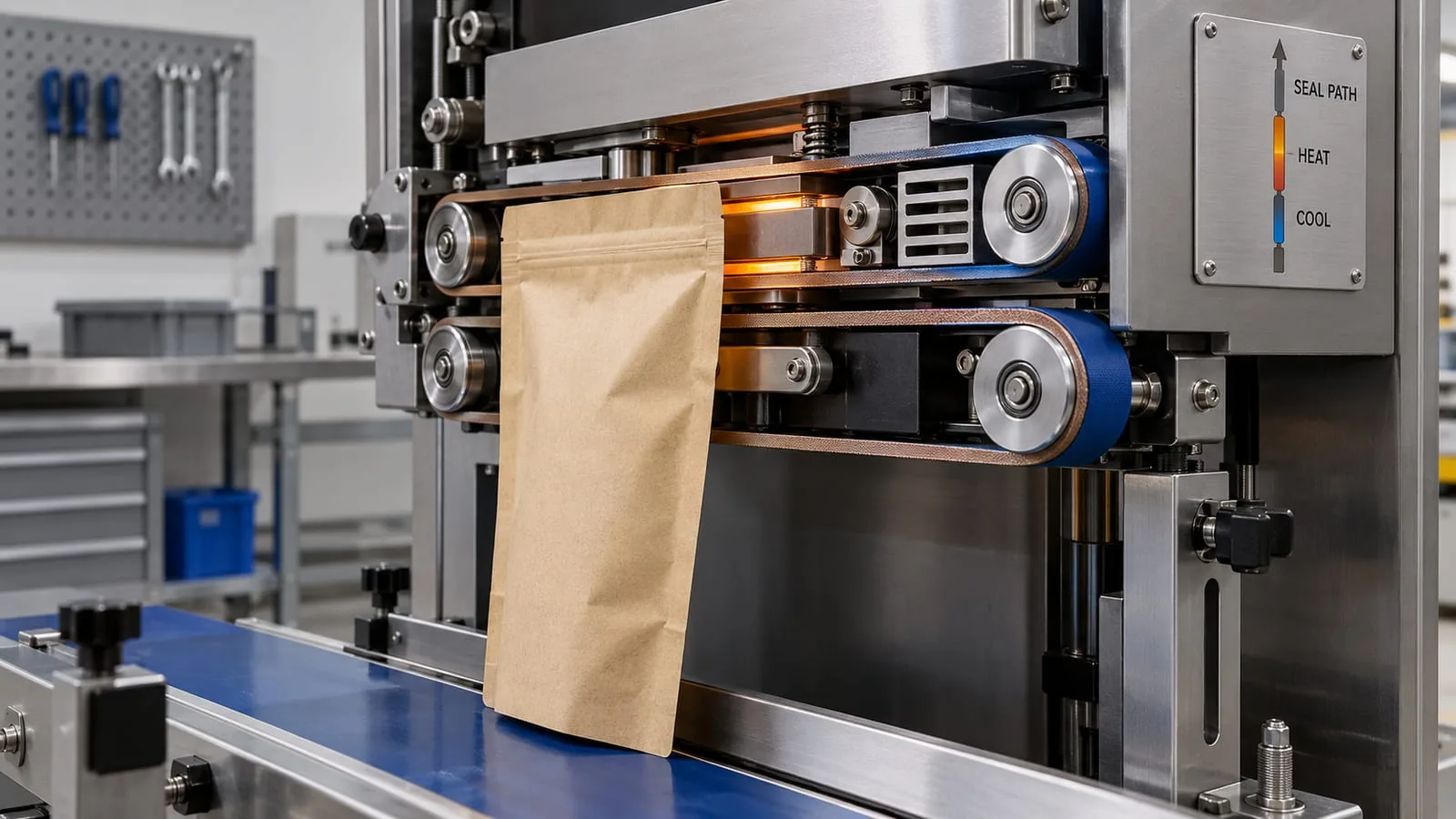
What happens inside a continuous band sealer?
A continuous band sealer closes bags and pouches while the package travels through a heated and cooling path. Many designs use two moving endless bands to carry the film through the contact area. The machine assembly may also include rollers, guides, tension adjustment, heating elements, PTFE contact surfaces and cooling parts.
The important distinction for a replacement enquiry is that the sealer is a complete piece of equipment, while the part being replaced is usually one component within that route. A band, element, guide or PTFE surface must match the machine layout and the material being sealed. A generic machine name is not enough evidence for a compatible part.
The continuous heat-seal bands service is the right starting point when the endless band is the component under review. If the problem concerns a heating wire, sealing surface or another part, identify that separately rather than assuming a new band will correct every seal fault.
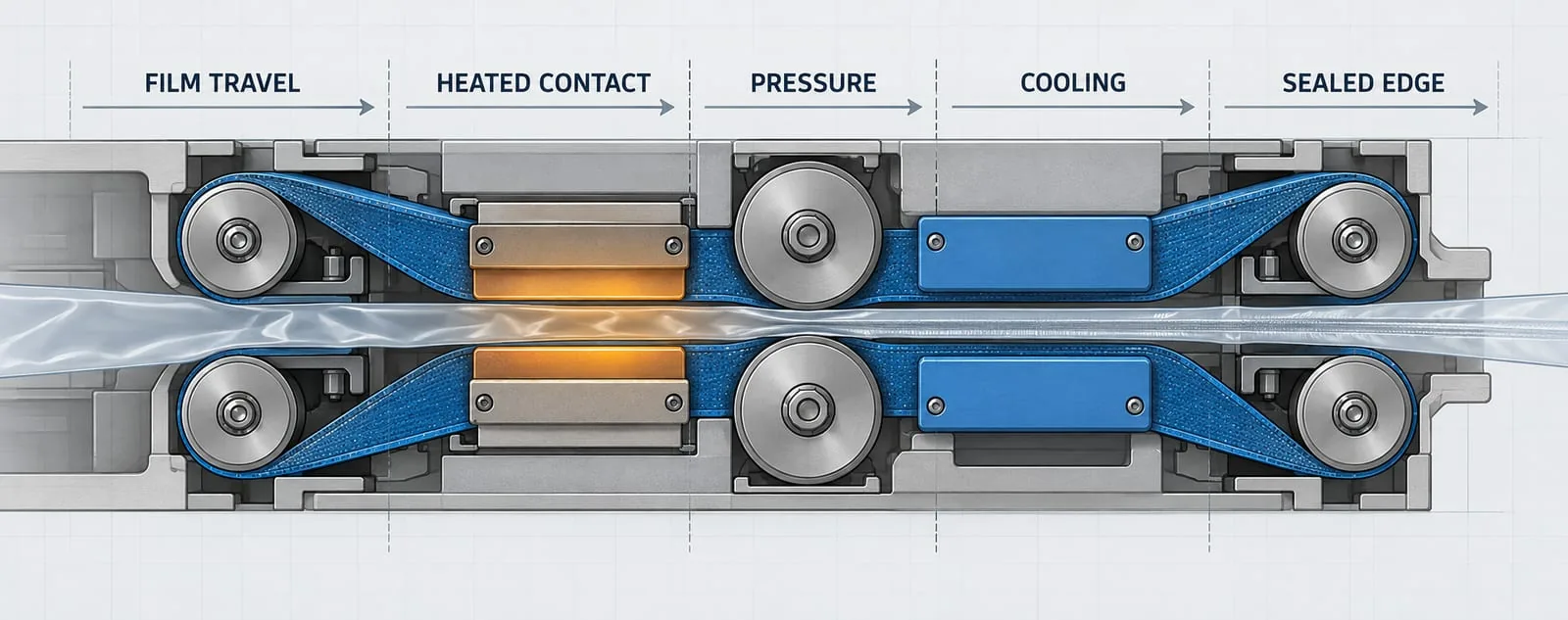
The sealing path
In a typical continuous path, the film is guided between the moving bands, brought into the heated contact zone, held together under pressure and carried through a cooling section before the sealed edge leaves the machine. The exact construction, belt arrangement and controls vary by equipment. Use the equipment manual for the actual route and operating limits.
A manufacturer-specific manual can help explain the principle, but its dimensions, temperatures and speed ranges should not be treated as universal values. For example, one continuous sealing machine manual describes moving belts, a heating section and a cooling section as part of its own machine design. It also warns about hot and moving parts and the need to keep the sealing path clean. Use such documentation as an equipment reference, not as a substitute for the machine details in your enquiry.
Which components need to match?
Start with the component that is visibly worn, then check the parts that control its contact and movement. The replacement scope may include more than the band itself:
- Endless sealing band: confirm the installed loop, width, thickness, joint or construction, edge form and any tracking feature.
- Heating element or wire: check its position, shape, connection arrangement and relationship with the sealing surface. The heat-seal elements and wires service covers component enquiries rather than complete sealing machines.
- PTFE coating or heat-seal tape: identify whether the surface is a coating, a tape layer or another supplied part. The PTFE heat-seal tape service can be considered when the release surface is part of the requirement.
- Guides, rollers and tension adjustment: record the route and the adjustment position. Edge movement may be caused by the route or tension, not only by the band.
- Sealing jaws or bars: where the equipment uses these alongside the band path, list them as a separate component. The sealing jaws and bars service helps keep that enquiry distinct.
Do not assume that two parts are interchangeable because they look similar. A different loop length, edge profile, joint, surface construction or guide arrangement can change how the component runs. Compatibility should be checked against the complete route and the packaging material.
Record the machine and component details
Before requesting a quotation, create a short record that another engineer can review. A clear component record is more useful than a single photograph of the machine nameplate.
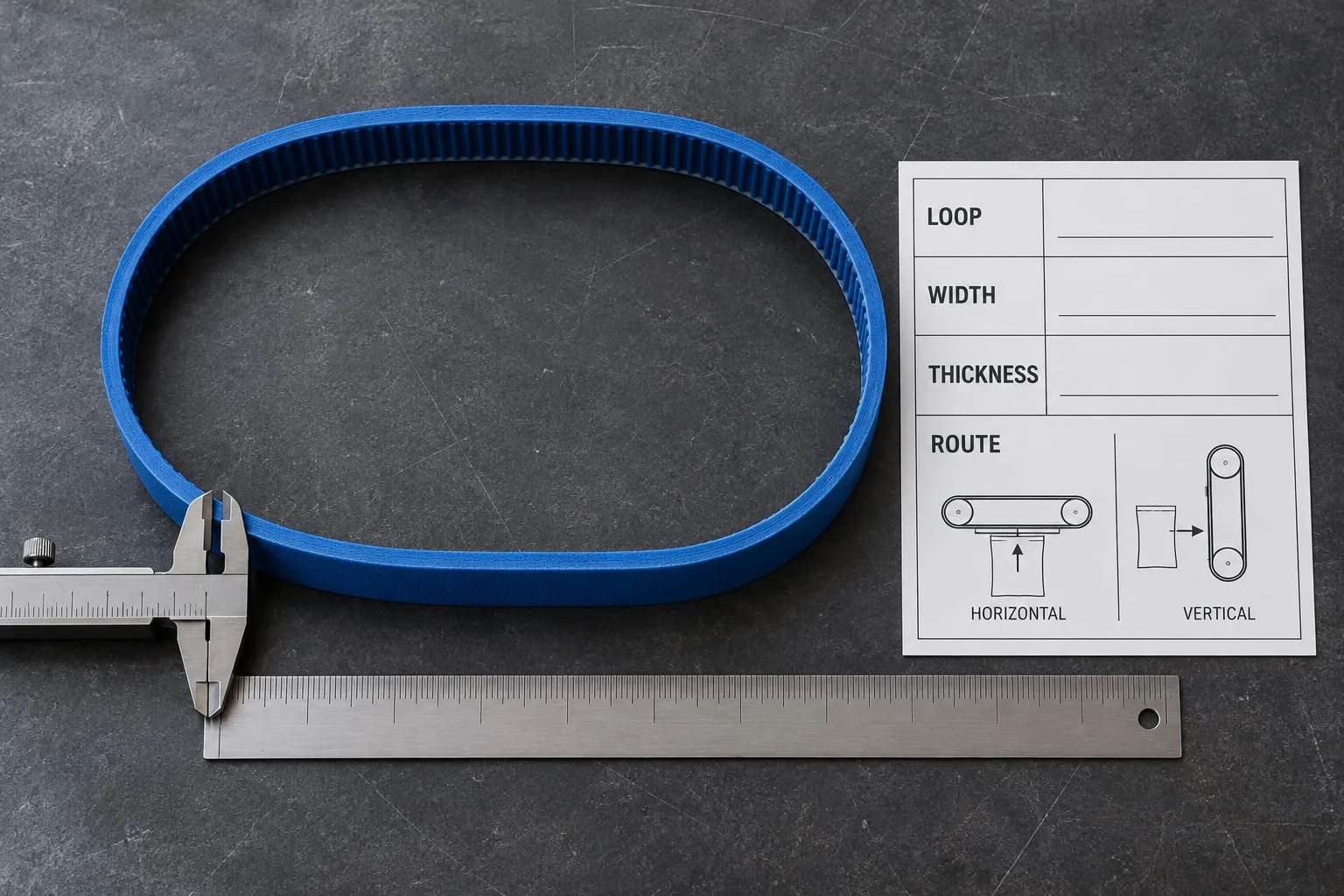 Record the following information where it is available:
- Machine manufacturer, model, serial or asset reference, and whether the sealing path is horizontal or vertical.
- Product and film or pouch construction, including any unusual surface, coating or laminate that contacts the sealing area.
- Installed loop length or circumference, band width and thickness, measured with the route and joint condition in mind.
- Band construction, surface texture, edge form, joint style, perforation or tracking feature. Do not infer material from colour alone.
- Clear photographs of the complete route, rollers, guides, tension adjustment, heater, cooling area and any adjacent jaw or bar.
- Symptoms, timing and recent changes: edge wander, residue, sticking, uneven seals, scoring, repeated adjustment or a sudden break.
Keep the old part as evidence, but treat a damaged or stretched band as a clue rather than an unquestioned specification. Compare its dimensions with the machine route and any available equipment documentation. If the band has been shortened, distorted or fitted under the wrong tension, its current measurement may not be the intended replacement measurement.
Inspect the route before replacing anything
Replacing a worn band without checking the route can leave the original cause in place. Inspect the band, guides, rollers and contact areas together, and record what you find before changing an adjustment.
Check tracking, tension and wear
Look for lateral movement, one-sided polishing, scoring, cracking, distortion, fraying, coating loss or material stuck to the working surface. Note whether the band moves away from the same edge repeatedly or only after the machine warms up. Those observations can help separate a component-size issue from a guide, roller or tension issue.
Check that rollers turn freely, grooves are clean and the tension adjustment still has useful travel. Do not compensate for a damaged guide by increasing tension without following the equipment instructions. A replacement band should not be used to hide a route that is misaligned or contaminated.
Check heating and cooling surfaces
Inspect the heater, PTFE contact surface and cooling area for residue, damage or build-up. The surface that contacts the film can affect release and seal appearance, while the cooling stage helps the seal leave the machine in a controlled condition. Do not guess at a temperature or pressure setting from a different machine.
Plexpack’s support material for its MPS6000 series shows why tracking and tension are equipment-specific checks: its guidance separates installation, tracking and tension tasks and lists belt breakage, flaking and seal-bar issues as different service symptoms. The exact procedure for another machine may differ, so use the relevant manufacturer instructions.
Replace the component safely and verify the first run
Packaging machinery can contain in-running nip points, stored tension and hot surfaces. The HSE packaging machinery guidance explains the need to safeguard moving parts such as in-running nips and trapping points. The HSE maintenance guidance covers planned maintenance, competent people, manufacturer instructions and isolation or lock-off before work.
Before removing a band or heating component, photograph the installed route and record the adjustment positions. Isolate the equipment, control stored movement or tension, allow hot parts to cool and verify that the machine is safe to access. Use the manufacturer’s removal and fitting sequence. Do not force a band over a roller or stretch it beyond the intended route.
After fitting, recheck guide engagement, roller condition and tension before restoring guards. On the first controlled run, watch the band from a safe position through the heating and cooling areas. Confirm that the package enters and exits without catching and inspect the seal result required by the process. Change one adjustment at a time and record the outcome so a repeat fault can be traced.
Horizontal and vertical application differences
Horizontal and vertical continuous band sealers can use similar component types, but the product route, pouch orientation, support arrangements and access to the sealing path can differ. The orientation alone does not identify the correct band. It is one part of the compatibility record alongside the machine model, loop route, component dimensions and film or pouch application.
For a horizontal application, record how the product is supported as it approaches and leaves the bands. For a vertical application, record the pouch direction, support or drop path and the way the band route is tensioned. In both cases, photographs should show the route rather than only the outside casing.
When to request a compatibility review
Request a compatibility review when the band has an unusual profile, joint, coating, tracking feature or route that cannot be measured confidently. Include the machine details, the measurements you have, clear route photographs, the component symptoms and the operating context. If the enquiry includes a heating element, PTFE surface, jaw or bar, list it separately so each part can be assessed against the correct evidence.
Heat Seal Components supplies heat-seal elements and wires, endless bands, custom impulse elements, PTFE coating and heat-seal tape, sealing jaws and bars, and component compatibility guidance for vacuum packers, impulse sealers, VFFS and flow-wrap equipment. This does not mean every machine model or adjacent part is automatically covered. Contact Heat Seal Components with the machine record and photographs before ordering.