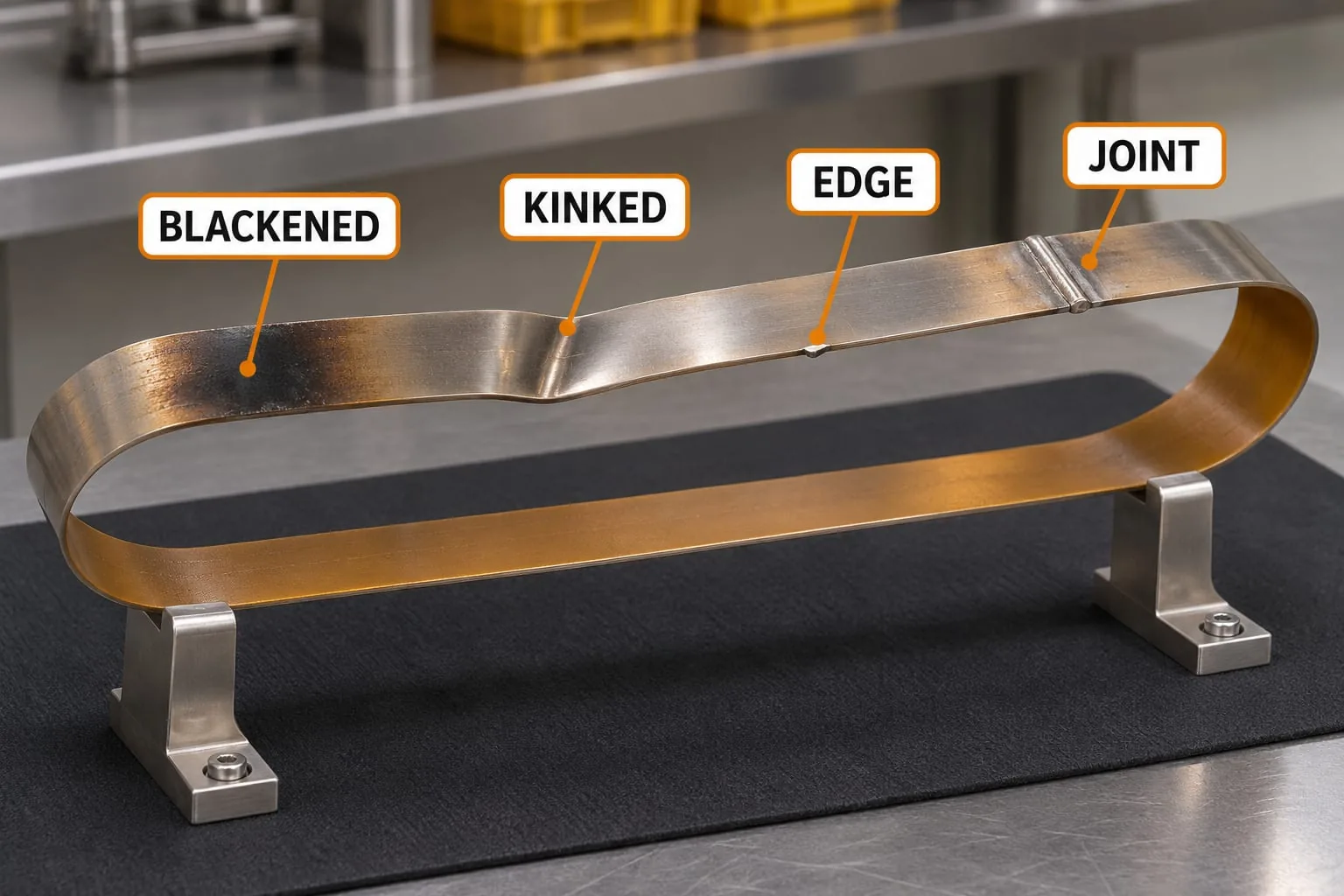
An endless heat-seal band rarely fails without leaving evidence. Darkening, contamination, a raised joint, edge damage, tracking changes or a worsening seal can all tell you that the band or its surrounding assembly needs attention. The difficult part is deciding whether the correct action is to monitor the condition, replace a supporting consumable or replace the band itself.
This guide gives packaging engineers, maintenance technicians, production managers and procurement teams a practical way to read those indicators. It uses condition and process evidence rather than an invented universal replacement interval. The equipment manufacturer’s instructions, the application and the site’s safe system of work remain the controlling references.
Start with the seal and the band together
An endless heat-seal band works as part of a wider sealing interface. The film, cover strip, backing or pad, jaw or bar, electrical connections and tracking arrangement can all affect the result. A mark on the band matters, but it should be read alongside the seal appearance and the route through the machine.
HSE guidance says maintenance should be planned with the manufacturer’s instructions, carried out by competent people and performed after the equipment has been made safe. That principle matters here: do not handle a hot, moving or energised band simply to confirm what it looks like. Use the equipment’s isolation procedure and allow hot parts to cool before inspection.
The visible indicators that deserve attention
Blackening, residue and surface damage
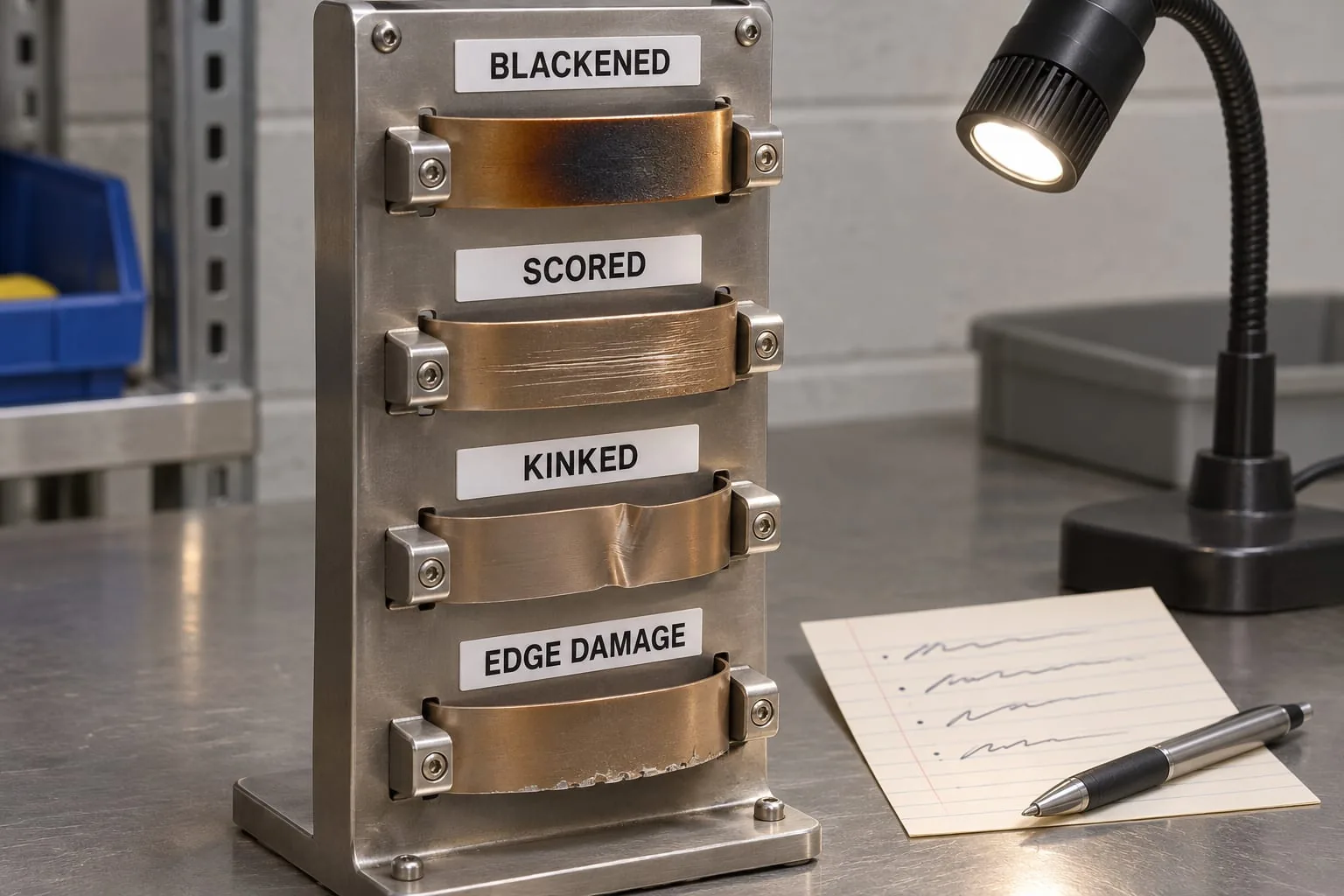
Blackening or foreign material on a band is a clear reason to stop and investigate rather than keep increasing heat or pressure. Packworld’s maintenance guidance identifies blackened or contaminated bands as replacement indicators for its equipment, while also noting that replacement frequency depends on the material, temperature, seal time and sealing rate. Treat that as equipment-specific guidance, not a universal life prediction.
Inspect the active sealing surface for residue, scoring, cracks, coating loss, distortion or a change in texture. Record where the defect sits in relation to the film path. A defect outside the active zone may be monitored under the machine maker’s instructions; a defect across the working zone needs a more cautious decision.
Kinks, raised joints and edge damage
An endless band should sit correctly in its route. A kink, raised joint, edge nick, frayed section or repeated tracking adjustment can change contact with the package or the supporting parts. Do not flatten a damaged area and assume the original condition has been restored. Record the position, direction of travel and whether the damage is recurring.
If the visible defect follows a guide, roller or clamping point, the band may be reporting an alignment or handling problem. That is why a replacement request should include photographs of the full route as well as close views of the band.
Separate band wear from support and insulation wear
Check the cover strip and backing
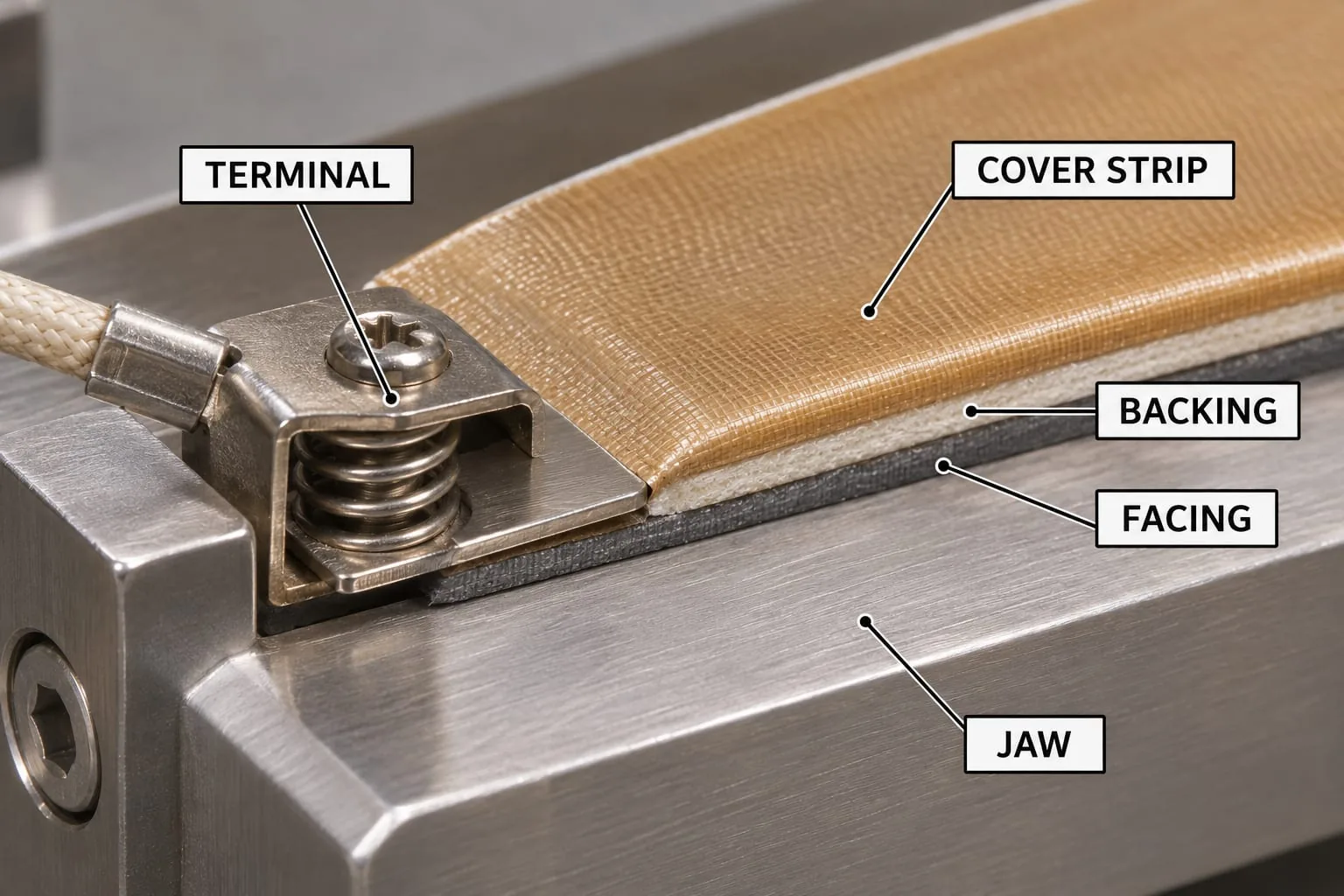
A worn cover strip or backing can change release, insulation and heat transfer even when the band itself looks acceptable. Check the adjacent strip and tape condition whenever a band is replaced.
Inspect for a cover strip that is worn through, lifted, wrinkled, contaminated or no longer centred. The relevant PTFE heat-seal tape service can help identify the correct component route, but do not substitute a generic tape or an unverified thickness for the documented product.
Check terminals, jaw alignment and facing
Look at the terminals or spring contacts, the jaw or bar face, the opposing facing and any guide that controls the band. Force Global’s ROPEX replacement guidance says to check the new band’s specified dimensions, inspect insulation, confirm terminal movement and fit the band flat without kinks. Those checks are useful because a new band can be damaged quickly by a poor support or connection.
Where the issue appears to be in the jaw or bar rather than the band, use the sealing jaws and bars service as the relevant component route. Where the part is a wire, ribbon or formed element rather than an endless band, compare it with the heat-seal elements service before ordering.
Use seal quality as evidence, not the only diagnosis
Gaps, weak seals, poor release and tracking
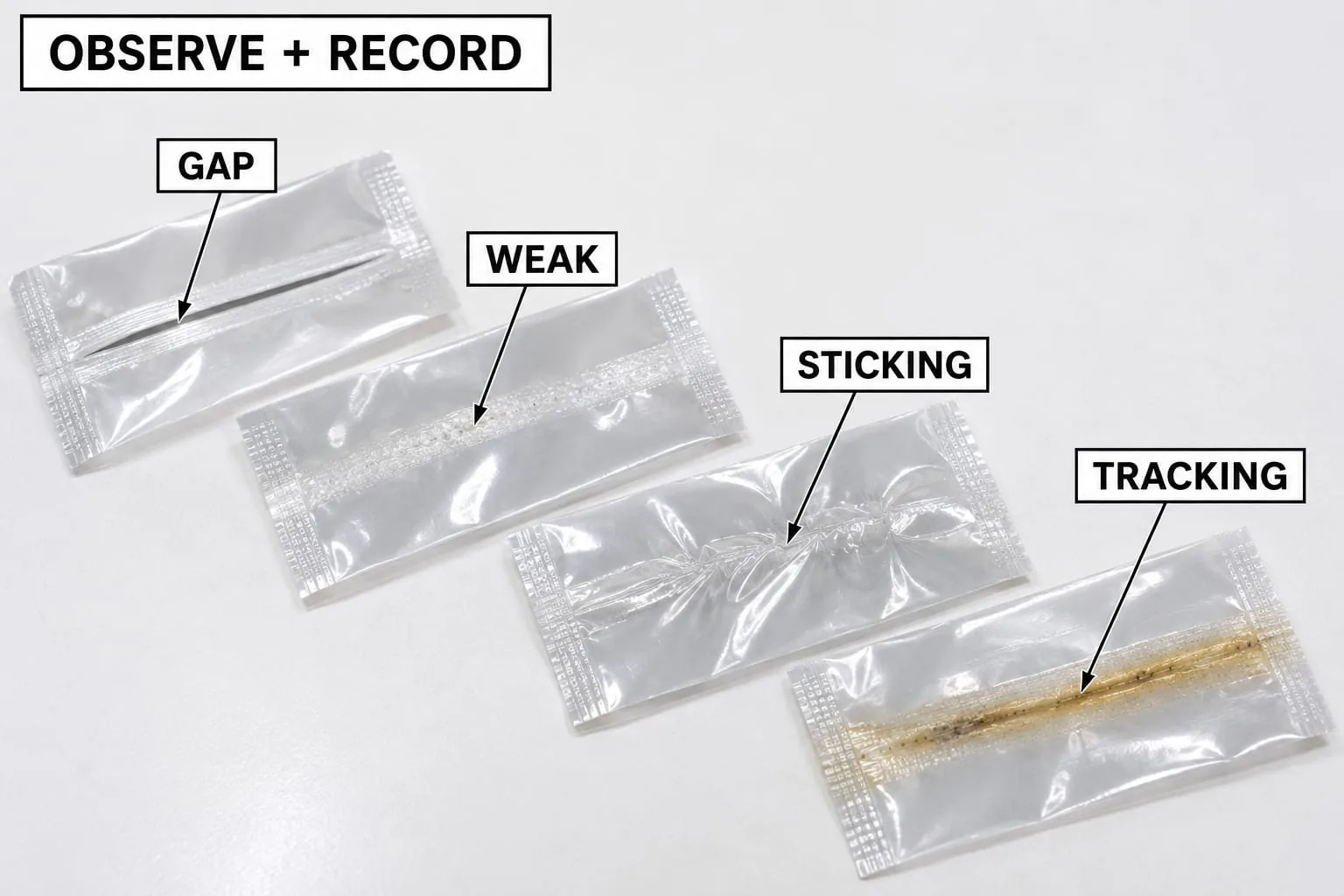
Record the actual symptom rather than writing only “bad seal”. Useful observations include a gap, weak-looking seam, poor cut-off, sticking during release, uneven seal appearance or a defect that follows the band route. Keep a representative sample where the site’s process allows it, and photograph the defect beside the machine position that produced it.
A band-related fault may repeat at one location or travel with the band. A cover strip, pad, jaw, guide, terminal or film path may produce a similar result. This is why a symptom points to an inspection decision; it does not prove that the band is the only part to replace.
When a setting or film issue is more likely
Temperature, seal time, cycle rate, pressure, film construction, contamination and jaw alignment can all influence the result. Packworld notes that band stress and degradation depend on application and operating conditions. Check the documented machine settings and recent process changes before changing a component specification.
If the band is clean, flat and correctly supported but the symptom remains, investigate the wider sealing interface under the manufacturer’s procedure. Do not increase temperature or pressure simply to compensate for a damaged band, worn cover or misaligned jaw.
Decide: monitor, change supporting parts or replace the band
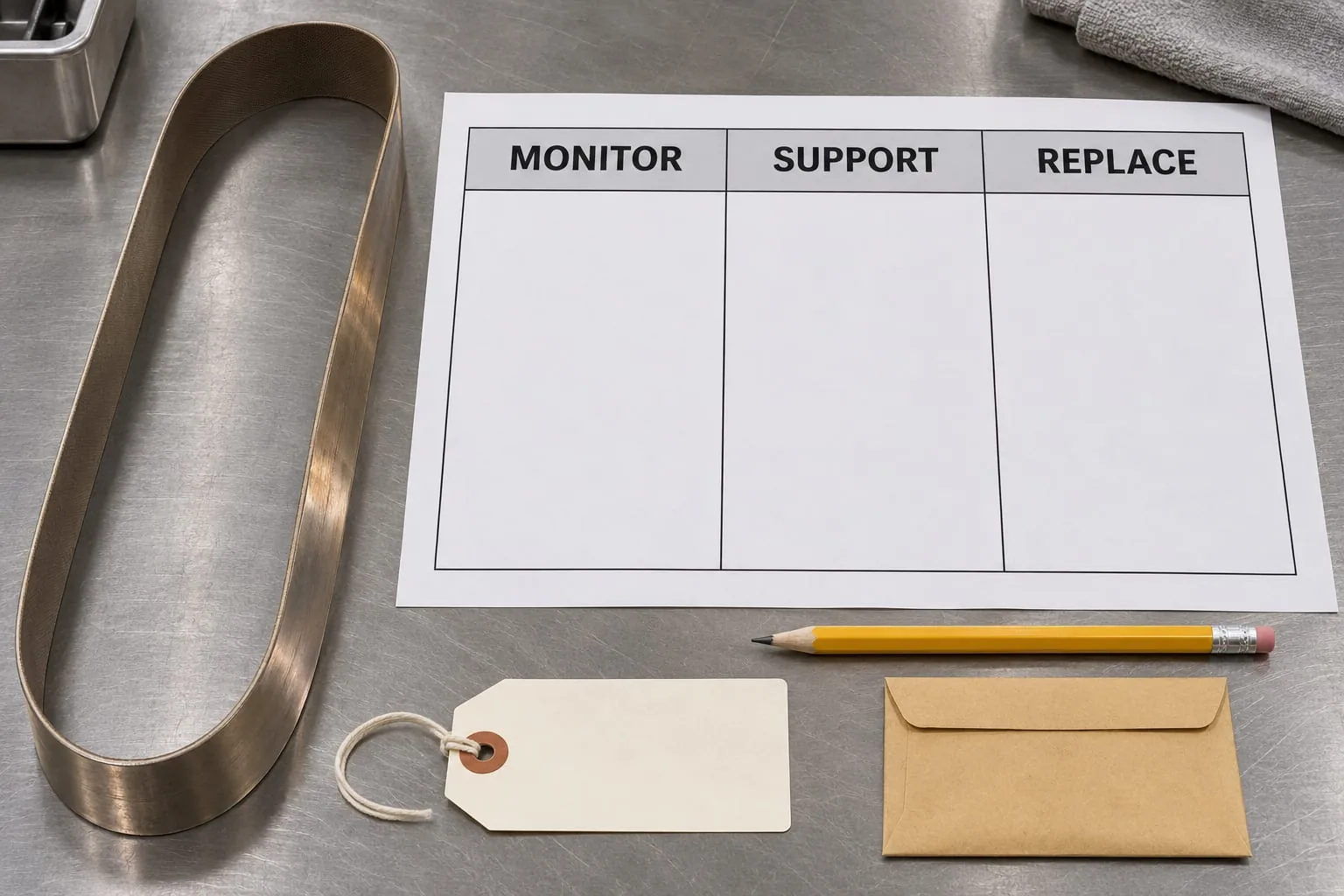 Use a simple decision record so the action can be explained to production and procurement:
- Monitor only when the observed condition is within the machine maker’s acceptance criteria, the seal remains acceptable and no safety or electrical concern is present.
- Change a supporting part when the band is serviceable but the cover strip, backing, facing, guide or terminal is degraded or misaligned.
- Replace the band when the working surface is blackened, contaminated, cracked, distorted, kinked, frayed or otherwise outside the documented condition, or when repeatable seal evidence points to the band after adjacent parts have been checked.
- Stop and escalate when the equipment cannot be safely isolated, the component identity is uncertain, or the defect could expose someone to electrical, thermal or mechanical risk.
This is a practical evidence framework, not a substitute for the machine manual or a site risk assessment. HSE says inspection frequency should take account of equipment type, use, conditions and manufacturer recommendations. Keep the decision record with the maintenance history where your site uses one.
Plan the changeover and record the result
Before removing a band, photograph its route, joint, terminal arrangement, adjustment position, cover strip and opposing face. Record the machine, station, orientation, measured dimensions where available and the symptom that triggered the inspection. Use the manufacturer’s changeover method and the site’s safe isolation procedure.
After fitting, confirm that the band sits flat, the joint and edges clear the route, the terminals are secure and the cover or backing is correctly positioned. Follow any model-specific calibration or burn-in procedure. Then record the post-fit inspection and the first acceptable production sample instead of relying on the machine starting normally.
What to send with a replacement enquiry
A useful enquiry should include:
- Machine manufacturer, model, station and sealing orientation
- Photographs of the complete band route and close views of the surface, edge, joint and terminals
- The observed wear indicators and the seal symptom
- Measured loop length, width and thickness where available
- Band construction, coating or cover requirement if known
- Cover strip, backing, pad, jaw or bar details
- Recent changes to material, temperature, seal time, speed or pressure
If you are not sure whether the failed part is an endless band, heating element, tape, jaw or bar, say so. Heat Seal Components can review the component route through its Heat Seal Services and you can contact Heat Seal Components with the photographs and machine evidence.
The strongest replacement decision is traceable: indicator observed, surrounding parts checked, safe changeover completed and post-fit seal confirmed. That record helps teams avoid both premature replacement and repeated failures caused by an unaddressed support or alignment issue.