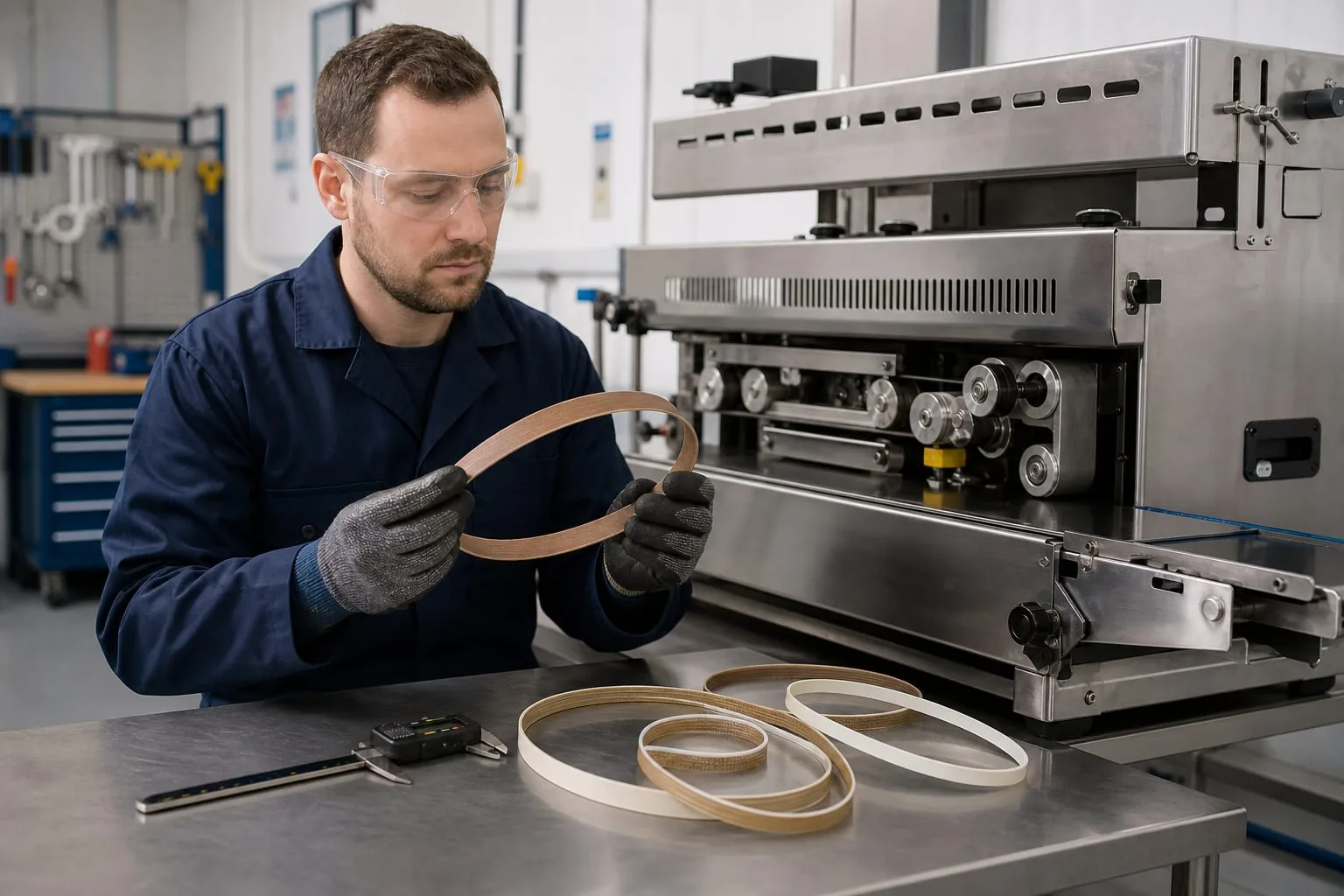
Confirm the band size, construction and machine layout before ordering a replacement.
Endless heat seal bands are replacement continuous sealing components used in band sealing machinery, including horizontal and vertical applications. Selection depends on verified dimensions, band construction, PTFE coating requirements, machine orientation and compatibility, so submit the machine specification and existing band details for a quote.
Endless bands and related components are replacement parts for continuous sealing systems. The right part depends on loop size, construction, coating, sealing path and machine layout.
Heat Seal Co supplies endless heat-seal bands, PTFE-coated belting and related components. Send the machine details, measurements and photographs for a compatibility review and quotation.
How Can You Specify the Right Endless Heat Seal Band?
Measure the Existing Band and Sealing Path
Measure the installed band before choosing a replacement. Record its endless loop length, width, thickness and route through the rollers and guides.
Isolate the machine before removing any part. Let heated parts cool first. If removal is not practical, measure the installed loop and photograph its route.
- Overall length: Measure the endless loop or confirm the path length.
- Width: Measure across the band, not the nearby guides.
- Thickness: Measure without pressing or deforming the band.
- Construction: Note whether it is plain, coated or profiled.
- Identification: Photograph labels, part numbers, joints, welds and surface details.
Information to record before requesting a replacement
| Specification | What to record | Why it matters |
|---|---|---|
| Loop length | Endless length or measured path | Controls fit, tension and tracking |
| Width and thickness | Measured dimensions in mm | Sets clearances and contact area |
| Construction | Plain, coated or profiled | Must suit the assembly and process |
| Surface condition | Worn, dirty, scored or damaged | May show that other parts need inspection |
Do not rely on a catalogue size or marketplace listing. Provide the machine make and model, orientation, package type, route, dimensions, construction and photographs.
Heat Seal Co supplies endless heat-seal bands for packaging machinery and can review replacement requirements.
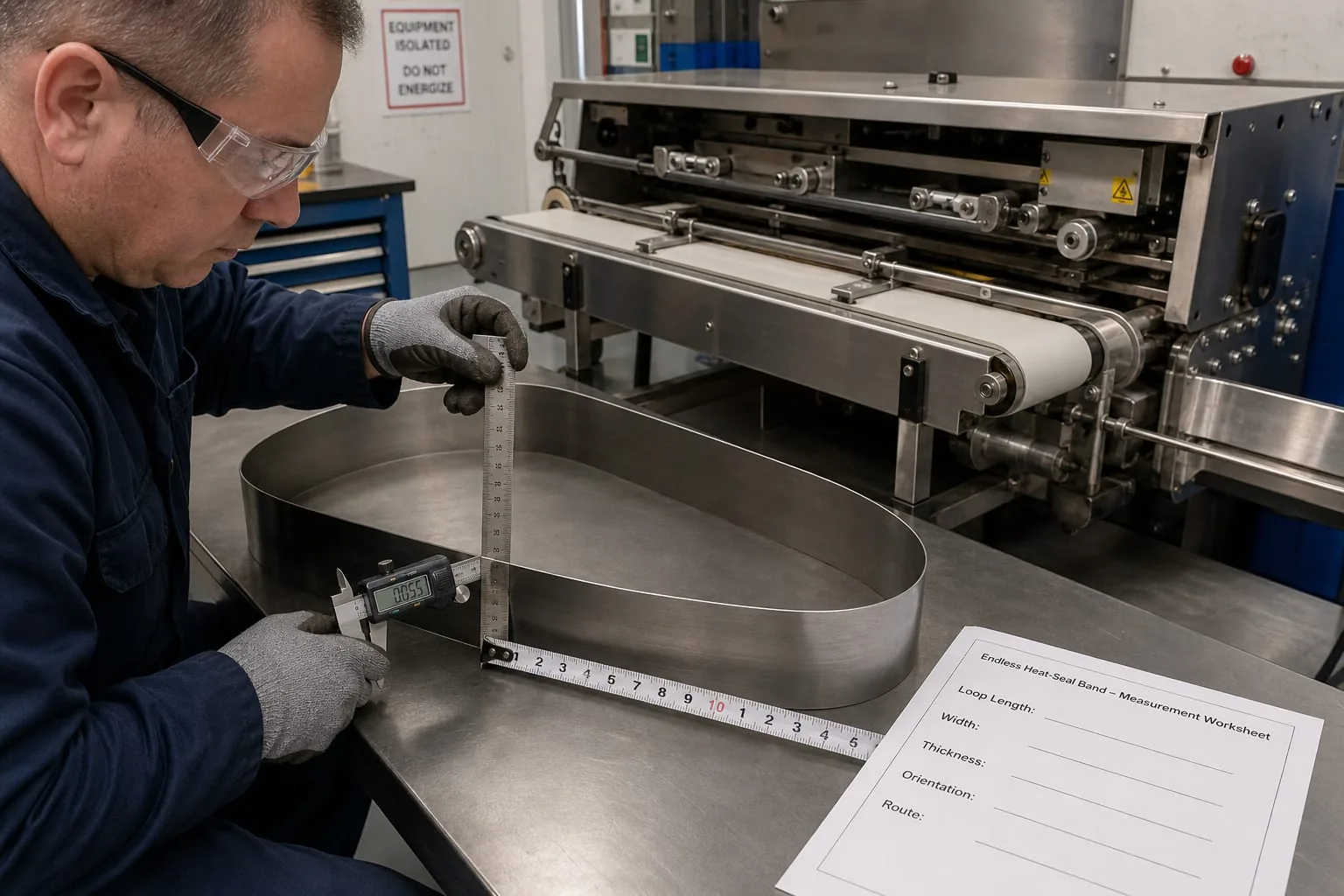
Measure the band’s loop length, width, and thickness, then document its orientation and routing through the sealer. These dimensions help ensure the replacement band fits the machine and sealing application.
What Is a Band Sealer Machine Belt?
How the Endless Loop Works
A band sealer machine belt is an endless loop in a continuous sealing system. It carries the package past heated surfaces while keeping contact and pressure steady.
The loop may run around rollers, guides and supports. Its size, tension, tracking and surface must match the machine.
A poor match can cause drag, uneven seals, early wear or stoppages.
Band, Belt and Related Component Terminology
Common replacement terms
| Term | Typical meaning | Confirmation required |
|---|---|---|
| Heat seal band | Endless loop in a continuous sealing path | Length, width, thickness and construction |
| Band sealer machine belt | Search term for a replacement loop | Confirm it is the sealing loop |
| PTFE or Teflon sealing belt | Loop described by its non-stick surface | Confirm coating, base and dimensions |
| Sealing component | Part such as an element, jaw, bar, guide or support | Confirm which part needs replacing |
The loop is not the heating element. The band moves through the sealing area, while a separate element may produce heat.
Describe the requirement as an endless heat-seal band. Include photographs of the full assembly.
How Do PTFE and Teflon Sealing Belts Differ?
PTFE Surface Requirements
PTFE belts may suit applications that need a low-stick, heat-resistant surface. This can help reduce sticking and residue during continuous operation.
PTFE alone does not confirm that a belt will fit or work correctly. Provide the loop dimensions, base construction, coating requirement, package material and known operating conditions.
PTFE means polytetrafluoroethylene. Teflon is a trade name often used for PTFE-based materials and coatings.
Use both terms when searching, then confirm the part specification.
Interpreting coating terminology
| Enquiry term | Possible indication | Information still needed |
|---|---|---|
| PTFE belt | PTFE surface or coating requirement | Loop dimensions and base construction |
| Teflon sealing belt | Commercial wording for a PTFE-type surface | Exact construction, dimensions and use |
| PTFE-coated custom belting | Made-to-requirement coated loop | Profile, length, width, thickness and coating |
Do not assume a coating will fix poor seals. Misalignment, wrong tension, worn guides, damaged rollers or poor settings can cause similar faults.
Send photographs of the surface and damage pattern with your enquiry.
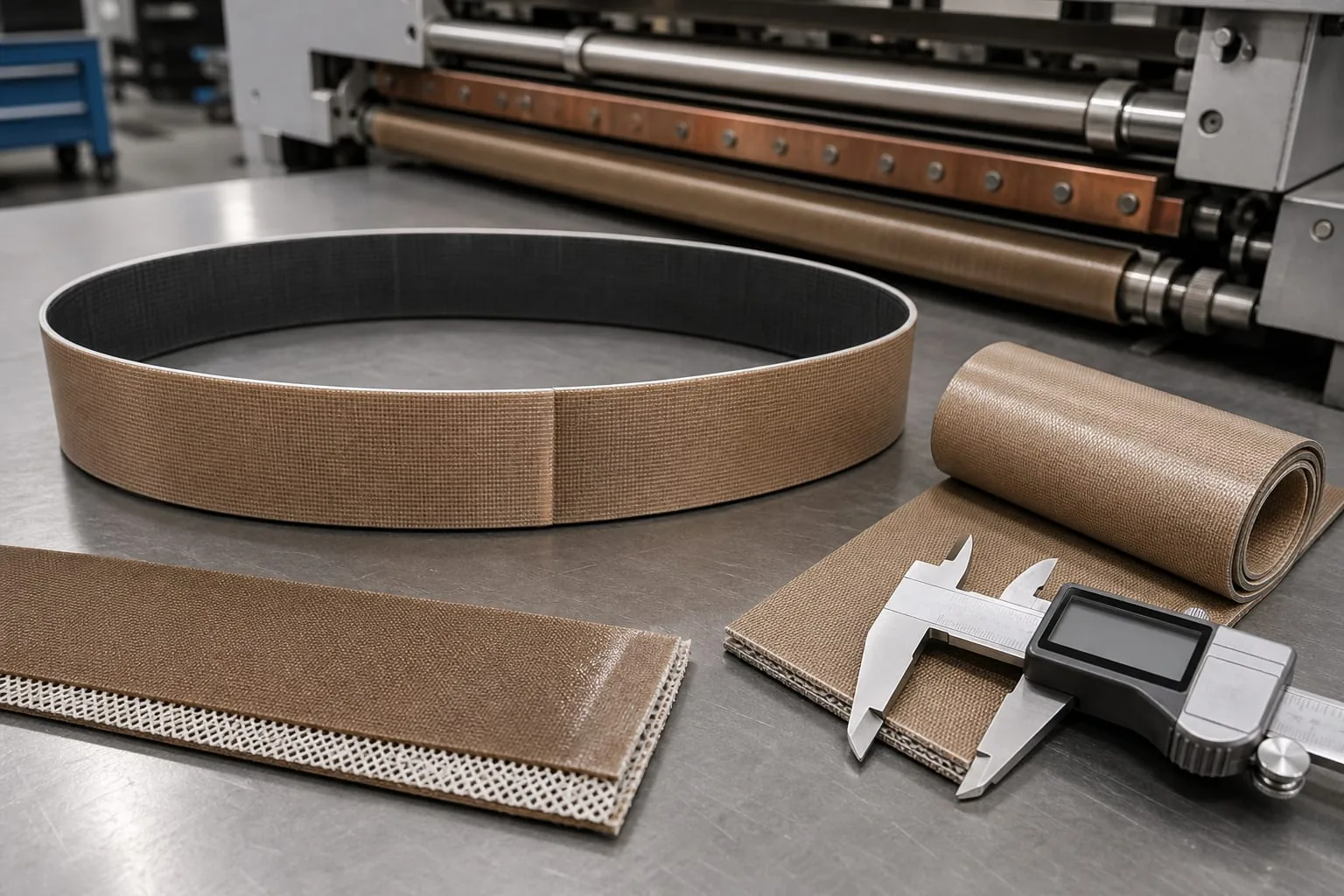
PTFE-coated bands can differ in fabric construction, coating, thickness, and profile. Comparing these features helps engineers select a sealing material that matches the equipment and required release performance.
Which Band Components May Need Replacement?
Inspect the Complete Assembly
Replacing the loop may not fix tracking or seal faults. Check the parts that guide, support, tension and position it.
- Guides and supports: Check for wear, burrs, dirt and movement.
- Rollers and tension points: Check their surfaces, rotation and adjustment.
- Heated surfaces: Check for residue, scoring and uneven contact.
- Heating elements and wires: These are separate heat-producing parts.
- Sealing jaws or bars: Check their alignment and contact.
- Fasteners and adjustment hardware: Confirm secure mounting and working adjustment.
Symptoms and replacement checks
| Symptom | Inspect | Possible consequence |
|---|---|---|
| Loop moves sideways | Guides, rollers, tension and alignment | Edge damage or uneven seals |
| Seal width varies | Position, heated surfaces and supports | Rejected packs |
| Material sticks | Surface, dirt and coating | Residue and cleaning delays |
| Loop slips or loses tension | Loop size, adjustment and drive contact | Interrupted production |
Do not assume a replacement band includes guides, rollers, heating elements or sealing bars. List each required part separately.
How Does Machine Compatibility Affect Band Selection?
Compatibility depends on the complete sealing assembly, not the machine name alone. Horizontal and vertical systems may have different paths, loads, guides, clearances and adjustments.
Provide the manufacturer and model, plus the actual loop length, width, thickness, construction, route and photographs. Include the sealing direction, package type, symptoms and any machine modifications.
For a continuous bag sealer machine, continuous band heat sealer or heat sealing machine, the model identifies the equipment family. It does not prove that a part will fit.
Heat Seal Co assesses compatibility from the machine and component details. It does not claim universal fit.
When Should You Replace a Heat Seal Band?
Consider replacement when the loop is stretched, scored, cracked, distorted, dirty or losing its coating. Other warning signs include frequent tracking adjustments, sticking, uneven seal width, edge damage and repeated stoppages.
Check the guides, rollers, tension points and heated surfaces before fitting a new band. Record the old adjustment positions, clean the path and check tracking during controlled operation.
A new loop may wear quickly if an alignment or support fault remains.
How Should an Endless Heat Seal Band Be Maintained?
Follow the machine maker’s safety and maintenance instructions. Isolate the equipment before access and let heated parts cool.
- Check tracking, tension and edge condition.
- Remove suitable process residue without damaging the surface.
- Look for scoring, cracks, distortion, coating loss and dirt.
- Inspect guides, rollers, supports and heated surfaces.
- Record wear, adjustments and replacement dimensions.
Keep a record of the loop size, construction, orientation, symptoms and photographs. These details help identify repeated alignment or compatibility problems.
How Can You Request a Replacement Band Quote?
Send the following information for a compatibility review:
- Machine manufacturer and model
- Horizontal or vertical orientation
- Measured endless length, width and thickness
- Band construction and coating requirement
- Route, guide arrangement and adjustment method
- Package material and known operating temperature
- Photographs of the part, edges, surface, rollers and guides
- Reason for replacement, such as wear, sticking, tracking or seal variation
Heat Seal Co manufactures and supplies replacement endless heat-seal bands, PTFE-coated custom belting and related components. Visit the Endless Heat Seal Bands and related product pages, then submit your machine details for a compatibility assessment and quotation.
Frequently Asked Questions
Are a continuous band sealer belt and an endless heat-seal band the same part?
They may mean the same replacement loop. However, “belt” can also mean a drive or support part. Confirm the position, route, dimensions and surface.
Can I order a PTFE or Teflon belt by machine model alone?
No. Provide the model, loop dimensions, orientation, construction and photographs. Model variations and modified assemblies can affect fit.
What information is needed for a custom PTFE-coated band?
Provide the loop length, width, thickness, profile or construction, coating requirement, machine route, package material, operating conditions and reason for replacement.
Does the replacement band include rollers, guides or heating elements?
Not unless the quotation says so. The loop, guides, rollers, heating elements and sealing bars are separate parts. List each required component.
Can Heat Seal Co quote a replacement for my continuous sealing machine?
Yes, subject to a compatibility review. Submit the machine details, measured part information and photographs before requesting a quotation.