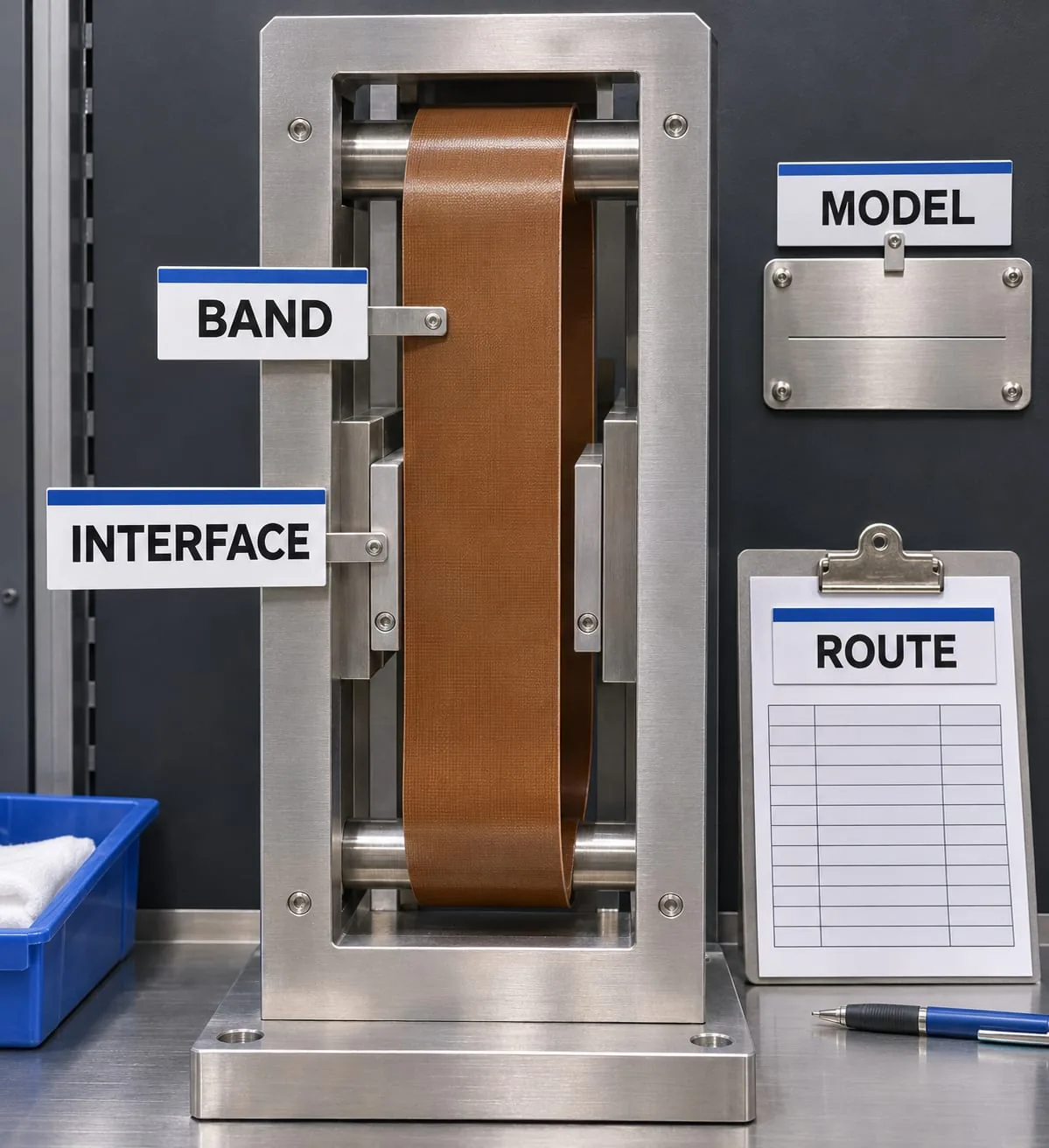
When a continuous sealing line needs a replacement band, the machine name alone is rarely enough to identify the right part. The band must fit the route, sit correctly against the heating and pressure components, and work with the material and duty of the application. A small difference in width, thickness, joint or tracking can change how the sealing zone runs.
This guide sets out the evidence a packaging engineer or maintenance technician should collect before requesting an endless heat-seal band. It focuses on dimensions, machine interfaces and practical compatibility checks. It does not replace the equipment manufacturer’s instructions or a risk assessment.
Why dimensions and machine compatibility must be checked together
An endless band is part of a working assembly, not an isolated strip. It follows a defined route around rollers, guides and the heated or pressure zone. The replacement therefore needs to match both the physical size and the way the machine supports, drives and tensions it.
The phrase “band sealer belt” can also cover different components. Depending on the equipment, the visible band may be a heat-seal band, a PTFE-type belt, a drive or support belt, or a part that works alongside a separate heating element. Confirm which component is fitted before asking for a quotation. Heat Seal Components’ endless heat-seal bands service is the most relevant starting point when the part is an endless sealing band.
A machine model is useful evidence, but it is not a complete specification. Similar machines can use different band routes, widths, end joints or support arrangements. A supplier should be able to compare the model and part number with measurements or photographs rather than assuming that a familiar machine name guarantees a match.
Record the dimensions that affect fit
Measure the old band where it is safe to do so, and record how each measurement was taken. Do not stretch a damaged band to make it appear longer. If the original is broken, photograph the route and keep both ends and any joint section for inspection.
Loop length and route
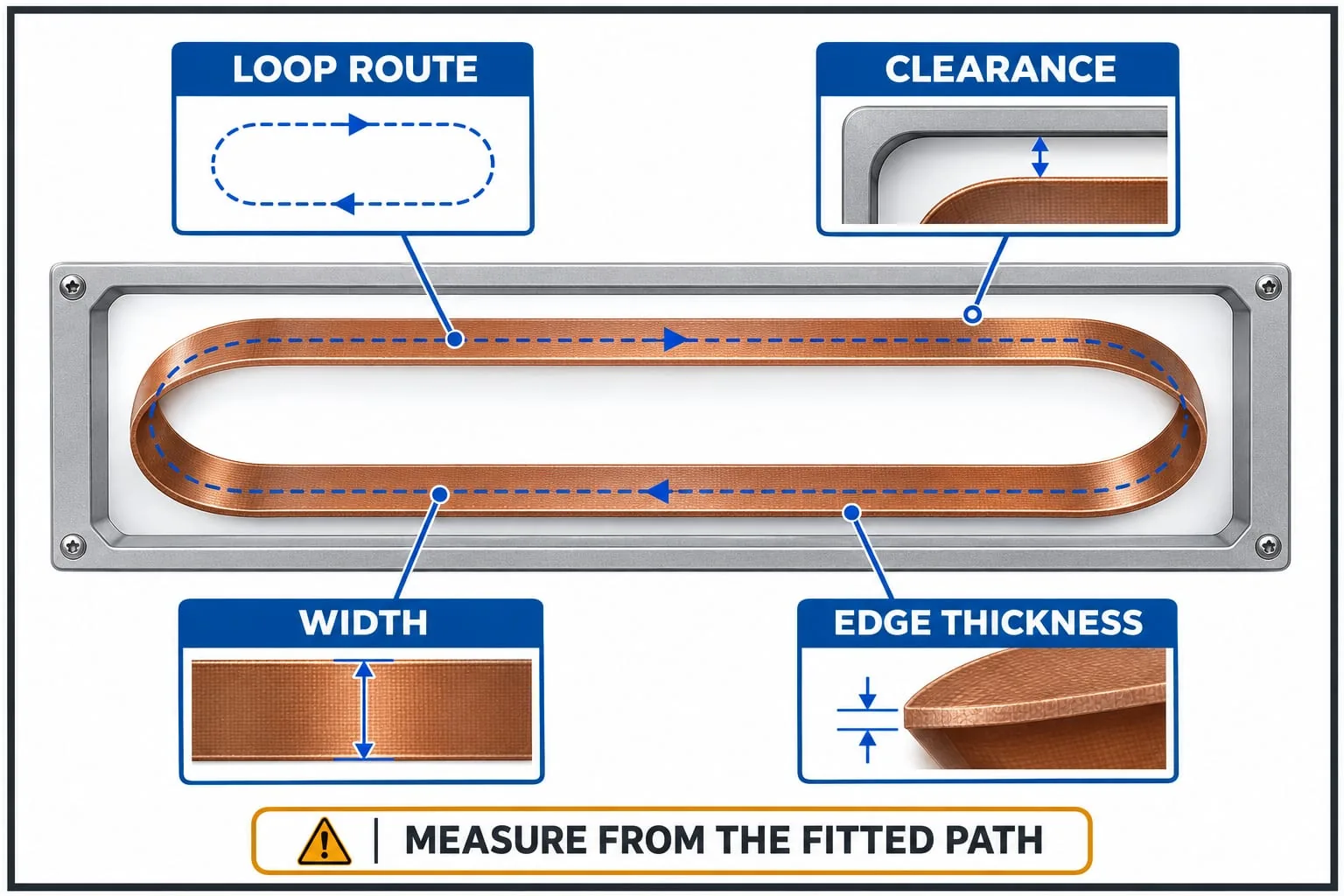
The loop length is only meaningful when the measurement follows the same path used by the machine. Note whether the band runs around a fixed roller, through a guide, over a heater or across a pressure point. If the route includes a tensioning adjustment, record its position before removal and photograph the adjustment range.
Where possible, provide the original band or a measured sample. A UK band manufacturer explains that a sample can allow direct matching when a part number is unavailable, while a machine model and OEM number can help confirm the intended size. That is a useful purchasing principle, but it is not proof that every model uses the same construction.
Width, thickness and profile
Measure the band width at more than one point if wear or fraying is visible. Measure thickness away from a damaged joint and note whether the edge is flat, tapered, layered or formed into a profile. Use suitable callipers or a micrometer and avoid compressing a soft coating during the reading.
For straight heat-sealing bands, ROPEX publishes example ranges for width, thickness and length, and notes that profile and alloy vary by application. Those figures are a useful reminder that dimensions and construction are linked. They should not be copied as a universal specification for an endless band.
If the band carries a coating or laminate, record the visible surface, backing and edge condition. A worn band may no longer show its original profile clearly, so a photograph of an unused section or a spare part is valuable.
Match the band to the machine interface
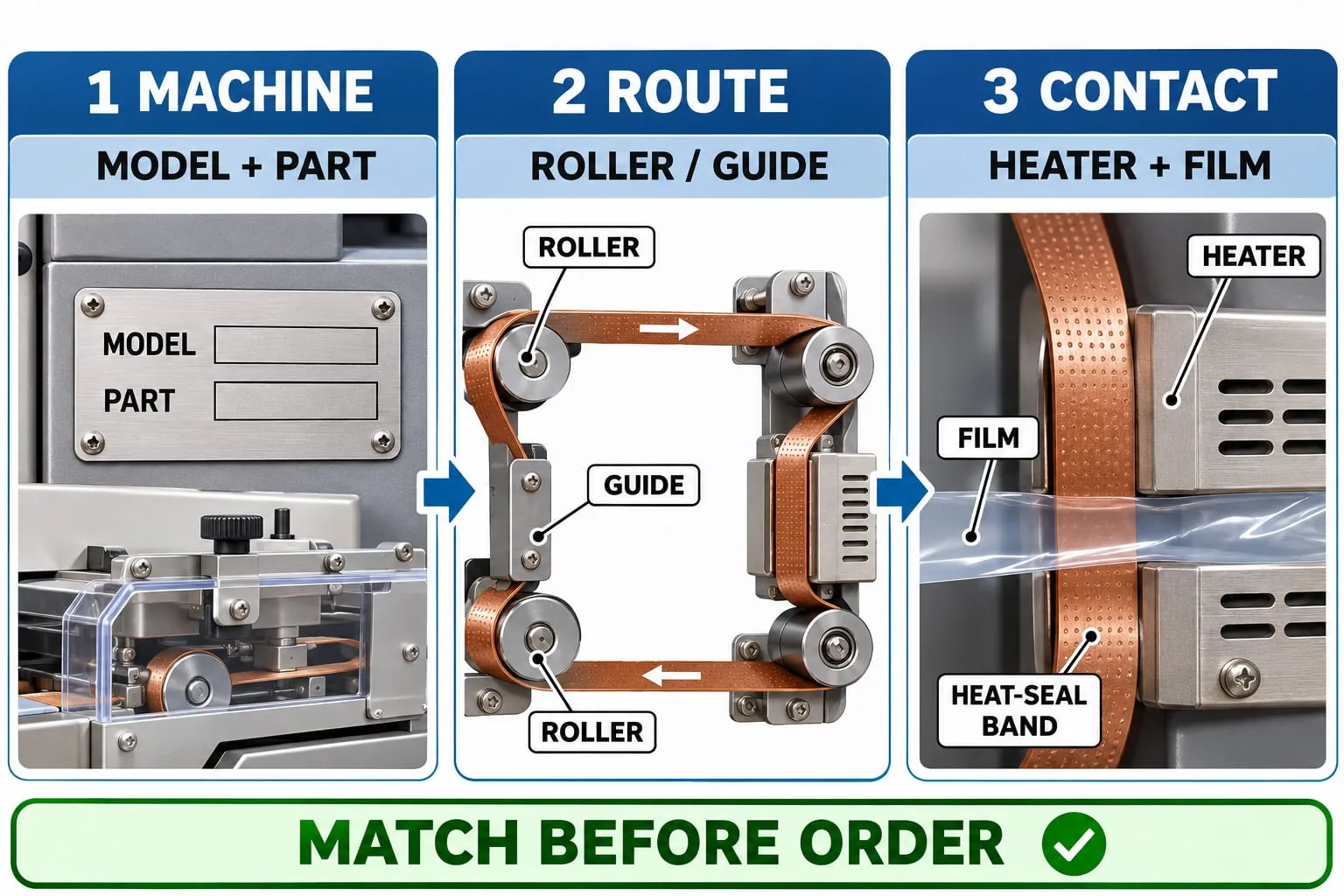
Compatibility is more than the band’s outside dimensions. Check every place where the part interacts with the machine, including the drive roller, guide faces, tensioning hardware, heater, pressure surface and film path.
Confirm the machine evidence
Collect the manufacturer, model, serial number if available, machine orientation and the station where the band is fitted. Add photographs of the installed band from the operator side and from the access side. Include the machine plate, part number, old packaging or purchase record if any of those are available.
Use the machine model as a cross-check, not as the only input. The route may differ between left-hand and right-hand versions, between horizontal and vertical packaging layouts, or after a machine modification. A clear photograph of the fitted component can resolve uncertainty that a model name cannot.
Check the neighbouring components
The replacement band must sit correctly relative to the parts around it. Check for:
- roller diameter and bearing position;
- guide width, edge clearance and any retaining lip;
- heater or sealing surface position;
- tensioner travel and adjustment direction;
- pressure or support surfaces that contact the package;
- terminal, joint or fixing arrangements at the band ends.
If the machine actually uses a jaw, bar or flat element rather than an endless band, say so in the enquiry. Heat Seal Components also lists sealing jaws and bars and heat-seal elements for different component arrangements. That distinction avoids requesting the wrong part because the machine is described generally as a “band sealer”.
Check the construction and sealing path
Two bands with similar measurements can still be unsuitable for the same duty. The surface must behave correctly where it contacts the package, the backing must support the route, and the joint must pass through the machine without catching or creating an uneven seal.
Identify the working surface
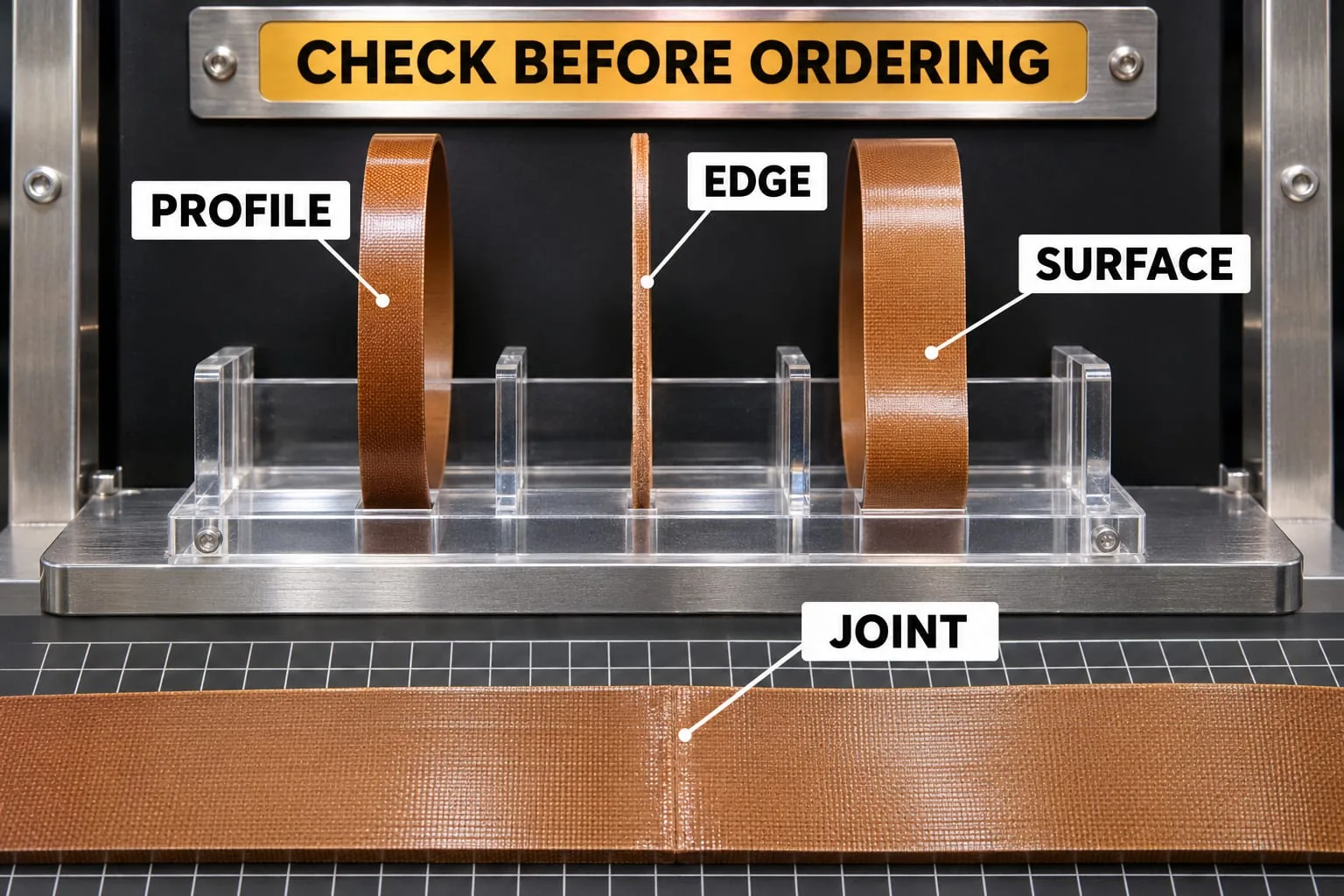
Record whether the band surface is smooth, textured, coated, laminated or visibly worn. Note contamination, scoring, lifted edges, glazing or deposits. A replacement should be specified from the intended application and the machine interface, not from colour alone.
Where a PTFE-type surface or cover is part of the assembly, describe the actual component and its position. Heat Seal Components’ PTFE coating service is relevant when the requirement concerns a coated sealing face or support component. It should not be treated as evidence that every brown or non-stick-looking band has the same material construction. If the component can contact food packaging, use application-specific evidence and GOV.UK food-contact guidance rather than assuming suitability from appearance.
Inspect the joint and edge
The joint is a working part of an endless band. Photograph it straight on and at an angle, with a scale nearby if practical. Record whether it is stepped, overlapped, scarfed, welded or otherwise formed, but do not assume the joint type from a low-resolution image.
Inspect both edges for fraying, lifting, cracking or a change in thickness. Edge damage can point to tracking or guide problems, so note whether the band was centred on the rollers before removal. If the joint has failed, keep the failed section and report where it failed in the cycle.
Build a reliable replacement request
A good enquiry lets the supplier validate the part before production. Send one concise record containing:
- machine manufacturer, model and serial number if available;
- station name and machine orientation;
- OEM or previous supplier part number;
- loop length, width, thickness and profile measurements;
- joint or end detail and photographs;
- roller, guide, heater and pressure-interface photographs;
- packaging material, product type and operating pattern;
- symptoms, failure location and the last known change to the setup.
Do not add a temperature, material grade or compatibility claim unless it is confirmed by the machine documentation or supplier review. If a replacement element, terminal or covered surface is involved instead of the band itself, describe that separately. Heat Seal Components can review custom impulse heat-seal elements when the evidence points to a made-to-order element rather than an endless band.
Plan inspection and changeover safely
Replacing a band involves moving parts, stored tension and potentially hot surfaces. HSE guidance on PUWER says work equipment should be suitable for its use, maintained safely, inspected where needed and provided with means of isolation from energy sources. Follow the machine manufacturer’s isolation and changeover instructions, and use a competent person for the work.
HSE inspection guidance says inspection should reflect the risks, installation conditions, deterioration and manufacturer recommendations, with records kept where appropriate. Record the old band’s condition, the replacement evidence, the route photographs and the checks made after reassembly. Do not run the machine with guards removed or with a band that is visibly misaligned.
After the change, confirm the band tracks correctly, clears adjacent parts, reaches the intended tension and does not rub on the edge of a guide. Check the first production samples against the site’s quality procedure. If the machine, sealing material or route has changed, review the compatibility record rather than relying on the previous setting.
If you have the machine details, measurements and photographs, contact Heat Seal Components for a component review. The Heat Seal Services page provides the wider route for an enquiry when you are not yet sure whether the requirement is an endless band, a heat-seal element, a jaw, a bar or a coated component.