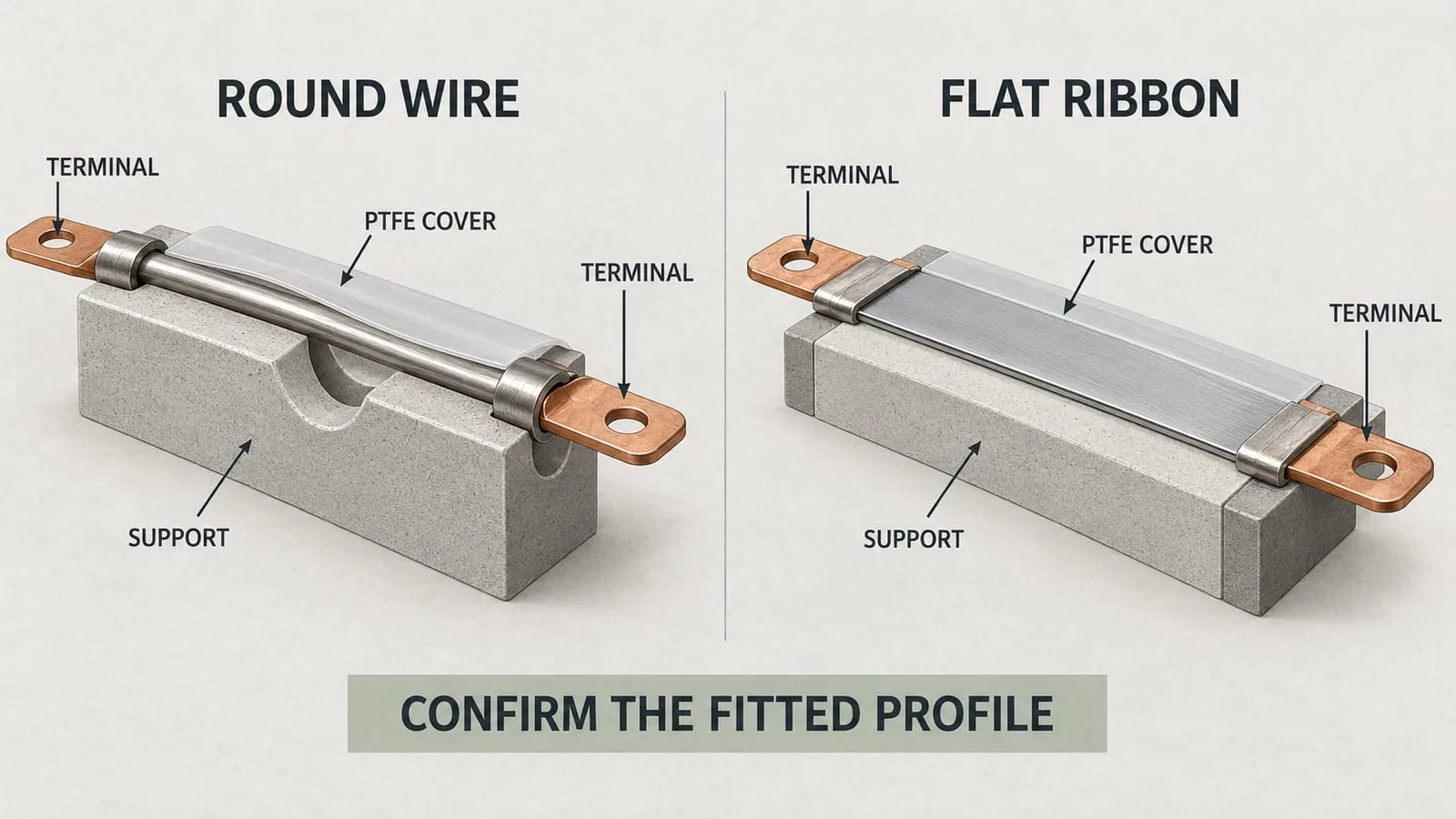
Replacing a heat-seal wire or ribbon is a fit and specification task. The machine name is useful, but it is not enough on its own. The element form, heated length, terminals, support, cover and electrical arrangement all need to match the sealing station.
This guide helps packaging engineers, maintenance technicians, production managers and procurement teams collect the right information before ordering. It focuses on component compatibility for impulse and bench sealers, continuous and rotary equipment, vacuum packers, VFFS and flow-wrap applications.
Start with the sealing method
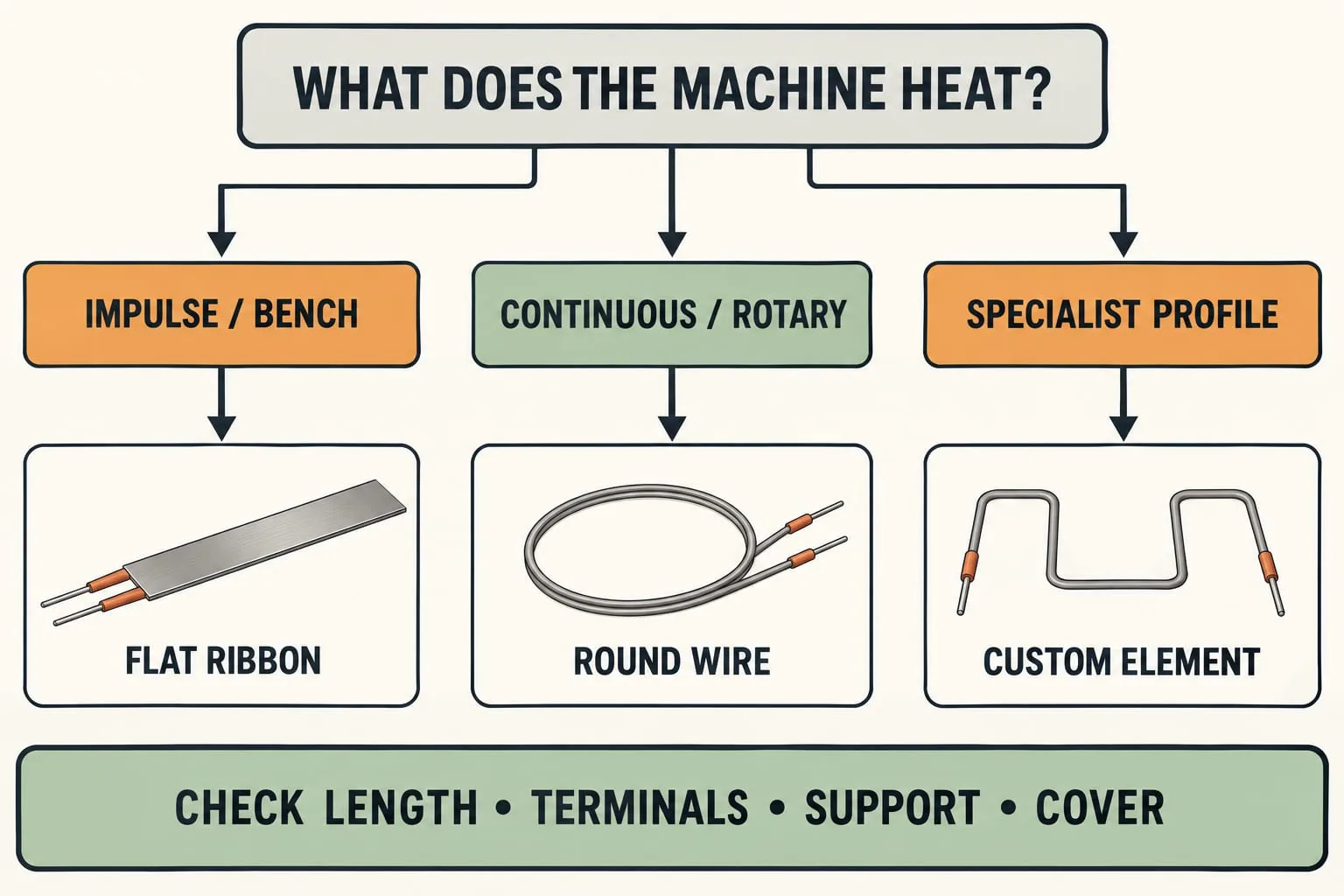
The first question is how the machine applies heat. An impulse sealer normally energises the element during the sealing stroke. Continuous and rotary equipment may use a wire, band or formed heated part that stays in a different relationship with the film. A machine described as a “sealer” can therefore contain very different replacement components.
Heat Seal Components’ heat-seal elements service distinguishes between flat ribbon elements and round-section wire. Use that information as a starting point, then compare it with the fitted assembly and the machine documentation.
Impulse and bench sealers
Impulse and bench sealers commonly use a flat ribbon element across a seal bar. The width, thickness, heated length, end shape and termination position all affect whether the part sits correctly. A similar-looking ribbon is not proof of compatibility.
If the element is for an impulse application, the custom impulse heat-seal elements service is the relevant route for a made-to-specification review. Include a clear photograph of the seal bar and both ends of the old element where possible.
Continuous and rotary equipment
Continuous or rotary sealers can use round-section heat-seal wire or another formed element. Record the wire diameter, heated path, terminal arrangement and the way the wire is held or tensioned. Do not assume that a wire used in one continuous machine will suit another machine with a similar name.
Specialist or formed profiles
Some sealing stations use a shaped element, a cut-off wire or a custom profile. The profile may control how the part sits against the film, cover or support. Treat the old element, a drawing or a marked-up photograph as evidence. Do not reduce a formed part to one width measurement.
Compare wire and ribbon geometry
Wire and ribbon are different component forms, not interchangeable labels. Ribbon has a flat width and thickness. Wire has a round diameter. Both also have a heated length, overall fit, terminals and a mounting route that must be checked.
What to record on a ribbon
For a flat ribbon element, record:
- ribbon width and thickness, measured from the original where possible
- active heated length and overall length
- terminal shape, hole or fixing centres and connection direction
- the support, cover and tensioning arrangement
- any visible profile, cut-off edge or double-seal feature
What to record on a wire
For a round wire element, record the wire diameter, heated length, end connection and tensioning method. Also record whether the wire sits in a groove, crosses a bar, follows a formed path or works with a separate cover. If the old wire has broken, measure the machine assembly without stretching or reshaping the remaining piece.
The custom heating elements service is useful when the fitted part is flat, formed or outside a simple catalogue description. Send the machine details and the physical evidence rather than guessing a material or size.
Check the full electrical and mechanical fit
The electrical specification and the physical fit must be reviewed together. Heating-element design depends on interacting variables such as voltage, power, resistance, material, dimensions and heat dissipation. Kanthal’s design-calculation guidance explains those relationships in general engineering terms. It is not a universal setting for a packaging machine.
Do not insert a resistance value or operating temperature from a different machine into a purchase request. If the original specification is known, provide it. If it is not known, provide the old element, the machine documentation, the measured geometry and the control information so the replacement can be reviewed properly.
The mechanical side includes the element path, pressure face, support, cover and terminal clearance. If the element sits in a jaw or bar, review the related sealing jaws and bars arrangement. If a non-stick layer covers the heated area, record its width, retention method and condition. A suitable PTFE heat-seal tape may be part of the wider assembly, but it does not replace a correctly specified element.
Build a useful replacement request
A supplier can check compatibility faster when the request contains one consistent set of evidence. Include:
- machine make, model and the sealing station or jaw position
- sealing method and application, such as impulse, vacuum packing, VFFS or flow-wrap
- element form: flat ribbon, round wire or a known custom profile
- active heated length, overall length and terminal or fixing centres
- ribbon width and thickness, or wire diameter, measured from the original where possible
- terminal style, connection route and mounting or tensioning arrangement
- photographs of the fitted path, the removed part and both terminals
- the old element, drawing or sketch if it can be handled and shipped safely
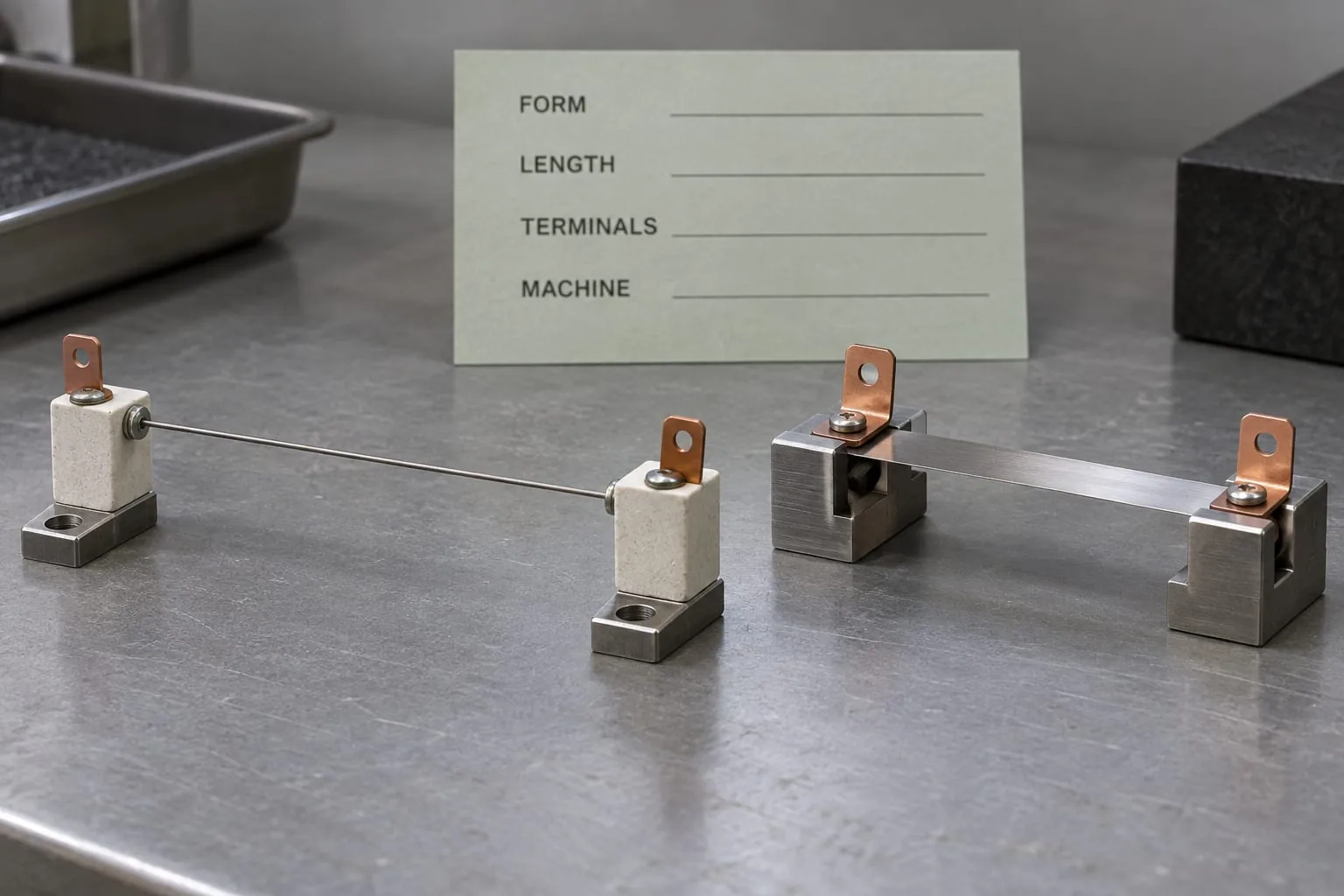
If there is uncertainty, label it. A note saying “dimension unknown” is more useful than a guessed value. Keep photographs square to the part where possible, add a scale only when it does not obscure the feature, and show the full path as well as close views of the ends.
Safe inspection before ordering
Replacement measurements should be taken under the site’s safe system of work. The HSE maintenance guidance says maintenance should be planned and carried out by competent people. It also highlights isolation, lock-off where unexpected reconnection is possible, release of stored energy and cooling of hot components before work begins.
Packaging machinery can contain moving, heated and guarded parts. The HSE’s guidance on packaging machinery stresses the need for effective guarding and safe systems of work, including during maintenance, on form, fill and seal machines, where forming dies and cutters are the main hazard areas. Follow the machine maker’s instructions and do not treat an emergency stop alone as proof of safe isolation.
Contact Heat Seal Components with the part details
Send the machine make and model, the measurements, the element form, terminal details, photographs and any drawing with your enquiry. If you are unsure which dimensions apply, include the old element or a clear photograph of the fitted path.
For a replacement wire, ribbon or custom element review, contact Heat Seal Components with the evidence you have. The team can confirm what needs to be checked before a component is quoted and made.