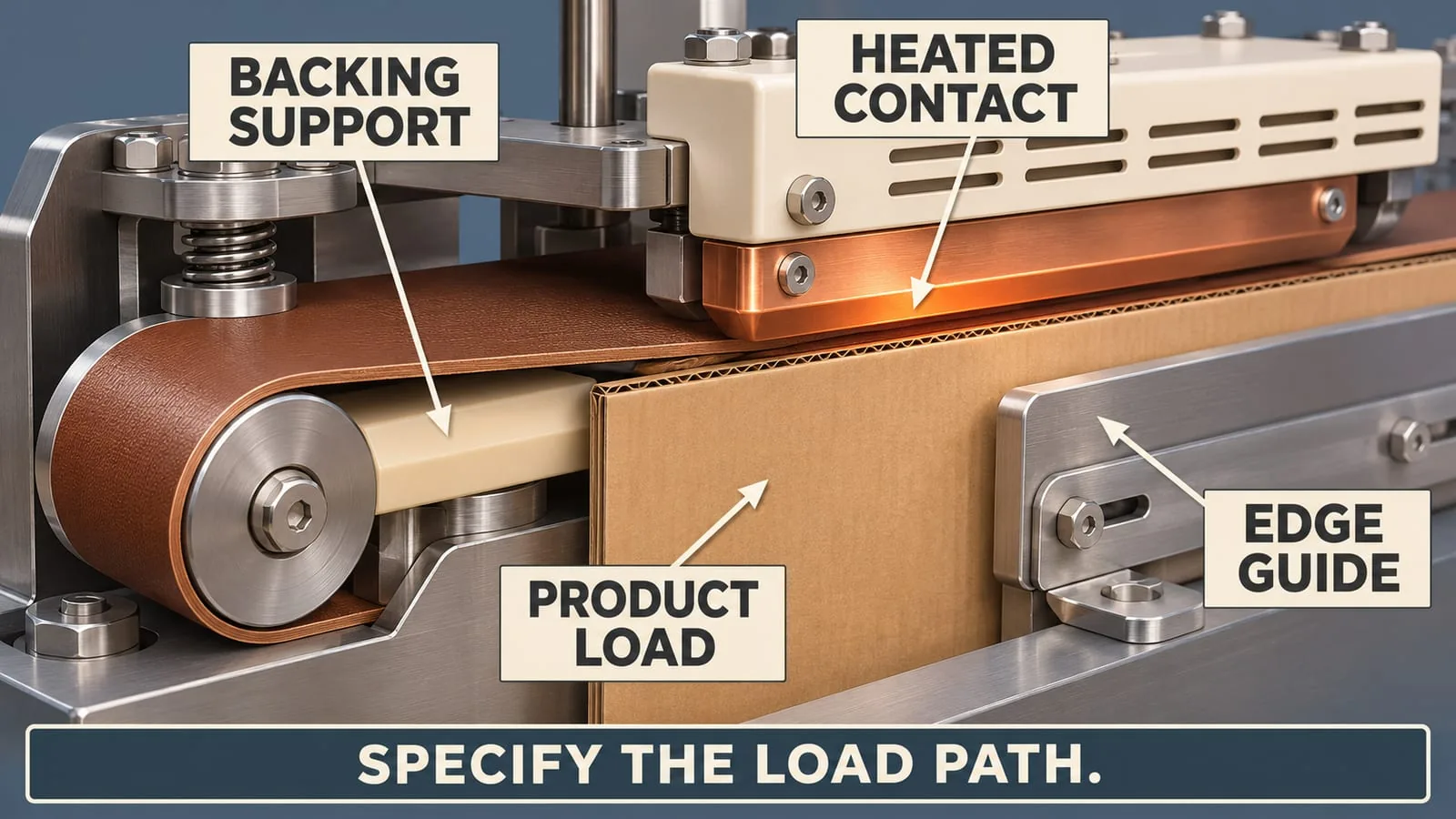
“Heavy duty” is useful shorthand in a packaging conversation, but it is not a complete component specification. A continuous band sealer depends on the relationship between the endless band, its support and guide arrangement, the heating interface, the terminals and the product path. A replacement selected only from a machine name can therefore be the wrong shape or connection even when the description sounds right.
This guide is for engineers, maintenance technicians, production managers and procurement teams who need to identify components for a continuous band sealing station. It focuses on the evidence to collect before ordering. It does not assume that every machine described as heavy duty uses the same band, support, heater or connection arrangement.
What “heavy duty” should mean in a component request
Treat the label as a starting point
The phrase may describe long running hours, a demanding production environment, a particular package format or simply the way a machine is marketed. It does not, by itself, confirm a band profile, material, width, heating method or replacement interval. Those details must come from the fitted assembly and the machine’s own documentation.
Start with the part that needs attention. Is the issue visible on the moving band, the backing or support surface, the guide, the heating element or the connection point? Separating those possibilities avoids ordering a visually similar part for the wrong position.
Define the load and sealing task
Record what the station actually seals and how the package approaches the sealing zone. Note the film or laminate description if known, whether the seal is made on a horizontal or vertical path, and whether the station is part of a vacuum packer, impulse sealer, VFFS or flow-wrap line. These details give a component supplier useful context without turning a machine label into an assumed specification.
Also record what changed: a worn edge, tracking movement, a damaged support, an open circuit, a poor seal or a planned changeover. A symptom is useful evidence, but it is not proof of the failed component or its cause.
Map the band, support and heat interface
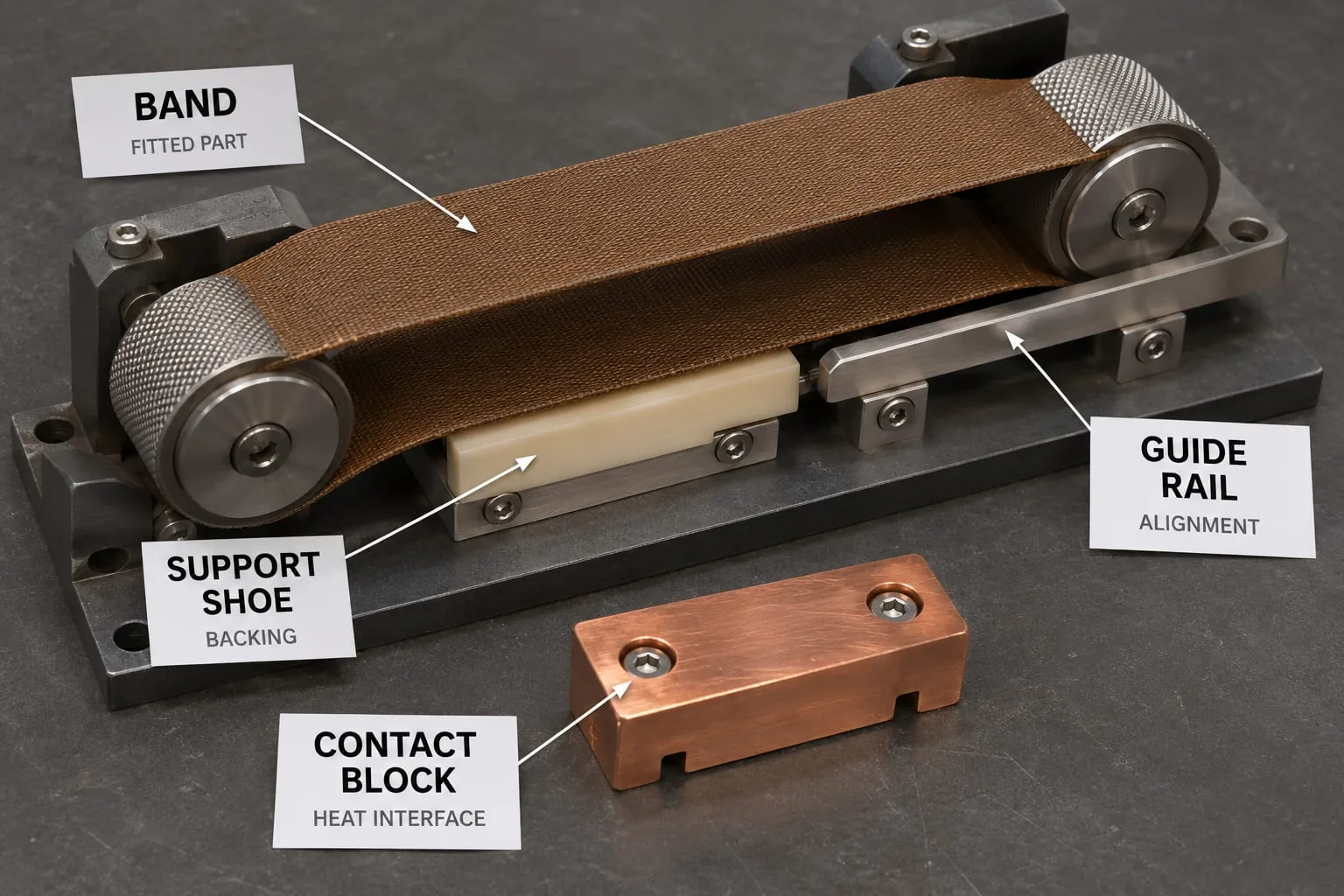
An endless band is only one part of the working path. Before requesting a replacement, map how it travels around the fitted station and where it is supported, guided and heated. Heat Seal Components’ heat-seal bands service is the most relevant starting point when the band itself is the component under review.
Trace the fitted band route
Take clear photographs from the operator side and from the service side if that is safe and permitted. Show the full route, the direction of travel and the areas that contact rollers, shoes or guides. Include a close view of any joint, fastener or termination only if that feature is present on the fitted part.
Do not assume that two bands with similar colour or width are interchangeable. The useful comparison is the complete working arrangement: profile, route, support, guide relationship and the way the band meets the heat interface.
Record the backing and guide relationship
A support shoe or backing strip may sit below the moving band, while a guide rail controls its path. Record whether each part is fixed, adjustable, coated, grooved or visibly marked, but describe only what can be seen or confirmed in the machine documentation. Heat Seal Components also provides PTFE coating service and PTFE heat-seal tape within its confirmed component offer; the correct choice still depends on the fitted application.
Specify the component from the fitted assembly
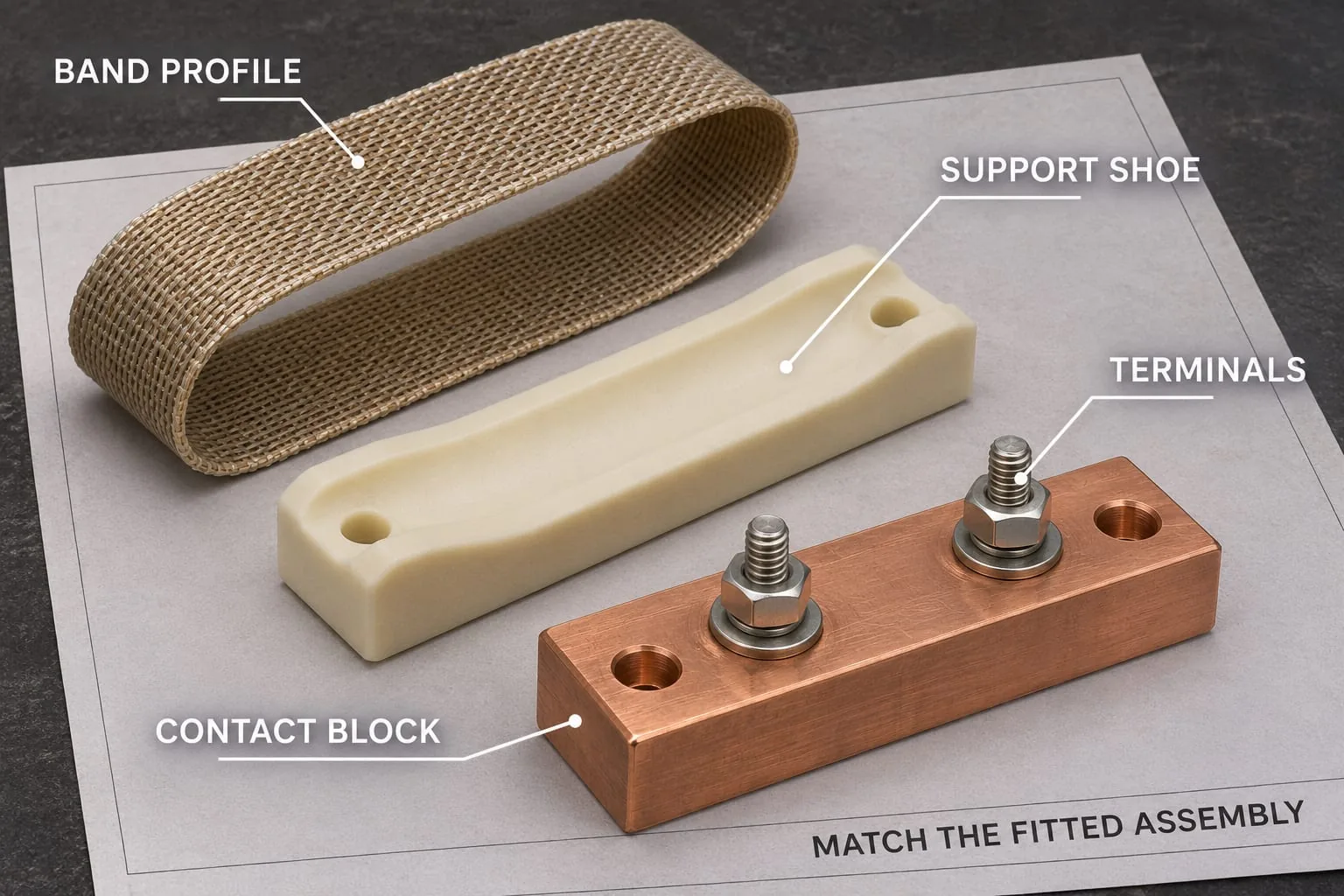
Once the load path is clear, build the request around the actual component rather than a generic search term. Heat Seal Components’ heat-seal elements service covers a different component family from an endless band, so separating the part types in the request helps prevent a category mistake.
Measure only what the part shows
Use metric measurements and label each one. Depending on the part, useful evidence may include visible band width, overall length or loop length, thickness, hole centres, mounting face, terminal spacing and the position of a cut-out. Not every measurement applies to every component, and a measurement should never be presented as a universal standard.
Photograph the measurement beside the part and keep the measuring reference square to the feature. If the component is damaged, photograph the undamaged section as well. A drawing, old part number or manufacturer reference can support the request, but it should be checked against the part currently fitted.
Match connections and nearby parts
Show how the element, contact block, terminal or jaw is held in place and what sits immediately beside it. A heating element or sealing jaw can be dimensionally close to another part while having different terminals or mounting details. Heat Seal Components lists sealing jaws and bars and custom impulse elements among its confirmed services; the machine details and the physical evidence remain necessary to assess compatibility.
Use compatibility evidence before ordering
Send machine and station details
Include the machine maker and model if known, the station name, the fitted component photographs, measured dimensions, connection photographs and the operating symptom. If a manual or parts drawing is available, include the relevant page rather than relying on a search result or an informal machine nickname.
For a VFFS or flow-wrap installation, identify whether the part belongs to the longitudinal or end-seal station. For an impulse sealer or vacuum packer, identify the sealing position and whether the requested part is a band, element, jaw, bar, coating or tape. Heat Seal Components can then review the request against the confirmed component category instead of guessing from the equipment label.
Keep vacuum or film requirements separate
Vacuum packaging and film handling can change the information needed for a component review, but they do not prove that a particular band or element is correct. If the request concerns a vacuum packer, use the vacuum-pack sealing elements service where that is the relevant component family. Keep the vacuum requirement, film construction and sealing geometry as separate fields in the procurement record.
The same discipline applies to a line that combines several sealing stations. A component that is suitable for one station should not be moved to another solely because the machine has the same brand or model family. Compatibility is a relationship between the component and the fitted station.
Inspect wear without guessing the cause
Packaging machinery can contain trapping and in-running-nip hazards. HSE guidance on packaging machinery highlights the importance of guarding and a formal safe system of work. Before inspection or maintenance, follow the site’s isolation procedure, allow hot parts to cool where required and verify that the equipment is safe to approach. HSE’s guidance on planned maintenance, PUWER, inspection and safe isolation provides the general framework; your site procedure and competent person remain the controlling instructions.
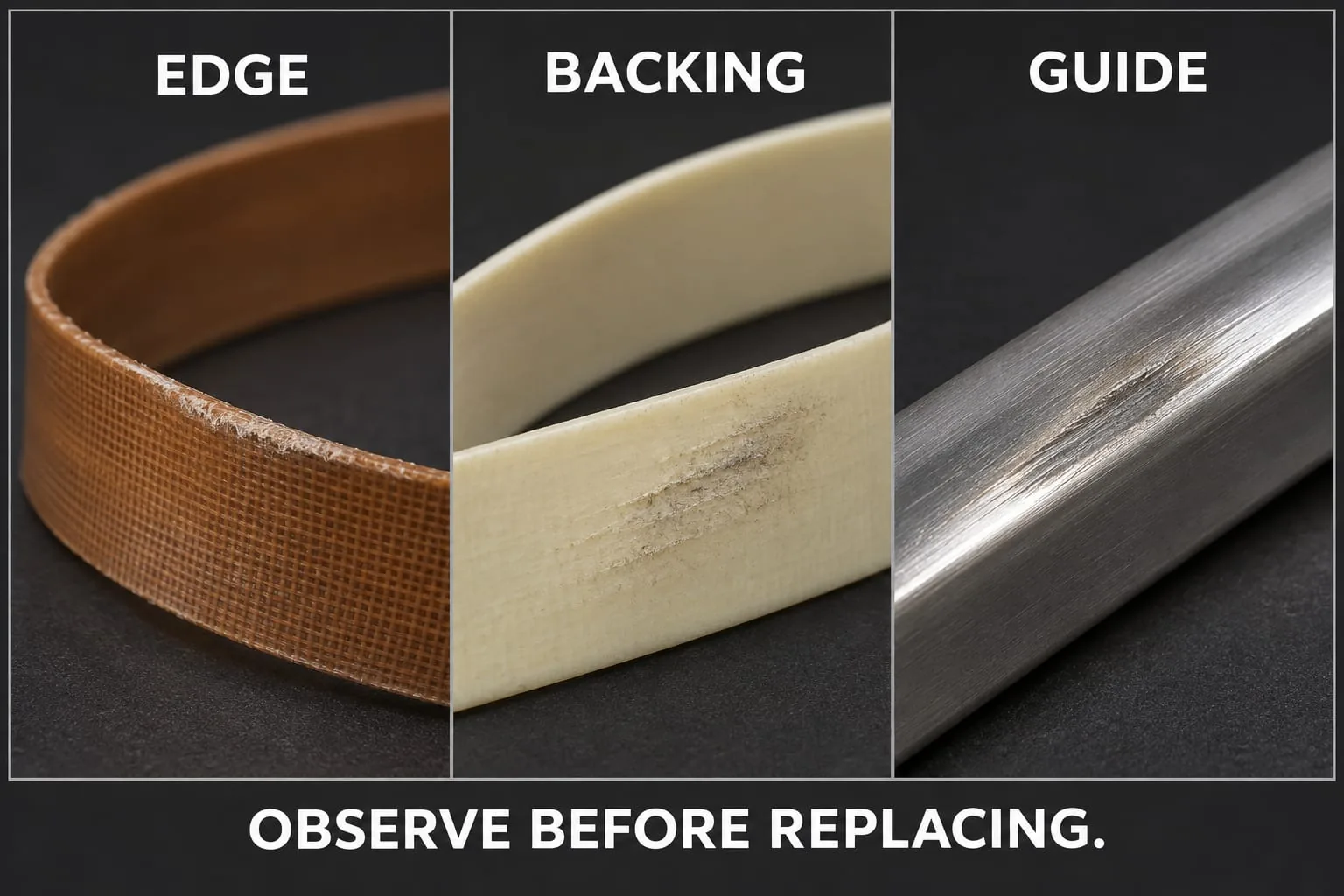
Check edge, guide and backing condition
Record visible facts in separate fields rather than writing a diagnosis into the first report. For example, note whether an edge is frayed, flattened, contaminated, scored or discoloured; whether a guide is loose, marked or out of position; and whether the backing is cracked, worn or carrying residue. These observations can be compared with the machine manual and maintenance history.
Do not convert one mark into a claim about temperature, tension, pressure or speed. Those factors may require machine-specific checks. The purpose of the first inspection is to preserve evidence and identify which component needs a closer review.
Record change after isolation and cooling
Use before-and-after photographs when a component is removed or replaced. Record the date, station, part description, visible condition and the action taken. Where the work equipment’s risk assessment or manufacturer’s information calls for it, keep the inspection and maintenance record with the equipment history. HSE explains that inspection should be proportionate to risk and that records can help show what was checked and when.
When custom component support is useful
A sample beats a machine-name guess
If the old part is available, a clear physical sample can be more useful than a broad search phrase. Package it safely, photograph both faces and include the measurements that are relevant to its shape. If it cannot be removed safely, provide clear images and the machine documentation instead of dismantling a guarded or hot assembly for a photograph.
Heat Seal Components’ confirmed offer includes endless heat-seal bands, heat-seal elements and wires, custom impulse elements, PTFE coating and heat-seal tape, sealing jaws and bars, plus compatibility support for vacuum packers, impulse sealers, VFFS and flow-wrap equipment. It does not mean that a complete sealing machine, packaging bag or general repair service is being supplied; the request should identify the component required.
Build a procurement record
Before sending the enquiry, check that it contains:
- the machine and station context, if known;
- the fitted component photographs and any available drawing or part reference;
- labelled metric measurements taken from the actual component;
- the support, guide, heat interface and connection details that are visible;
- the operating symptom or planned change, kept separate from any unproven diagnosis; and
- the required quantity, delivery context and any timing constraint that the supplier needs to understand.
This record gives maintenance and procurement teams a shared reference. It also makes later comparisons easier if the same station needs another component review.
If you need help identifying an endless band, heating element, PTFE component, sealing jaw or bar for a continuous band sealing station, contact Heat Seal Components with the machine context, photographs and measurements. The more closely the request describes the fitted assembly, the easier it is to discuss compatibility without guessing.