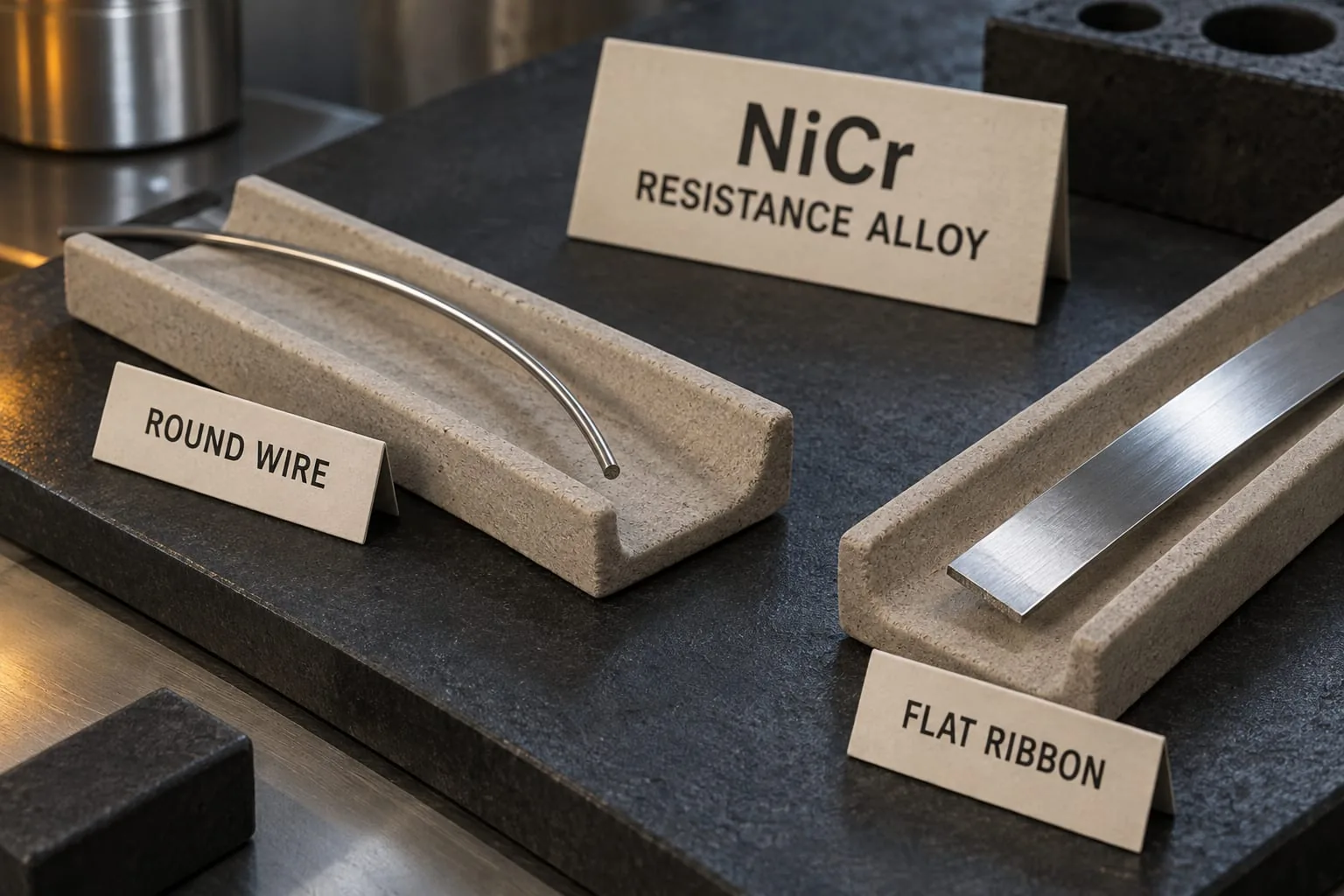
If a failed heat-seal element is described as Nichrome wire or ribbon, the material name is only the starting point. A compatible replacement also depends on the profile, active heated length, terminals, support, cover, electrical information and the sealing station where it is fitted.
This guide is for UK packaging engineers, maintenance technicians, production managers and procurement teams checking replacement elements for impulse sealers, vacuum packers, VFFS and flow-wrap equipment. It explains what to record before ordering and how to keep the decision tied to the component actually installed.
What Nichrome means in a heat-seal element
Resistance alloy is only one part of the specification
Nichrome is commonly used as a short name for nickel-chromium resistance alloys. Manufacturers publish different alloy data and supply forms such as wire and strip. That means “Nichrome” should not be treated as a complete order specification.
The Heat Seal Elements service page is a useful scope reference for element forms and replacement requirements. Compare its description with the removed part and the assembly around it. Do not select a replacement from the material name alone.
For a useful request, confirm the original alloy or grade where it is recorded, then add the physical and electrical evidence. If the original specification is missing, label that gap instead of guessing it from colour or appearance.
Why operating conditions still matter
Resistance-heating design depends on several linked variables. Kanthal’s design-calculation guidance discusses material, dimensions, resistance, voltage, power and operating conditions together. It is useful engineering context, not a universal setting for a packaging machine.
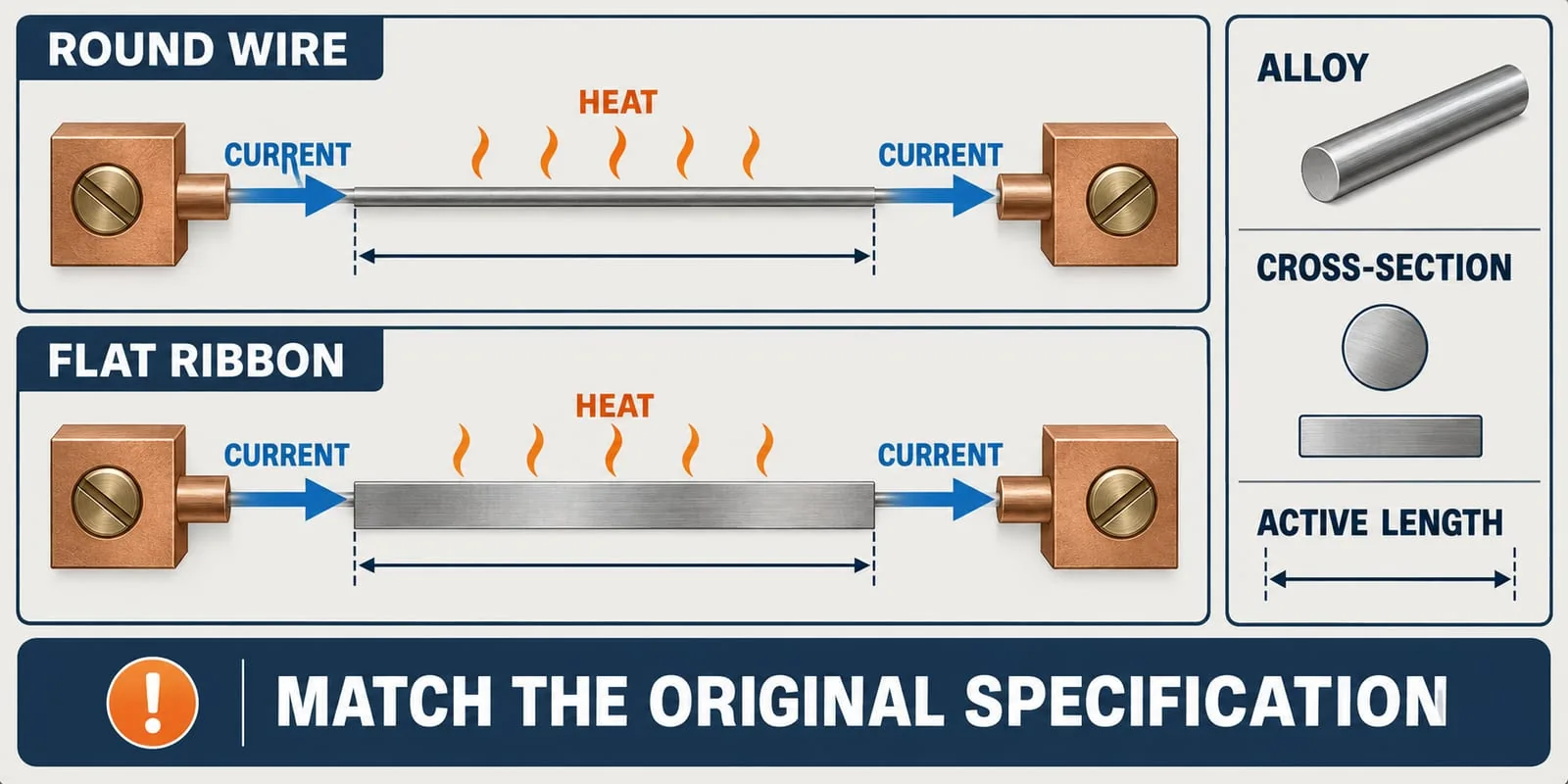
The same material family can be supplied in different profiles. A round wire and a flat ribbon can therefore require different measurements, mounting details and replacement checks even when both are described as Nichrome.
Round wire or flat ribbon: match the form to the assembly
The installed profile is one of the quickest ways to remove ambiguity. Photograph the complete path before removing a broken part, including both ends, terminals, supports and the cover or tape arrangement.
Round wire
For round wire, record the wire diameter, active heated length, inactive end allowances, terminal or fixing arrangement and the route through any grooves or supports. Do not flatten, stretch or straighten the sample before recording it. A damaged wire can lose the evidence needed to identify how it was held in the sealing assembly.
Flat ribbon
For flat ribbon, record width and thickness separately. Also note whether the ribbon is straight, formed, folded or held in a shaped channel. The heated section may not be the same as the overall part length, particularly where the ends are clamped or connected outside the sealing area.
The custom impulse elements page is relevant when the part needs a formed or custom review. Include a scale reference in photographs and use millimetres for every dimension.
Check the complete element before ordering
Profile and active length
Separate the active heated length from the end-to-end length and from the distance between fixing points. Record wire diameter or ribbon width and thickness, then mark the measurement points on a photograph or drawing. If the element has bends, holes, notches or stepped ends, measure each feature from a fixed reference point.
The machine jaw or bar can provide a second reference when an element has broken or distorted. It cannot replace the element record, because the heated section may not run across the full mechanical envelope.
Terminals, support and cover
Record terminal type, orientation, fixing centres, connection direction and the route taken by the connection. Note the support, tensioning arrangement, insulation, cover or tape and the condition of the channel or bar.
The wider sealing jaws and bars arrangement matters because a new element cannot correct a damaged support, unstable connection or incorrect mounting route. Keep those observations separate from the replacement specification so the supplier and maintenance team can review the right intervention.
Record the evidence before requesting a replacement
What to record before requesting a quote
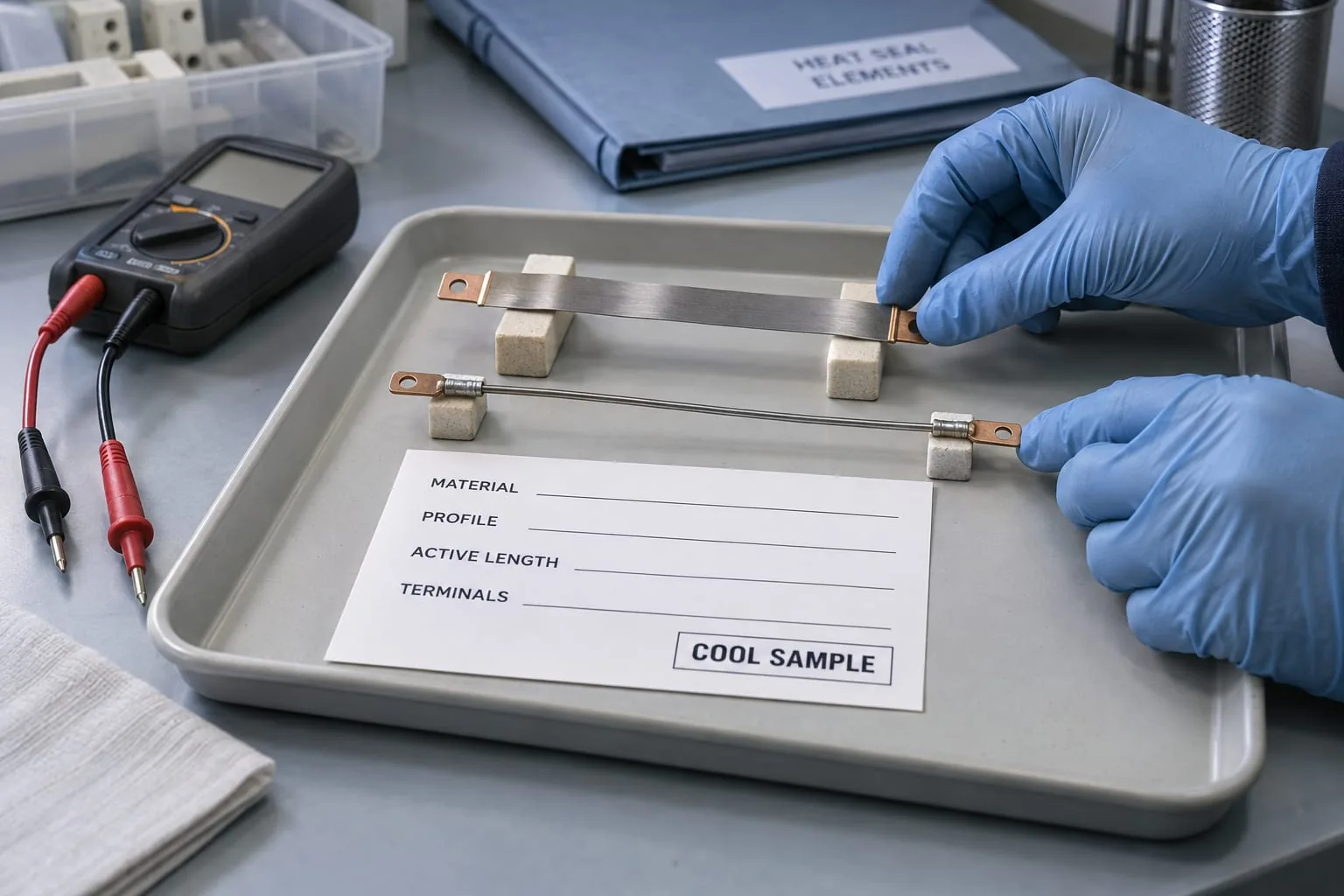
Use one evidence pack rather than sending an isolated length or a material name. Include:
- the machine make, model and sealing station;
- the application: impulse, bench, vacuum, VFFS or flow-wrap;
- the original element, if it can be retained safely;
- wire diameter, or ribbon width and thickness;
- active heated length, overall length and end allowances;
- terminal style, orientation, fixing centres and connection route;
- support, cover, tensioning and jaw or bar details;
- any documented voltage, power, resistance or original part reference;
- clear photographs of the installed path, removed part and both terminals.
Mark uncertain measurements as uncertain. A dimensioned drawing or a marked-up photograph is more useful than a precise-looking number that has no clear reference.
Measure only after safe isolation
Measurements must follow the site’s safe system of work. HSE maintenance guidance covers competent maintenance, isolation, lock-off where unexpected reconnection is possible, release of stored energy and cooling hot components.
Packaging equipment can combine moving, heated and guarded parts. HSE’s guidance on packaging machinery covers forming, filling, sealing and cutting equipment. Follow the machine maker’s instructions and do not treat an emergency stop alone as proof of safe isolation.
Match the component to the machine application
Impulse and bench sealers
An impulse or bench sealer may use a straight flat ribbon across a seal bar, with terminals and insulation arranged for that particular jaw. Check the seal length, active heated length, ribbon dimensions, end form and connection position. A similar-looking ribbon is not proof of compatibility.
For a non-standard impulse part, the custom impulse heat-seal elements service is the relevant product route. Send photographs of the seal bar, element path and both ends with the request.
Vacuum packers
Vacuum packers can use bar-mounted elements with defined terminals, supports and fixing points. Record the chamber or bar position, element form, active heated length, terminal arrangement and cover condition. If the old part is damaged, use the jaw or bar as supporting evidence and send the component record for review.
VFFS and flow-wrap equipment
VFFS and flow-wrap machines may use formed parts, paired jaws or continuous sealing components in longitudinal, transverse, fin or lap sealing stations. Identify the station and the path of the component through the assembly. Note whether the replacement is a flat element, wire, formed part or another confirmed component type.
The live packaging application solutions page provides application context. The machine model helps with identification, but the fitted component, dimensions and terminals still need to be checked.
When a custom element may be needed
A standard-looking wire or ribbon may not match a formed path, unusual terminal arrangement, non-standard active length or modified sealing assembly. A custom review is more appropriate when the original drawing is incomplete, the part has several bends, or the replacement must follow an existing support and connection route.
Send the old element where safe, a dimensioned sketch, clear end photographs and any available machine documentation. Ask for confirmation of the proposed profile, active length, terminals and electrical information before the part is made. Do not infer those details from a broad machine category.
How to send a compatible replacement request
Put the evidence into one request and identify what is known, measured and uncertain. A useful pack normally contains the machine and station details, application, component photographs, profile measurements, active length, terminal information, support and cover observations, and any verified electrical data.
If the element failed after a change to the jaw, cover, control settings or connection, record that event as context. The failure may need a wider assembly check rather than a direct material substitution.
For a replacement wire, ribbon or custom element review, contact Heat Seal Components with the evidence available. The team can confirm which details are needed before a compatible component is quoted and made.