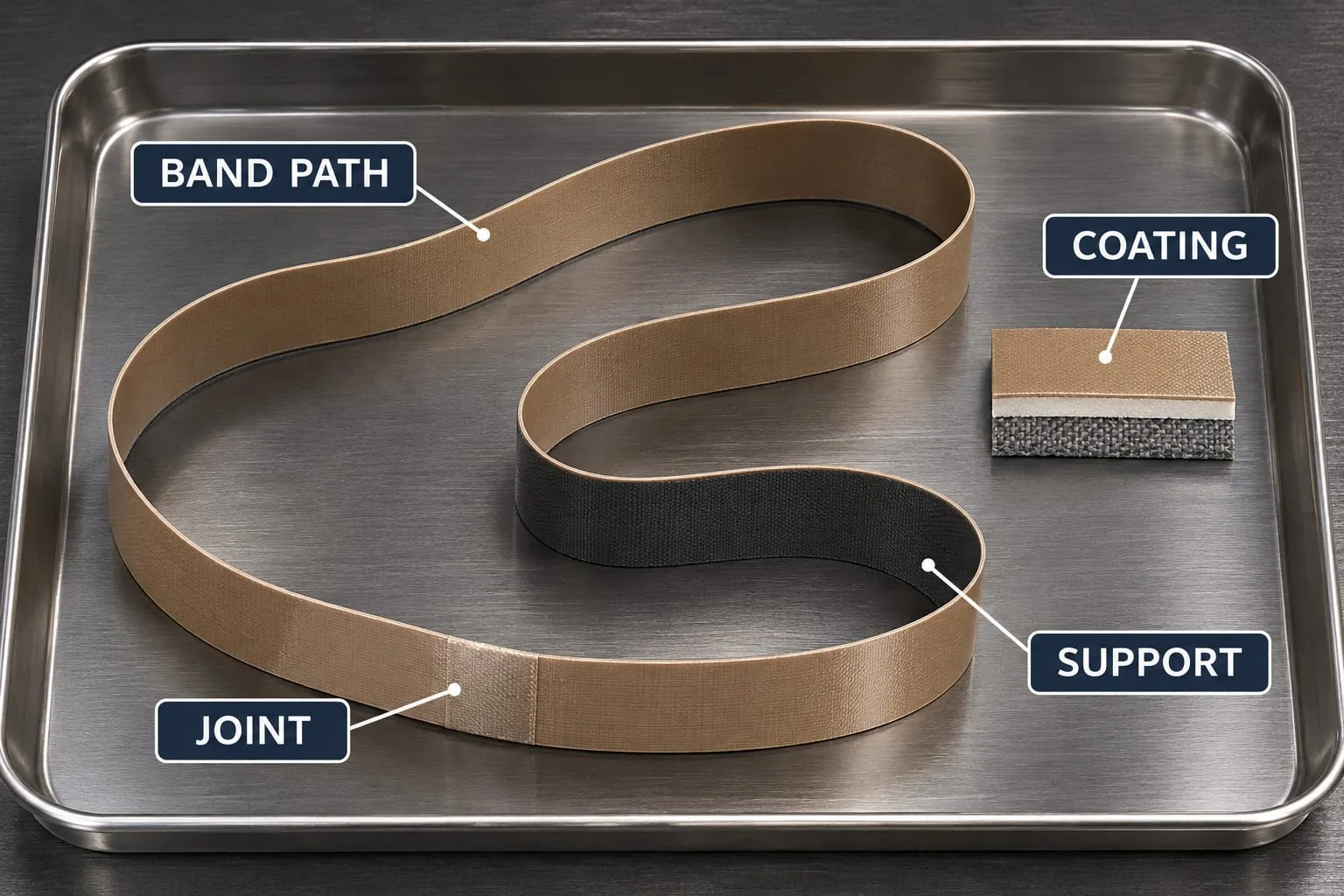
A PTFE-coated heat-seal band is a working part of the sealing interface, not simply a strip chosen because it looks similar to the old one. The coating can provide a release surface, while the band’s width, length, joint, edge finish, support path and relationship with the heated area determine whether it belongs in a particular packaging line.
This guide is for UK packaging engineers, maintenance technicians, production managers and procurement teams. It explains how to specify a PTFE-coated band without confusing it with PTFE tape, a drive belt or a complete sealing assembly. It does not prescribe one universal coating, temperature, tension or dimension for every machine.
What a PTFE-coated band does
PTFE is used as a release surface in food-processing belts and conveyors, and the same principle helps explain why PTFE-coated bands are used at some continuous sealing interfaces. Chemours describes PTFE-coated belts as providing a release surface for high-volume processing. That does not, by itself, identify the correct band for a specific sealer.
The band remains a mechanical and heated-interface component. It must travel through the intended path, meet the guide and support arrangement, and present the correct surface to the film or laminate. A coating choice cannot compensate for a wrong width, a damaged joint, an unsuitable support or a different sealing geometry.
Keep these parts separate during an enquiry:
- a PTFE-coated endless band or sealing belt that travels through the machine
- a PTFE strip or heat-seal tape that covers a sealing face or protects a separate element
- a drive or transport belt that moves the package or conveyor
- a heated element, sealing jaw or bar that provides the heat and pressure interface
If the part needs to be identified as an endless band, start with the endless heat-seal bands service. If the requirement is a surface cover rather than a moving band, use the PTFE coating service or the PTFE heat-seal tape service route instead.
Start with the machine and band path
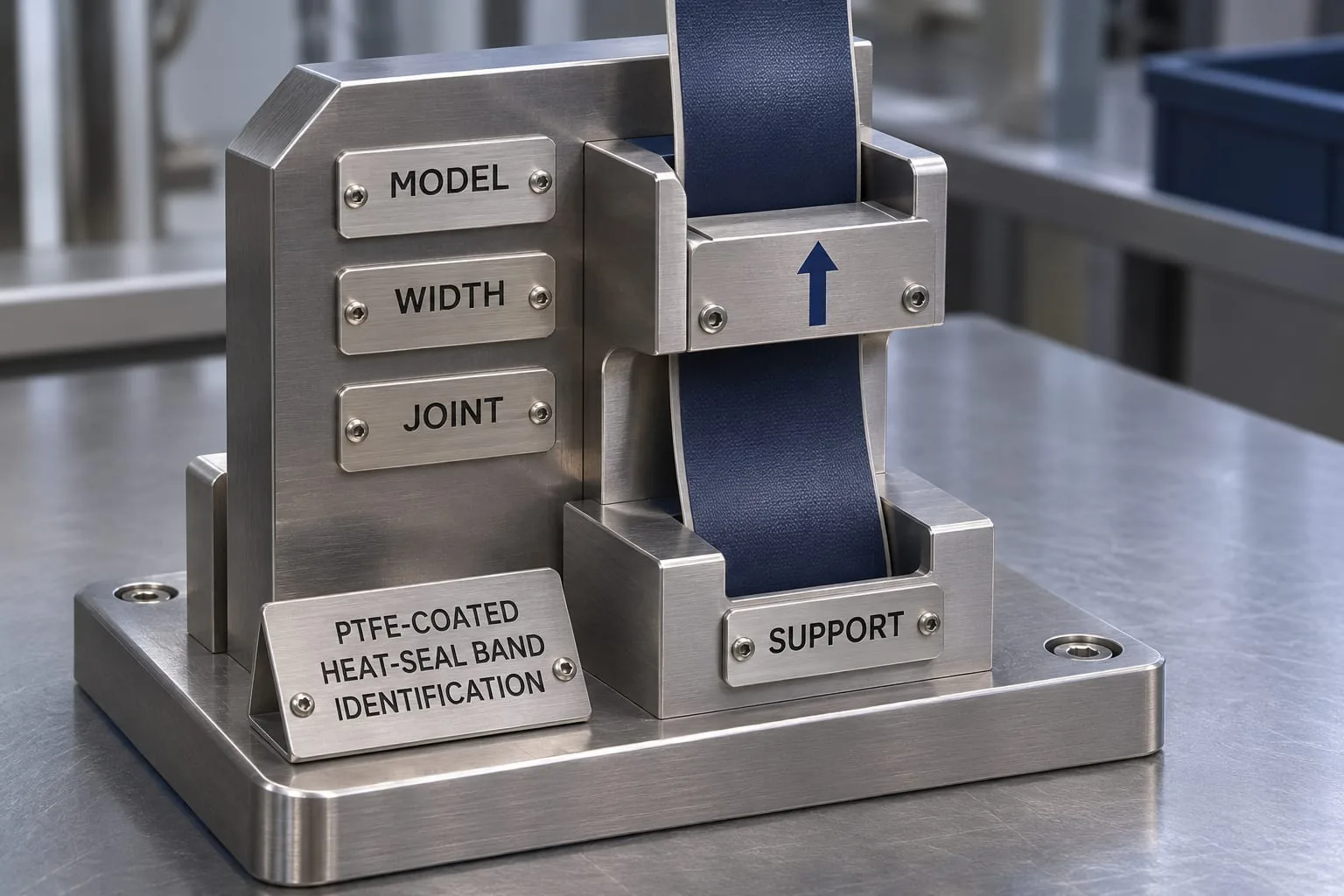
Record machine identity first
Write down the machine make, model, sealing station and whether the line is horizontal, vertical, intermittent or continuous. Keep the machine name separate from the component description. A band that fits one model may have a different width, joint, guide or support arrangement on another.
Audion’s D 545 AH product sheet is a useful example of why the machine context matters. It identifies a specific continuous sealer, a 10 mm seal, a stated film range and PTFE bands inside that model. Those figures describe that product; they are not a specification for every packaging line.
Capture photographs of the installed band, the machine identification plate and the surrounding sealing station. Include enough of the path to show where the band changes direction, where it is supported and where it meets the film.
Trace the complete contact path
Follow the band from its return route to the active sealing area. Note the guides, rollers, supports, cooling section, heated interface and any cover or guard that affects access. If the line uses separate transport and sealing belts, label them in the record so a procurement request does not merge two different parts.
The heat-seal elements service and sealing jaws and bars service pages are useful when the band works alongside a heated element, jaw or bar. The band should be assessed with the surrounding assembly rather than ordered from a photograph alone.
Separate band selection from coating selection
The coating is a surface property
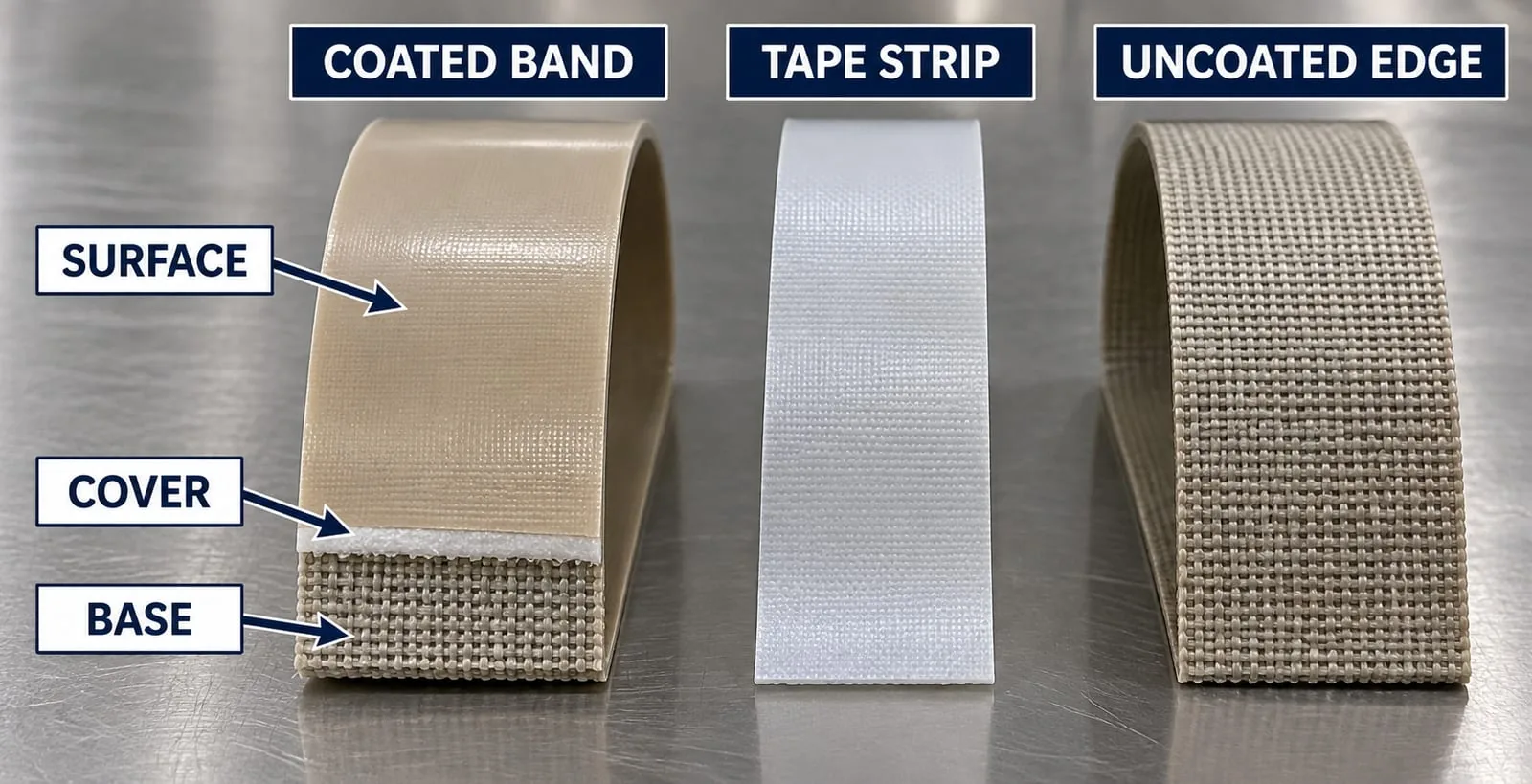
PTFE can help create a low-stick release surface, but “PTFE” is not a complete component specification. The coating may be on a moving band, a fixed cover, a sealing face or another industrial part. Ask what the coating is doing in the machine and which surface contacts the packaging material.
Chemours explains that PTFE-coated belts are used to create a release surface in food-processing applications. Audion’s spare-parts information also distinguishes PTFE rolls and strips from seal wires and identifies them for particular sealer families. Together, these examples show why the coating, base component and machine model should be recorded separately.
Do not substitute tape for a moving band
A strip of PTFE heat-seal tape may protect a sealing face, but it is not automatically a replacement for a PTFE-coated endless band. A tape route, adhesive backing, joint and wear pattern can be completely different from a band that runs through guides and around supports.
When a cover is worn, record its position and purpose. When a band is worn, record its path, dimensions and joint. When both are worn, treat them as related but separate lines in the enquiry.
Match dimensions and joining arrangement
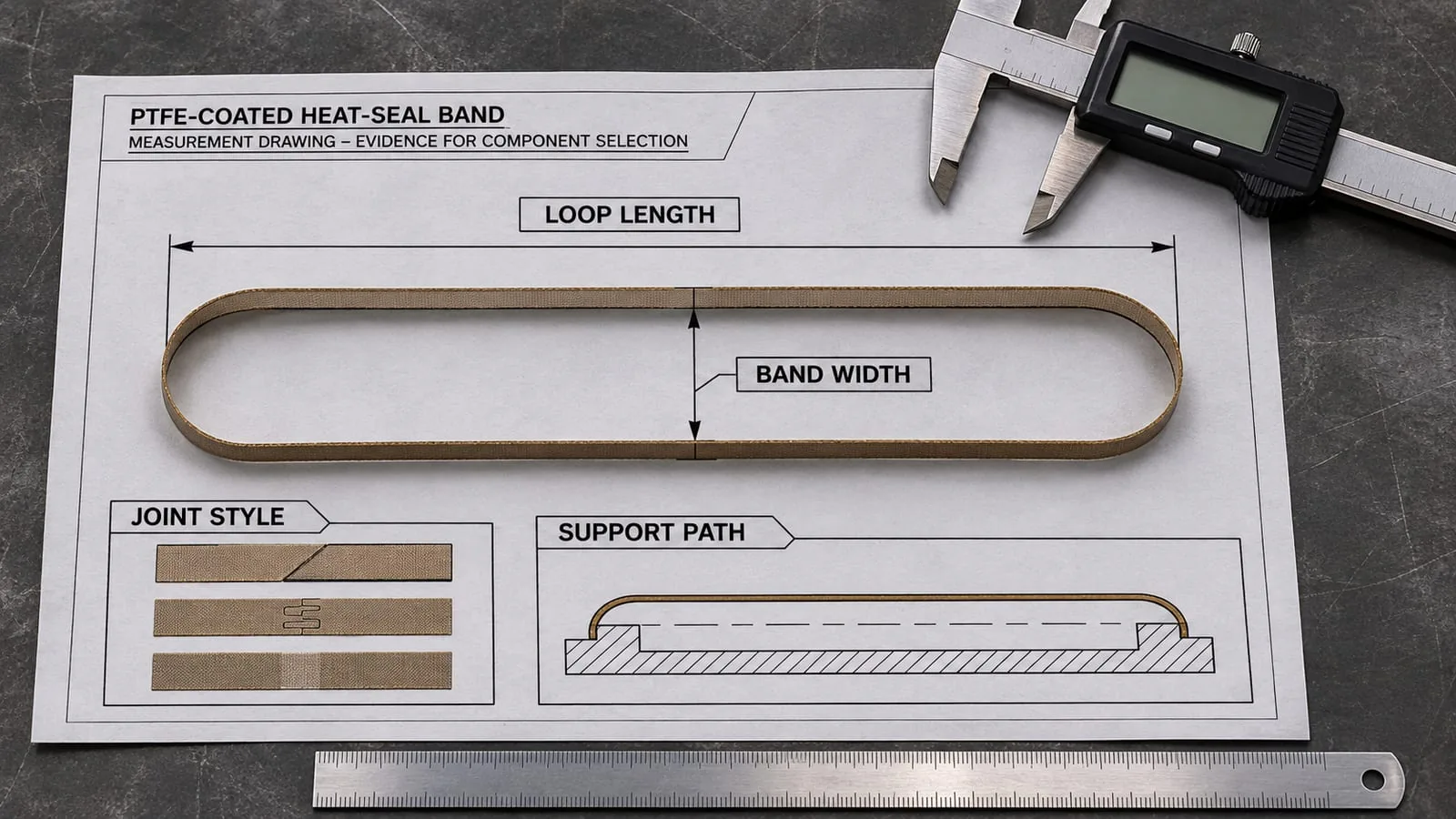
Measurements to capture
Use safe, repeatable measurements and identify how each value was taken. Depending on the machine, the useful information may include:
- visible band width and thickness, recorded in millimetres
- loop length or the installed route length, where it can be measured reliably
- joint or terminal style, including how it passes through the guide
- edge finish, perforation or profile details visible on the installed part
- guide, support and pulley dimensions that constrain the band path
- the active sealing width and the position of the band relative to the film
Do not turn a measurement from one machine into a standard catalogue value. Audion’s PTFE roll page lists different upper and lower strip sizes for named Magneta and Sealmaster models. That is useful evidence of model-specific selection, not a universal size recommendation.
Check the joint and edge condition
The joint can be the first part to catch, lift or mark the film. Inspect it only under the machine’s safe isolation and cooling procedure. The HSE maintenance guidance recommends planning maintenance, following manufacturer instructions and isolating energy before work; hot components must also be allowed to cool.
Record whether the band is continuous, joined, clipped, welded or otherwise terminated only when that is visibly confirmed. Note any raised edge, frayed base, local thinning or coating loss. If the joint cannot be identified clearly, send a close photograph and the machine details rather than guessing.
Check film, pressure, cooling and the sealing interface
The correct band depends on how the line uses it. Record the film or laminate family, the material thickness if known, the seal width, the pressure arrangement and whether the band passes through a cooled section. Do not assume that a band suitable for PE on one machine will behave identically on another line or with a different sealing interface.
Sealer Sales lists etched PTFE bands on a particular Emplex MPS6500 band-sealer specification. Audion’s D 545 AH sheet likewise describes PTFE bands, film types and seal dimensions for one named machine. These are helpful manufacturer or distributor examples, but neither should be copied as a universal component specification.
If the suspected fault is electrical or comes from a heated support, use the relevant heat-seal elements service or sealing jaws and bars service route. A PTFE-coated band cannot correct an incorrect element, uneven jaw, damaged support or cooling problem.
Build a procurement-ready specification
Before asking for a replacement or quotation, prepare a short evidence pack:
- machine make, model, station and line orientation
- photographs of the band, joint, guides, supports and active sealing area
- measured width, thickness and route or loop information in millimetres
- coating description and the surface that contacts the film
- joint, edge, terminal and profile details
- film or laminate type, seal width and the observed fault
- separate entries for the band, PTFE tape or cover, drive belt and heated component
The Heat Seal Services route can help organise a component enquiry, and you can contact Heat Seal Components with the machine details, photographs and safe measurements. A clear record reduces the risk of buying a visually similar band that cannot follow the machine’s path.