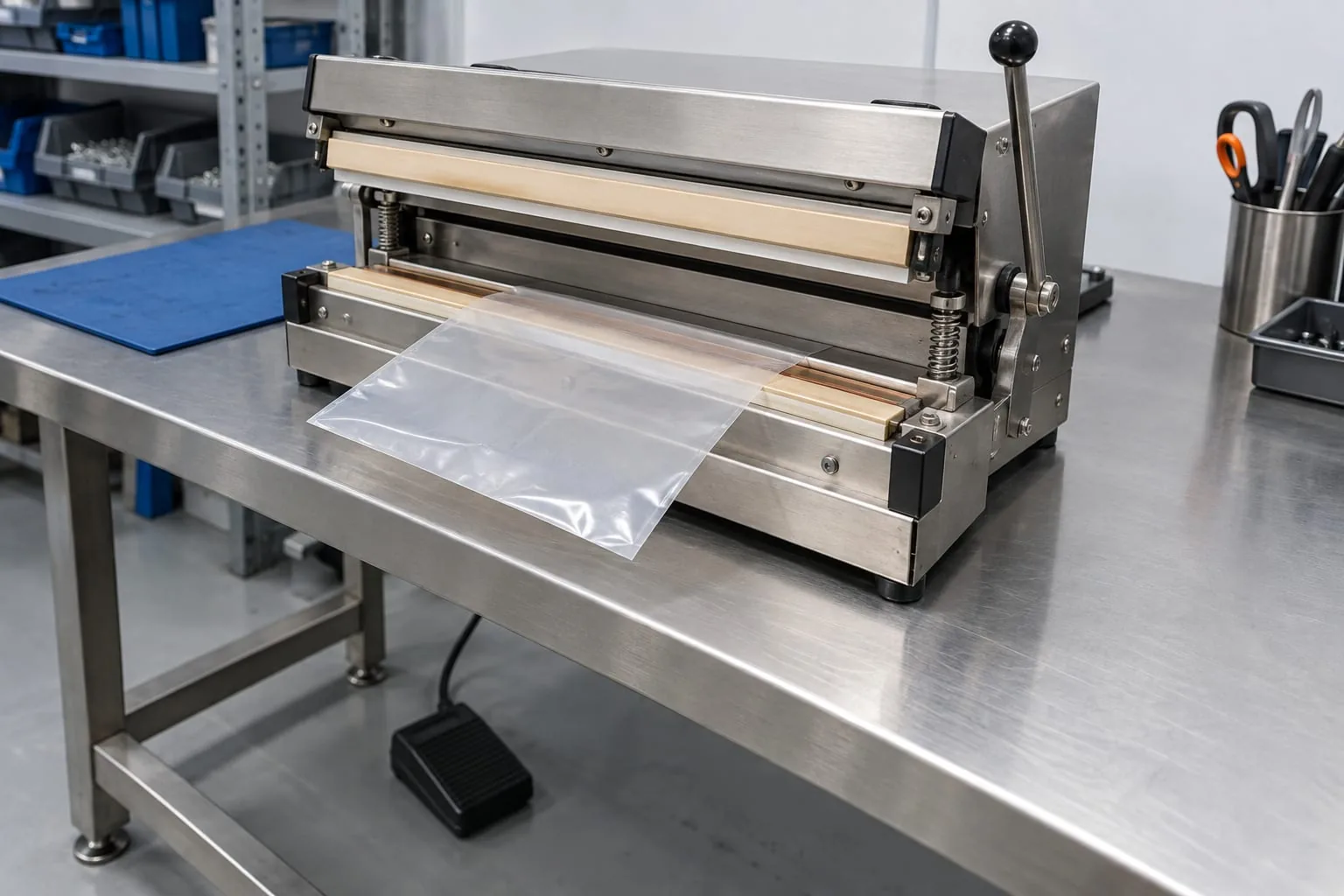
A semi automatic sealing machine is an application, not a replacement part specification. The sealing result still depends on the heating element, jaw face, cover material, pressure and the way the operator presents the pack.
That makes component selection a measurement task. A replacement that looks similar can still have the wrong seal length, terminal arrangement, mounting pattern or contact profile.
This guide is for UK packaging engineers, maintenance technicians, production managers and procurement teams. It treats the machine as the application context. Heat Seal Components supplies compatible heat-seal components and technical guidance, not complete sealing machines.
What semi automatic operation changes
Semi automatic equipment can reduce variation in a small-batch or repeat packaging process, but it does not remove the need for a controlled set-up.
Operator input still matters
Each cycle still depends on how the film or pouch is positioned, how the jaw closes and whether the material is held in the correct place until the seal has formed and cooled.
Use the same working method each time:
- Position the pack or film consistently against the intended stop.
- Keep the seal zone flat, clean and free from folds or product contamination.
- Use the same closing movement and hold time for each test sample.
- Record the material construction and the machine settings used for the sample.
The heat-seal path remains the control point
The machine name does not tell you which element, wire, jaw or cover is fitted. Treat the existing assembly as the reference. The heating path must transfer heat evenly, the contact faces must meet correctly and the covering material must prevent the film from sticking.
Components that affect the seal
Heating element or wire
Start with the part that creates the heat. Heat-seal elements and wires are made in different profiles, lengths and terminal arrangements. Use the existing part, the machine documentation and measured dimensions together. Heat Seal Components’ heat-seal elements service explains the type of component that may need to be matched.
Do not assume that a wire, ribbon or cartridge can be substituted because it has the same apparent length. Electrical connections, support points and the way the element sits against the jaw all affect fit and operation.
Jaw face, support and PTFE cover
The jaw face spreads pressure across the seal zone. Its profile, width, flatness and support arrangement must match the machine. A sealing jaw or bar may also need a PTFE cover or tape to keep the film from adhering during the cycle.
Inspect the face for scoring, distortion, loose fixings and worn covering. Heat Seal Components supplies sealing jaws and bars as well as PTFE heat-seal tape, so the right replacement route depends on whether the metal assembly, the cover, or both are worn.
Actuation and mounting
On a semi automatic unit, the lever, pedal, actuator or closing mechanism affects repeatability. It also affects how the upper and lower faces meet. A new element will not correct a jaw that is misaligned or unable to apply even contact.
For a non-standard impulse arrangement, record how the element is retained and connected before ordering. Custom impulse heat-seal elements may be appropriate when the original part cannot be identified from a standard catalogue description.
Record the part data before you order
Capture evidence from the installed assembly while it is still possible to compare the old and new parts. The exact machine model is useful, but it is not enough on its own.
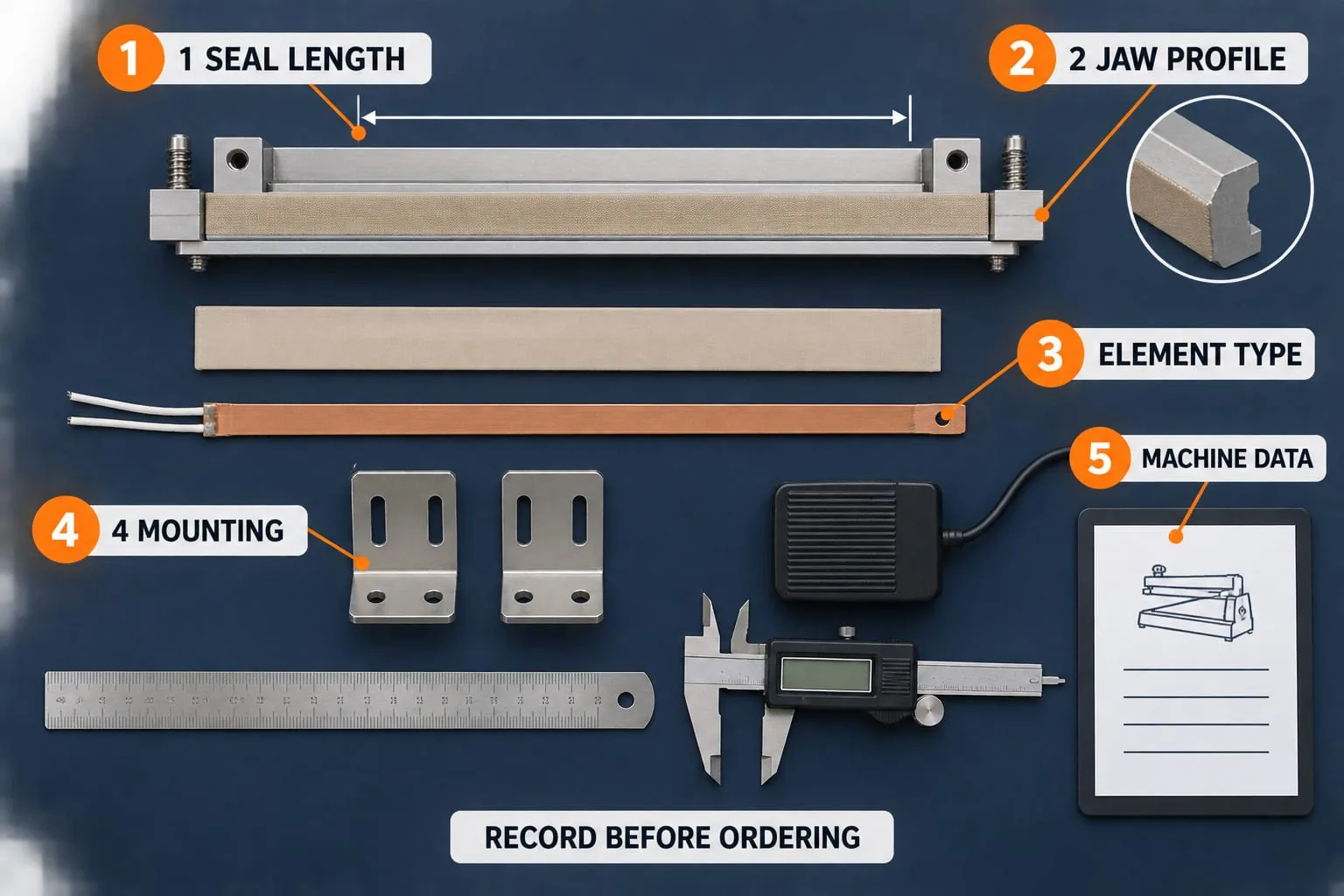
Capture these details from the existing assembly
- Record the machine maker, model, serial information and the sealing application.
- Measure the usable seal length and the width of the seal face in millimetres.
- Describe the jaw profile, support strip, cover and any visible wear.
- Record the element type, terminal style, fixing points and cable route.
- Photograph the mounting pattern and note which side of the assembly each part occupies.
Use evidence, not a guessed equivalent
Keep the old part until the replacement has been checked. Compare the new component against the recorded dimensions and mounting details before it is fitted. If one measurement is unclear, ask for a technical review rather than treating a close-looking part as compatible.
Set the process around the packaging material
A replacement component must work with the material being sealed. DuPont’s heat-sealing guidance explains that dwell time, sealing temperature, sealing pressure, sealant characteristics and the test method all affect seal strength.
Treat time, temperature and pressure as linked
The settings interact. Changing one variable may require a change to another, and a control value is not always the same as the condition at the actual seal interface. Do not copy a setting from a different film, laminate or jaw arrangement.
Start with the material supplier’s information and the machine manufacturer’s instructions. Establish a controlled starting point, then adjust one variable at a time while keeping the sample material and presentation method consistent.
Check contact, cooling and alignment
A clean, flat and correctly aligned contact face helps the material receive even heat and pressure. Look for cold spots, sticking, uneven seal transfer or a seam that changes width from one end to the other. Allow the seal to cool in the same way for every comparison.
Maintenance and safe intervention
Maintenance should cover both the consumable parts and the conditions that make the machine safe to open. HSE guidance says work equipment should be maintained in good repair, maintenance should be planned, and work should be carried out safely by competent people.
Inspect the contact surfaces
With the machine in its safe state, remove residue using the method in the equipment instructions. Check the PTFE cover, element, jaw face, terminals, springs, stops and fixings. Replace a cover or element when wear changes the contact or seal path, not only after a complete failure.
Isolate before opening the machine
Switch off, isolate the electrical supply and prevent unexpected start-up before intrusive maintenance. Release stored energy where it applies and allow hot components to cool. HSE’s maintenance guidance also stresses locking off where power could be restored accidentally.
Keep a simple change record
Note the date, component identity, measured dimensions, reason for replacement, material tested and the result of the first controlled samples. A short record helps the next technician see whether a fault follows the part, the material or the machine set-up.
Check the seal after a component change
Do not release a replacement part to routine production from a visual guess. Run a controlled sample with the same material, orientation and operating method used for the intended process.
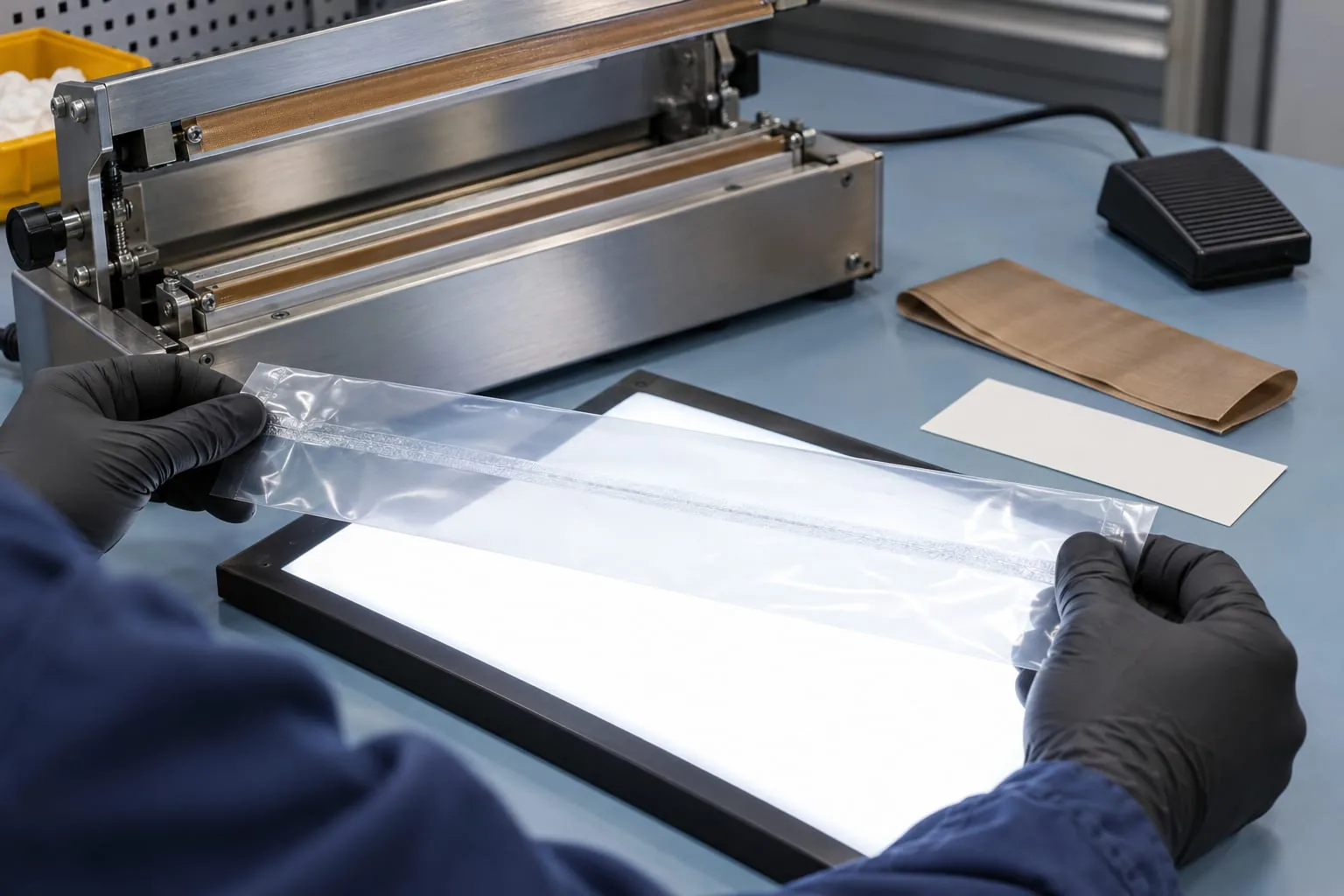
Use a controlled sample
Check that the new part is seated correctly, the cover is smooth and the jaw closes along the intended seal zone. Produce enough samples to compare the beginning, middle and end of the seal rather than judging one isolated point.
Check appearance, continuity and repeatability
Look for a continuous seal line, even contact, clean separation where a peelable pack is intended, and the absence of wrinkles, burn-through or unsealed gaps. If the result changes between otherwise comparable cycles, stop and investigate alignment, pressure, dwell or material presentation before ordering another part.
A PAC Machinery bag-sealer datasheet shows why model, seal length, jaw choice, element type and cycle controls belong in the compatibility record. Treat manufacturer data as equipment-specific evidence, not as a universal setting for every semi automatic machine.
When to ask for a replacement component
Escalate the part enquiry when:
- The element is open circuit, visibly damaged or no longer supported correctly.
- The PTFE cover is worn, contaminated or no longer protects the sealing face.
- The jaw does not meet evenly, the seal width changes, or the machine has visible mechanical damage.
- The part label is missing, the measurements conflict, or the original supplier information is unavailable.
Choose compatible parts with Heat Seal Components
Heat Seal Components can review replacement heat-seal elements, wires, PTFE cover tape, heating elements, sealing jaws and bars against the information you provide. Send the machine model, clear photographs, measured seal length, jaw profile, terminal details and any existing part reference through the contact page.
For an unusual element or a non-standard closing arrangement, use the service information for custom impulse heat-seal elements before you order. A short technical enquiry is safer than fitting an unverified substitute.
Contact Heat Seal Components with the recorded dimensions and photographs so the replacement route can be checked against the actual machine application.