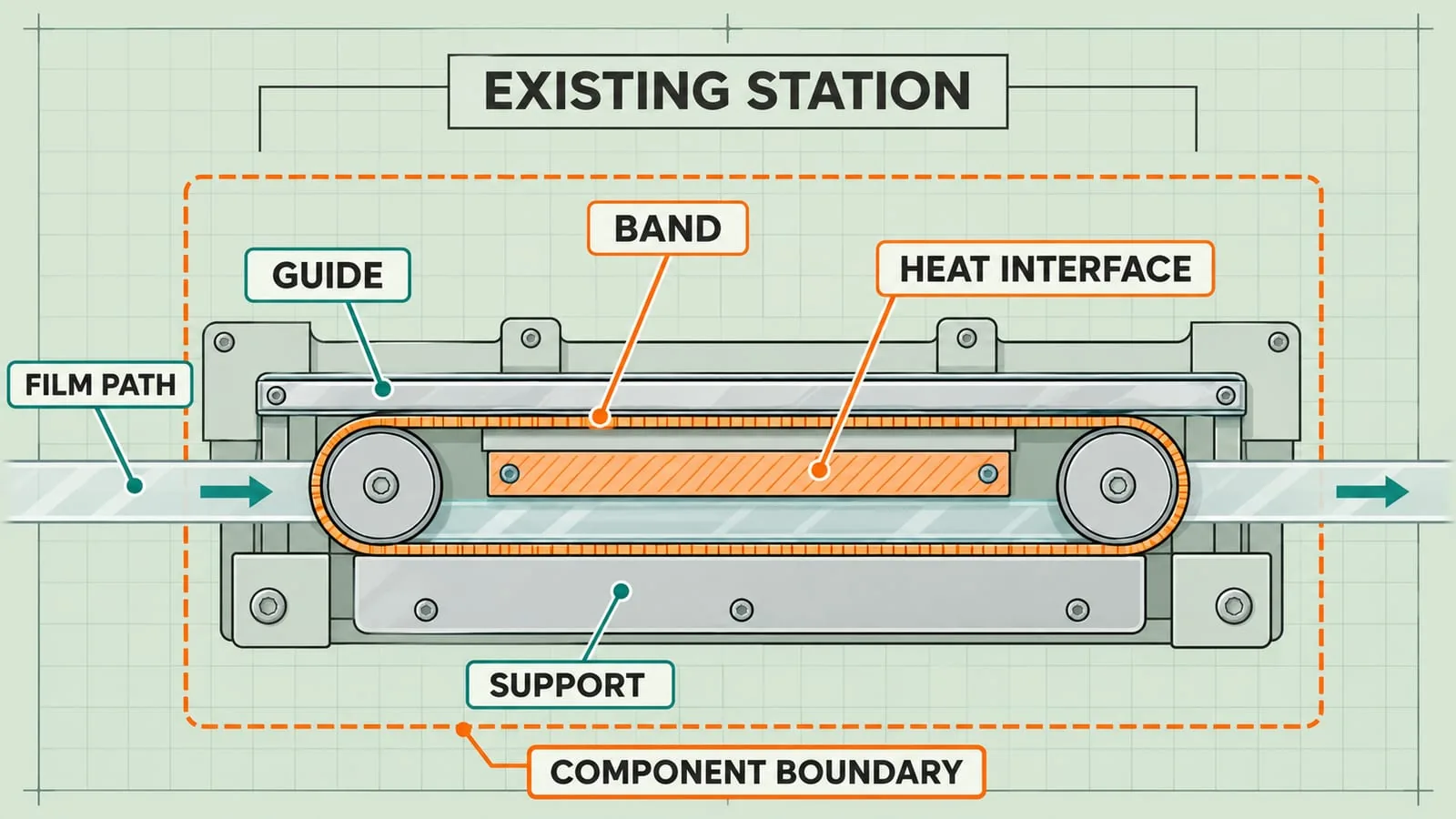
The phrase “shrink band sealer” can describe a complete equipment arrangement, but it does not identify the replacement part inside that arrangement. A maintenance or procurement request still needs to show the fitted band, guide, heat interface, support and connection details.
This guide is for teams inspecting an existing line or preparing a component enquiry. Heat Seal Components does not supply complete shrink equipment, bags or shrink film. Its confirmed offer is component-led: heat-seal elements and wires, endless bands, custom impulse elements, PTFE coating and heat-seal tape, sealing jaws and bars, and compatibility guidance for relevant packaging equipment.
What the machine term tells you
Treat the search term as context
“Shrink” can refer to the packaging process or material used elsewhere in a line. “Band sealer” can refer to the moving sealing arrangement that closes or seals a pack. Neither word, on its own, identifies the band profile, guide geometry, heating method, support surface or connection.
Begin with the equipment maker, model, serial or asset reference. Record which station is being inspected and whether the request concerns an endless band, a heat-seal element, a coated contact surface, a jaw or another fitted part. If the line has several similar stations, label each photograph.
The reference helps put an enquiry in context for the heat-seal bands service, but it is not a substitute for component evidence. Similar equipment names can hide different interfaces.
Separate the sealing station from the rest of the line
Identify where the material enters the sealing zone, which parts guide it, and where the sealed pack leaves. A nearby conveyor, film guide, coding unit or guard may be important to the machine but may not be the component making the seal.
Use one overall photograph and one close photograph of the sealing station. Add arrows or a simple station label only after the equipment has been made safe under the site’s procedure. Do not remove a guard just to obtain a better photograph.
Map the film and band path
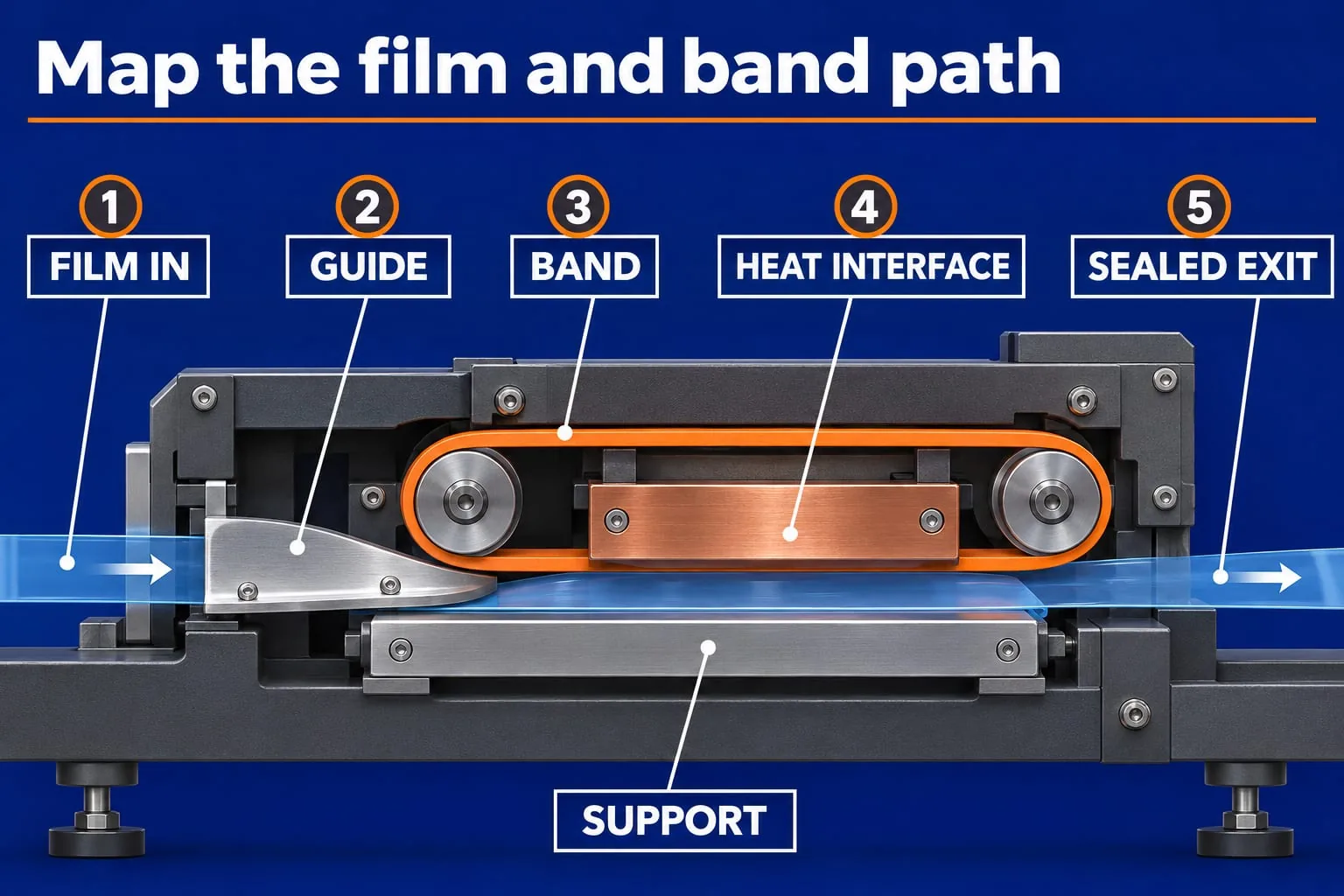 Describe the path from the material route outward. Mark the film or pack path first, then identify the band, guide faces, heat interface, support and exit point. The purpose is to distinguish the active sealing components from transport, guarding and adjacent equipment.
Follow the band through the station
Record every visible change in direction and every part that keeps the band in position. Depending on the fitted design, that may include rollers, guide faces, retaining features, tensioning arrangements or an endless loop. Do not assume that a band visible near the product path is a heat-seal band until its function is confirmed.
If part of the route is hidden, record it as hidden. A photograph from a second safe viewpoint may show the route more clearly, but an unknown section should stay marked as unknown rather than being filled with a typical value.
Mark the contact and support surfaces
Identify the surface that transfers heat and the surface that supports the material or band. They may be separate parts, and the contact face may use a protective treatment. Where the fitted design calls for it, PTFE coating or PTFE heat-seal tape may form part of the component discussion. The required treatment must be confirmed from the assembly and operating conditions.
Do not infer a temperature, pressure, dwell time or line speed from the equipment name. Record only values confirmed by the machine documentation or site process, and show the source of each value.
Build a compatibility record
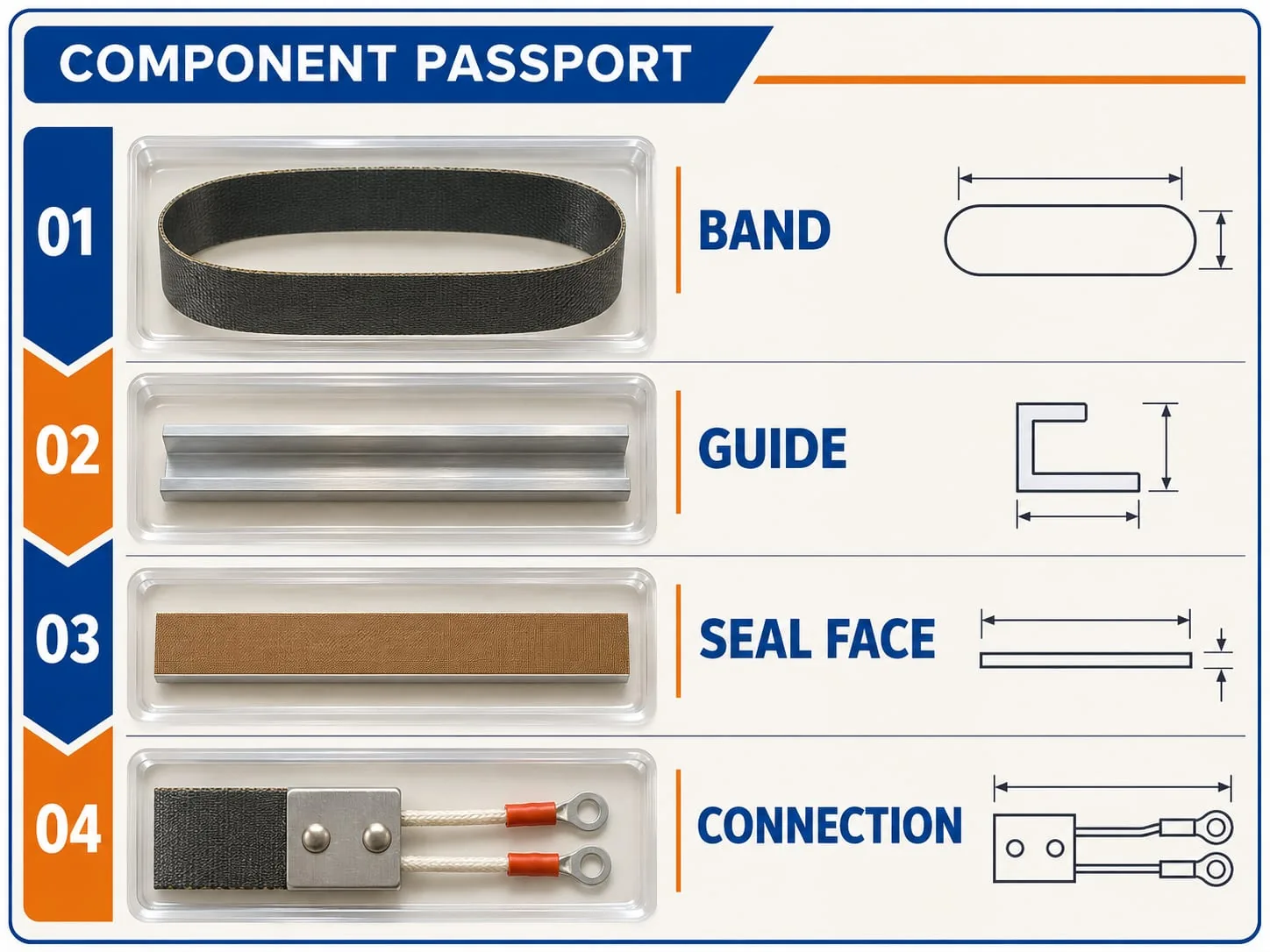 An organised compatibility record reduces back-and-forth during a technical enquiry. Keep the maker’s plate, station photographs, measurements, removed-part reference and any drawing together under one temporary part name when a readable part number is unavailable.
Photograph the part in context
Take an overall image of the equipment, an image of the sealing station and close views of the band edge, guide, heat interface, connection and retaining features. Use a consistent orientation where possible. Include a scale only when it does not hide the edge or terminal that needs to be identified.
If a part has been removed, label which side faced the product or film path and which side faced the guide or support. Keep terminals, fasteners, cover pieces and protective layers with the component until its identity is clear. A damaged part can still show a useful profile or connection arrangement.
Record measurements in millimetres
Use metric units and state what every measurement means. Depending on the component, a useful record may include:
- band width, thickness and visible loop or run dimensions;
- guide length, width, profile and mounting-hole positions;
- heat-interface length and retaining-feature positions;
- lead exit, terminal type and connection orientation; and
- clearances to adjacent supports, guards or covers.
Never replace an absent measurement with a typical value. If the installed part cannot be measured safely, mark the value as unknown and provide a clear photograph or removed-part reference.
Keep the part category honest
The evidence may point to heat-seal elements, an endless band, a coated contact surface or sealing jaws and bars. These categories are not interchangeable. A nearby shrink-film handling item does not become a heat-seal component merely because it sits on the same line.
Choose the component route before ordering
Match the part to the fitted application
Compatibility combines machine context with the physical and electrical evidence. Send the supplier the equipment maker and model, station position, band route, product or film path, measured features, connection details and photographs. Include process information only where it is already confirmed by the machine documentation.
Heat-seal components can be used in different packaging arrangements, including impulse sealing, vacuum packing, VFFS and flow-wrap equipment. That does not make parts interchangeable. A band, element, tape or jaw should be assessed against the actual route and contact arrangement rather than a broad label.
Where a made-to-fit component is required, custom heat-seal element support is most useful when the enquiry includes a drawing, sample or complete measurement set. Heat Seal Components supplies components and compatibility guidance; it does not supply a complete shrink band sealer.
Check the protective layer separately
If the sealing face uses PTFE, record whether the requirement is a coating applied to a component or PTFE heat-seal tape used as a replaceable layer. Note where the layer sits, what it contacts and whether the existing assembly identifies a thickness or fixing method. Do not substitute raw PTFE or a generic tape without evidence that the fitted design calls for it.
Plan inspection and maintenance
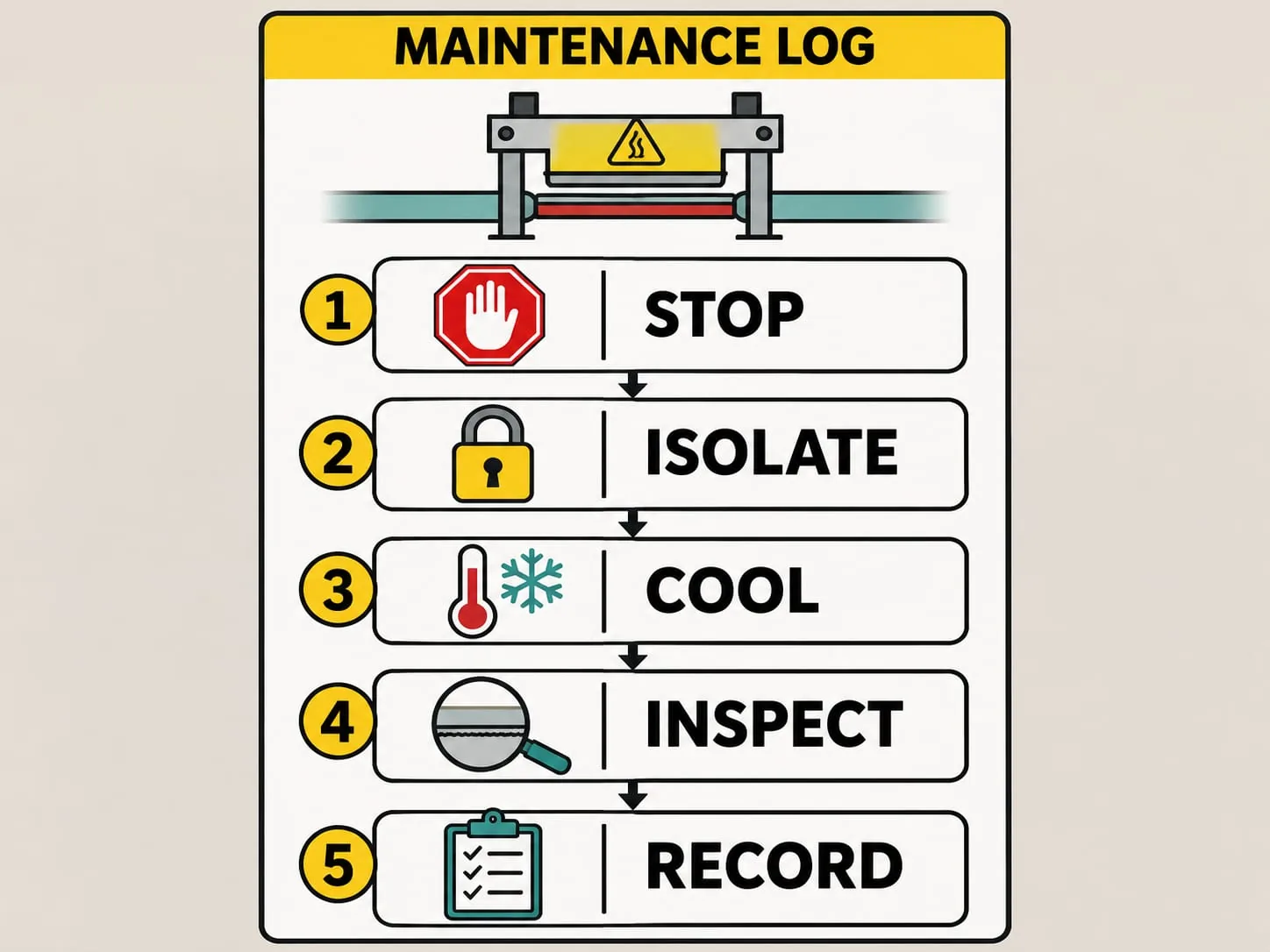 Maintenance records should relate to the actual equipment and the risks present on site. HSE guidance on packaging machinery highlights trapping points, guarding and the need for safe systems during cleaning, maintenance and blockage clearing.
Stop, isolate and allow cooling
Before touching a band, guide or heat interface, follow the site’s procedure for stopping and isolating the equipment. Consider electrical, pneumatic, hydraulic and other energy sources that could start movement or cycle the station. Prevent inadvertent reconnection where the procedure requires it, release stored energy, and allow hot components to cool.
HSE’s maintenance guidance says maintenance should be planned and carried out by competent people, with moving plant isolated or locked and hot components given time to cool. This article does not replace the manufacturer’s instructions, site risk assessment or safe system of work.
Record condition without diagnosing the cause
Describe what is visible: fraying, a polished contact area, contamination, a damaged cover, loose fasteners, a displaced guide or a change in edge shape. Record the location and photograph the observation. Do not turn an observation into a fault diagnosis unless a competent person has investigated it.
HSE advises that inspection should reflect risk assessment, manufacturer’s recommendations and the conditions in which the equipment is used. Its inspection guidance also explains that inspection records should be retained where inspection is required. A component note can support this process, but it is not a replacement for the site’s maintenance system.
When component support is appropriate
Send evidence, not just a machine name
A clear sample, drawing or complete measurement set is valuable when a component has no readable part number. Include the interfaces that must remain unchanged: guide contact, mounting face, retaining method, electrical connection and protective layer. If the band is part of a matched assembly, identify the companion parts rather than sending an isolated description.
The confirmed offer covers heat-seal elements and wires, endless bands, custom impulse elements, PTFE coating and heat-seal tape, sealing jaws and bars, and compatibility guidance for relevant packaging equipment. The evidence determines whether a specific request fits that offer.
Keep a repeatable procurement record
Save the final photographs, measurements, equipment reference, station label and supplier correspondence under one part reference. When a repeat order is needed, compare the new requirement with the same evidence rather than recreating the specification from memory. If the line or packaging material changes, update the record before reordering.
For a component review, contact Heat Seal Components with the machine reference, sealing-station photographs, measurements and any available drawing or sample. Clear evidence makes it easier to distinguish a band requirement from a different heating element, tape, jaw or guide requirement.