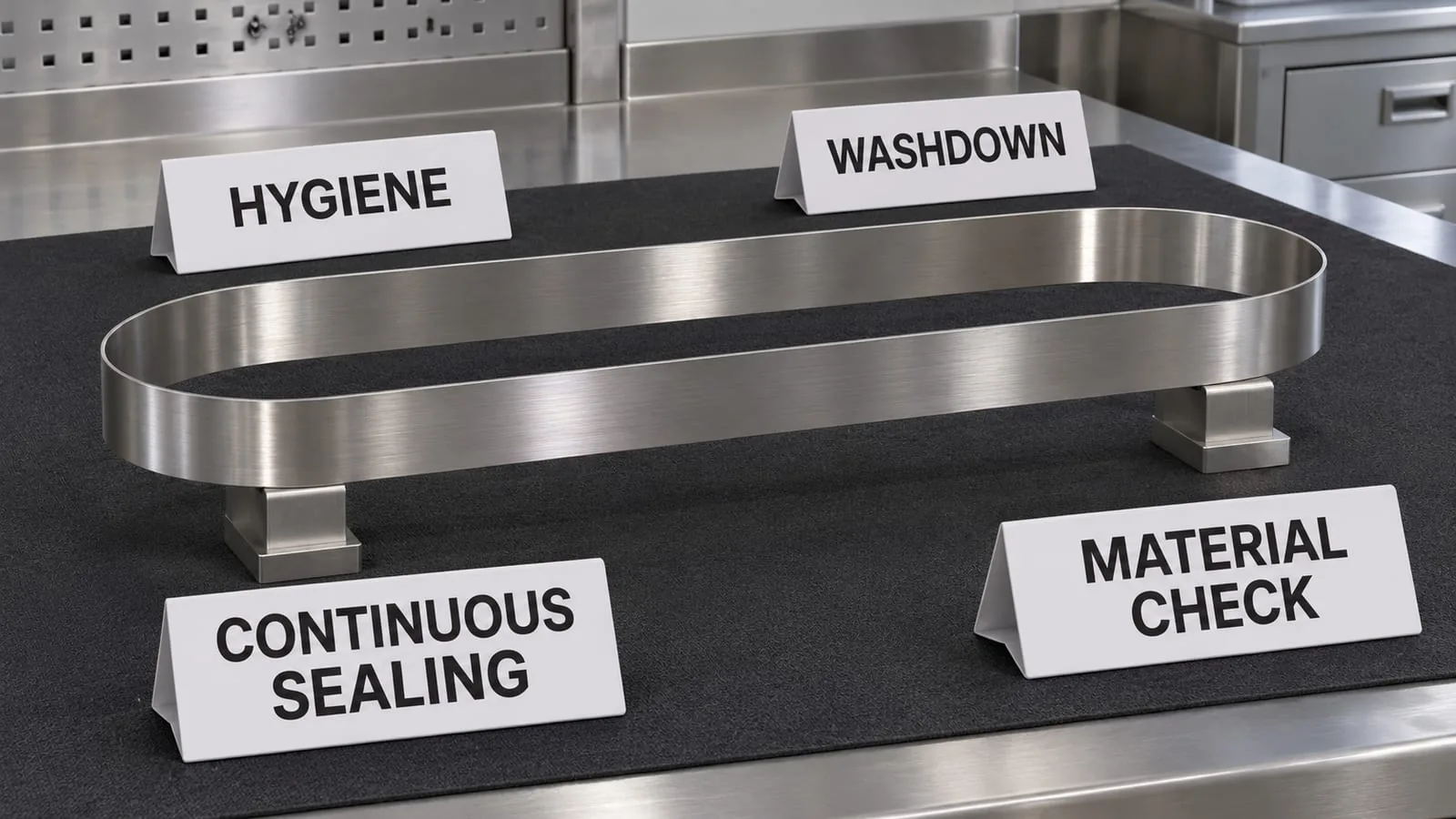
Stainless steel can be a practical material choice for an endless heat-seal band when the sealing assembly needs a cleanable, corrosion-resistant band surface and the process has been specified correctly. The material name alone is not enough. The band still has to match the sealing path, heating arrangement, cover system, supports, tension and the material being sealed.
This guide is for UK packaging engineers, maintenance technicians, production managers and procurement teams comparing stainless-steel heat-seal band applications. It explains where the material may be relevant, which evidence to collect before ordering and how to keep the band, cover and sealing interface working as one component system. It does not assign a universal grade, dimension or replacement interval: those details depend on the application and equipment documentation.
Start with the band application, not the material label
An endless heat-seal band is part of a continuous sealing assembly. It travels through a defined path, meets the packaging material at the active zone and then returns through guides, supports and any cooling or release arrangement. A stainless-steel band may be relevant to that assembly, but it is not a drop-in substitute simply because it has the same apparent width.
The material, cross-section, loop geometry, joint, terminal arrangement, cover and support all affect the result. So do the process conditions: film construction, contamination, pressure, contact time, temperature control, line speed and the amount of cleaning or moisture around the equipment. Treat the application as a component-compatibility question rather than a search for a generic “stainless band”.
Prewa’s heat-sealing catalogue lists stainless-steel endless belts alongside impulse bands, PTFE products and other heat-sealing parts. That is useful evidence that stainless endless belts are an established component category, but it does not prove that every stainless grade or belt profile suits every machine. Use the supplier’s technical information and the equipment maker’s instructions as the controlling references.
Where stainless-steel bands may be useful
Hygiene-sensitive packaging areas
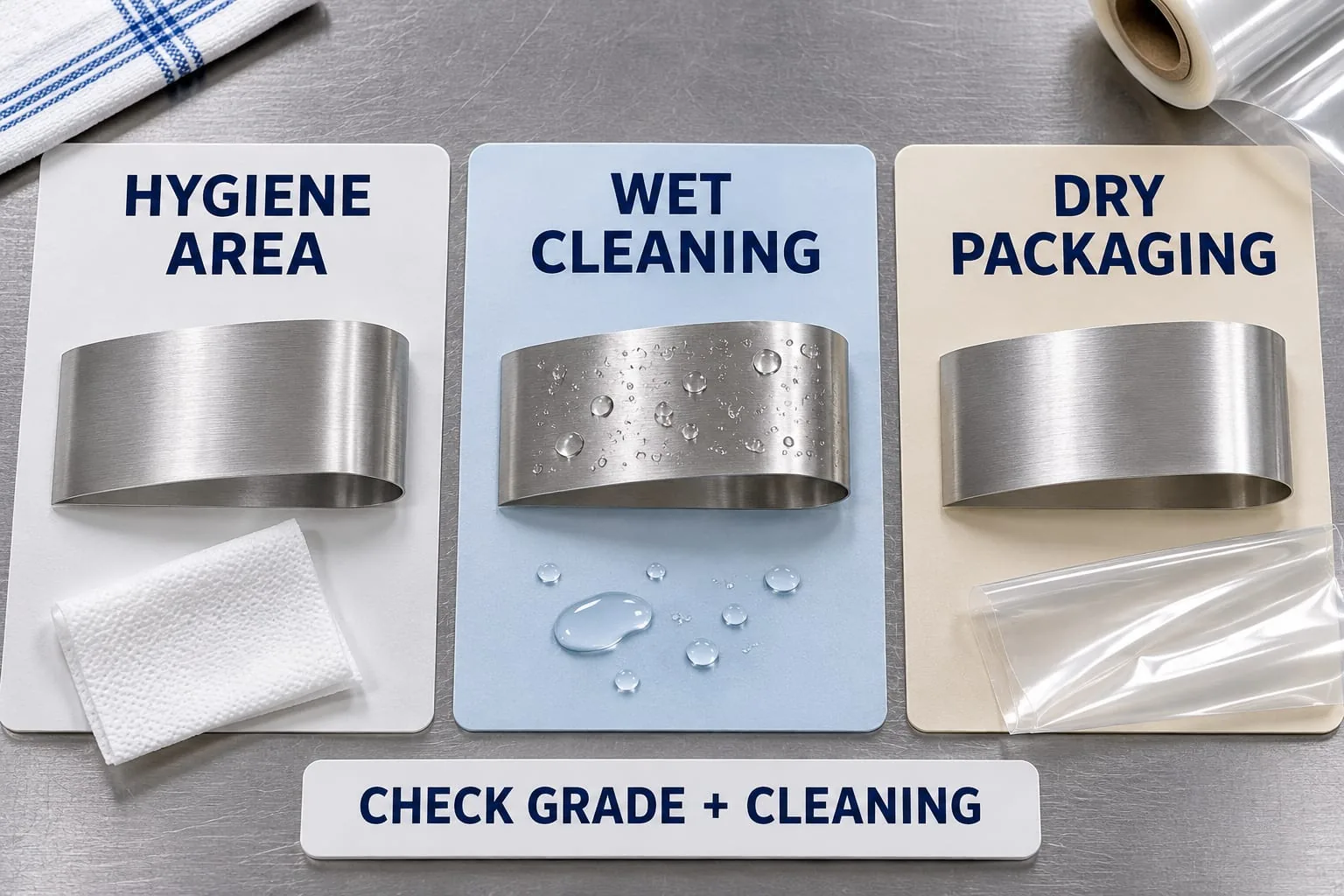
Stainless steel is widely used in food and beverage processing because the correct grade and surface condition can support cleaning and corrosion resistance. The British Stainless Steel Association guidance on food processing explains that 304 and 316 types are common in food-processing equipment, while also stressing that grade selection depends on the application.
For a heat-seal band, that means asking what the band will contact, how it will be cleaned and whether the band is inside or outside the product-contact boundary. Do not describe a band as “food grade” from the word stainless alone. Confirm the material, finish, cover and cleaning requirements for the actual assembly.
Moisture, cleaning and corrosive exposure
Frequent cleaning, condensation, salt, acidic residues or chemical exposure can change the material decision. Stainless steel is corrosion-resistant, not corrosion-proof. The BSSA’s corrosion guidance notes that localised forms of attack can occur and that each grade responds slightly differently to a corrosive environment. A band that looks suitable in a dry packaging area may need a different review in a wet or chemically aggressive environment.
Where cleaning is part of the operating routine, record the agents, concentration, temperature, contact time and rinsing method. Avoid assuming that a familiar disinfectant is harmless to every stainless grade. The material choice, surface condition and cleaning method should be reviewed together.
Clean component identification during procurement
Stainless-steel band enquiries are easier to validate when procurement records the component route clearly. Include the machine manufacturer and model if known, the sealing station, the band path, the packaging material, the operating environment and photographs of the installed assembly. If the band is only one part of a wider sealing head, identify the cover, backing, jaw or bar and guide arrangement as well.
Match the band to the sealing process
Continuous band sealing paths
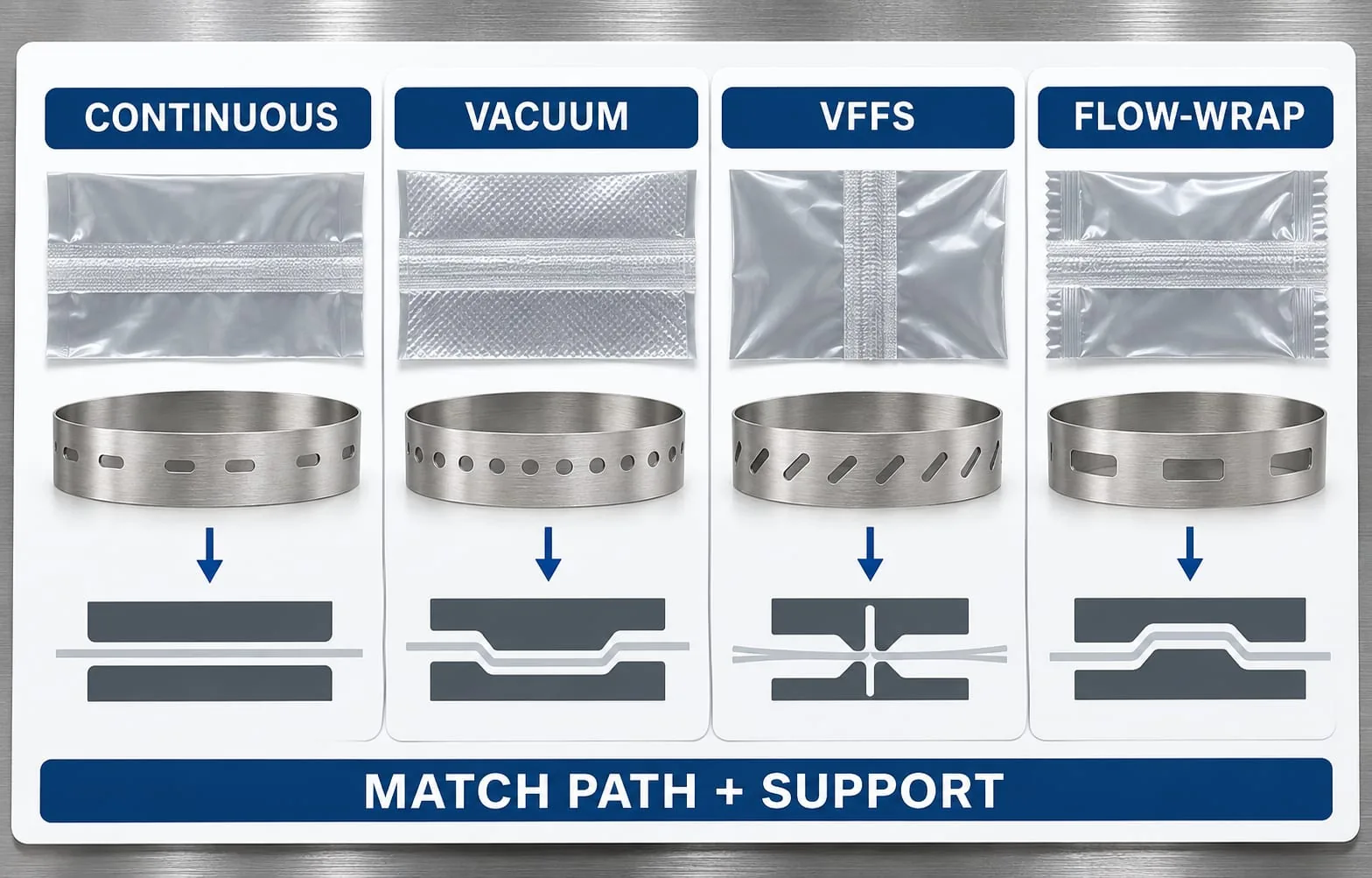
Continuous band equipment uses a moving band and a repeatable sealing interface. The important questions are not only the band’s material and width, but also how it is driven or guided, how the active zone is heated, how the band is insulated and how the package is released. A replacement must follow the established path without rubbing, twisting or changing the supported contact area.
Check whether the existing band is endless, joined, coated or covered. Record the joint position and the way the band is tensioned. If the replacement changes the joint, thickness or stiffness, the guides and cover may need a documented compatibility review before the part is ordered.
Vacuum, VFFS and flow-wrap applications
Vacuum packers, VFFS lines and flow-wrap equipment can use different sealing stations and component geometries. A band that is suitable for one station may not suit another, even on equipment from the same manufacturer. Identify whether the band contributes to a longitudinal, transverse, fin or lap seal, and record the direction of travel and the package presentation.
The site should confirm the approved temperature, pressure, contact time and speed range. Do not increase a setting to compensate for a band that is too thin, incorrectly supported or poorly tracked. If the application is uncertain, the Heat Seal Elements service and heat-seal bands service are the relevant component routes for a compatibility enquiry.
Specify geometry and material together
Material grade and surface condition
“Stainless steel” is a family of materials, not one complete specification. The BSSA explains that corrosion resistance varies between grades and that surface finish and condition affect performance. Its general corrosion guidance also warns that stainless is not immune to every environment.
Ask the supplier to confirm the material designation, surface condition and any relevant forming or joining details. If the original documentation is missing, do not invent a grade from colour or appearance. Provide a sample, drawing or clear photographs and state the cleaning chemicals, moisture, salts and temperature that the band will see.
Width, thickness, loop and joint
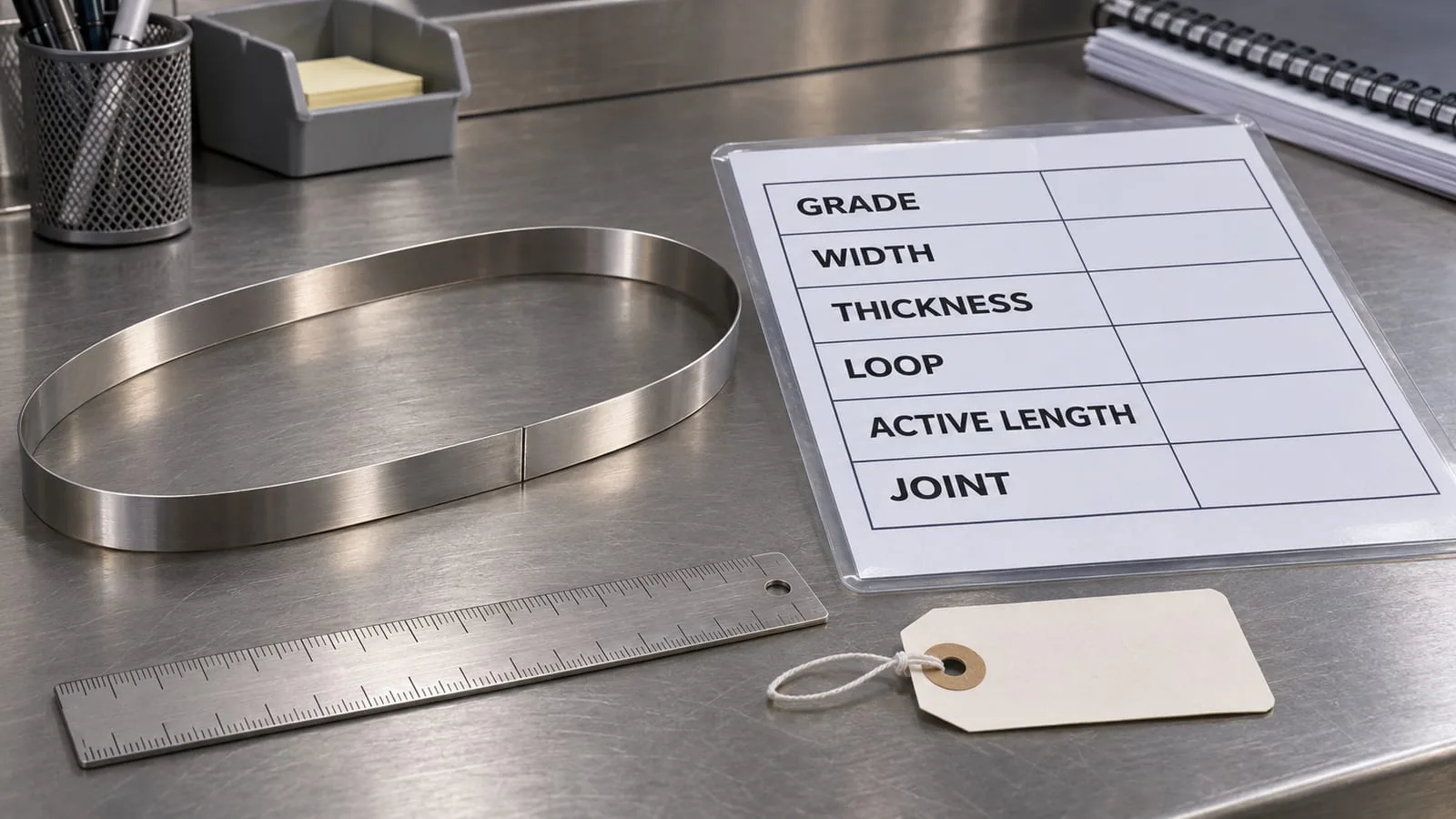
Measure the existing band in millimetres while it is cool, isolated and supported. Record the working width, thickness, total loop length, active sealing length, joint or weld detail, terminal features, holes, clips, tensioning method and any formed sections. Photograph the band in position before removal so the orientation and route are not lost.
Measure the support and cover as well as the band. A small change in thickness can alter the contact height, cover compression, tension or electrical behaviour. A replacement that fits the loop but changes the sealing plane is not a confirmed match.
Electrical and thermal information
If the band is a heated resistance component, record the available resistance, supply information, controller settings and any approved test conditions. Do not assume that two bands with the same dimensions have the same electrical behaviour. The machine documentation or a competent technical review should control the final electrical specification.
Pair the band with its cover, jaw and support
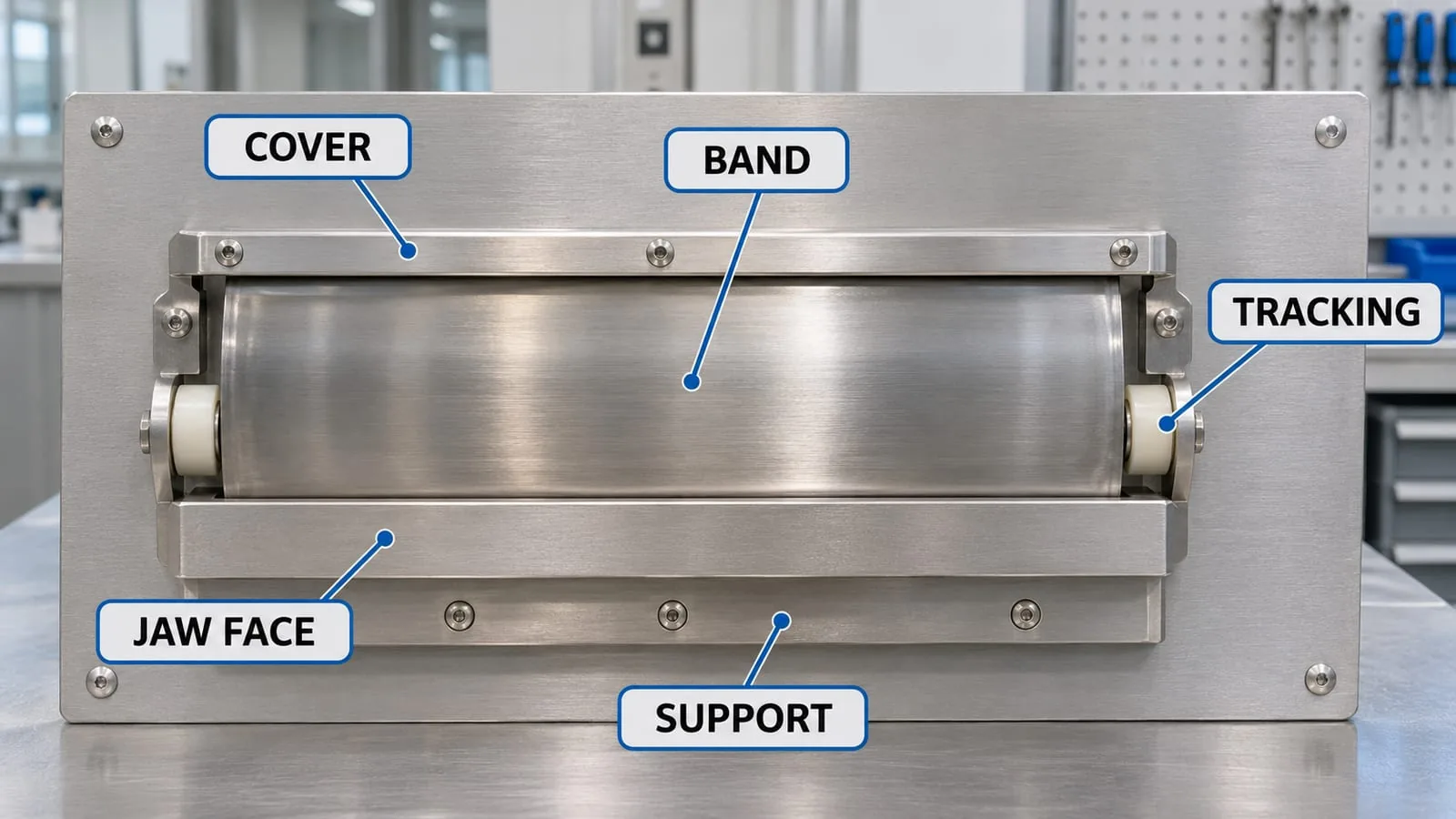 The stainless band does not create a seal in isolation. A cover or release layer can affect sticking and heat transfer. A backing or pad can affect insulation and pressure. A jaw or bar can affect alignment and contact. A guide or terminal can create a local defect that looks like material failure.
Inspect the existing assembly before ordering a replacement. Look for worn PTFE cover, lifted edges, contaminated surfaces, uneven support, damaged terminals, loose fasteners and tracking marks. Where the assembly needs a new PTFE coating or heat-seal tape, specify the cover route with the band rather than treating it as an unrelated consumable. Where the jaw or bar face is worn or distorted, use the sealing jaws and bars service as the relevant enquiry route.
The strongest evidence is a simple comparison: photograph the band, cover, support and jaw before removal; record the symptom and the machine position; then compare the post-fit seal under approved settings. That makes it easier to separate a band fault from an alignment or support fault.
Maintain stainless steel without assuming it is maintenance-free
The BSSA explains that stainless steel surfaces must be kept clean to maintain corrosion resistance and that deposits can create problems. It also notes that chlorides and some disinfectants can cause pitting. Keep the maintenance method specific to the grade, finish and process rather than applying a generic cleaning recipe.
For a planned inspection, use the site’s safe system of work and the HSE maintenance guidance. Isolate the electrical and other energy sources, prevent inadvertent reconnection, release stored energy and allow hot components to cool. HSE also says maintenance should be carried out by competent people and that damaged or faulty equipment should not simply be left in use.
Record the band’s condition after cleaning: surface deposits, pitting, scoring, discolouration, edge damage, joint condition, tracking and the state of the cover. If corrosion is suspected, identify whether it is surface contamination, pitting or a more serious material or environment issue before deciding that the band only needs polishing.
What to send with a stainless-steel band enquiry
A useful enquiry should include:
- Machine manufacturer, model, station and sealing orientation
- Packaging material and the seal pattern or application
- Complete band-route photographs plus close views of the joint, terminals and active zone
- Band width, thickness, loop length and active length in millimetres where available
- Material grade or previous supplier information, if known
- Cover, backing, support, jaw or bar details
- Electrical, temperature, pressure, contact-time and speed information where approved and available
- Cleaning agents, moisture, salt or chemical exposure relevant to the band
Heat Seal Components can review the component route through its Heat Seal Services. If the part is not clearly a stainless endless band, say so and include the photographs rather than selecting a substitute by appearance. You can contact Heat Seal Components with the machine evidence and measurements for a compatibility discussion.
The correct stainless-steel band application is the one that matches the material environment, geometry, heating arrangement, cover system, support and sealing process together. That evidence-led approach helps procurement avoid a visually similar replacement that changes the sealing interface or fails in the cleaning environment.