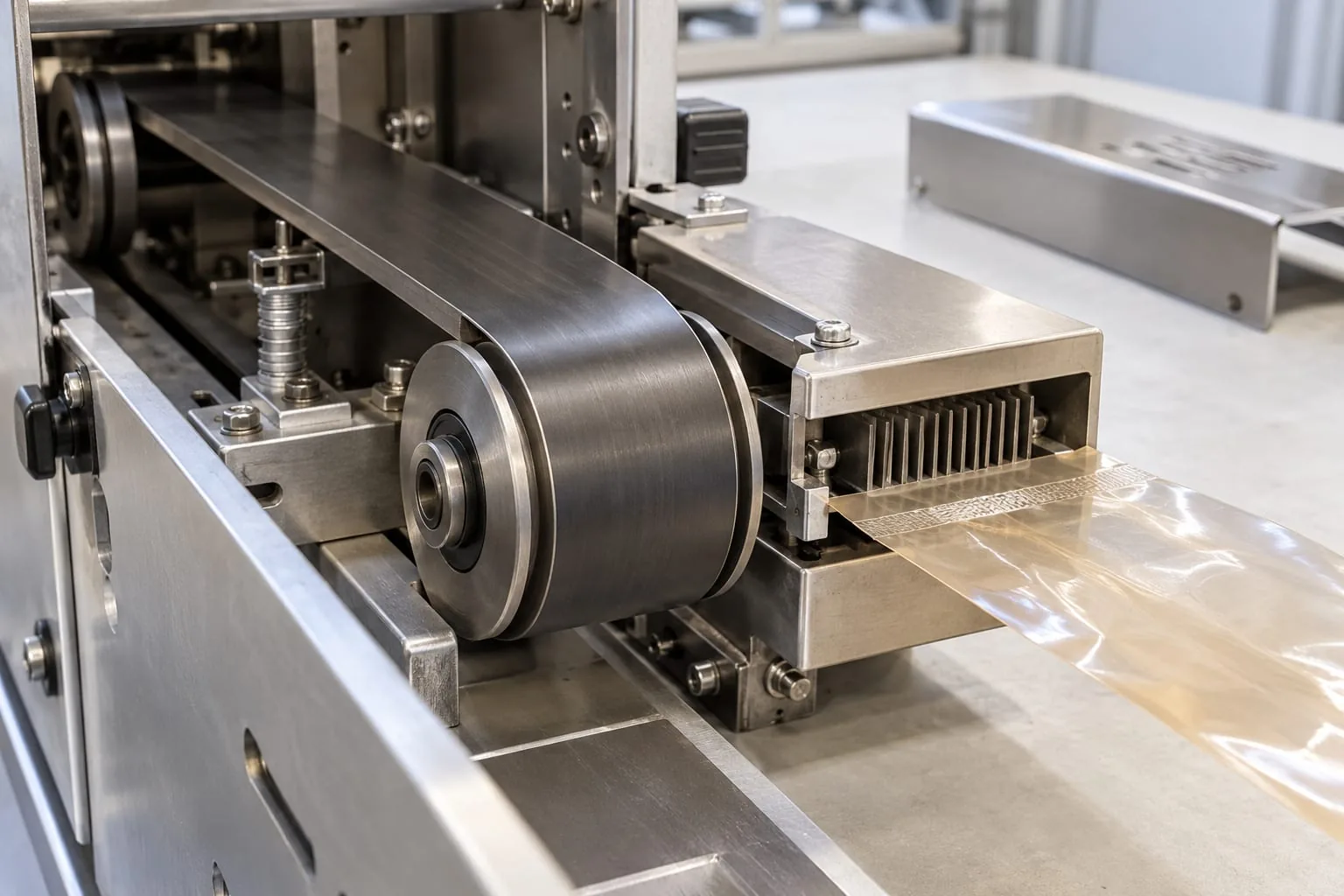
On a continuous heat-sealing line, the endless band is a working component, not the machine itself. It carries the sealing surface through the heated and cooling parts of the route while the pack moves through the line. Rollers, guides and an adjustment point keep the loop aligned. A band that is the wrong size or construction can therefore affect tracking, contact and the consistency of the finished seal.
The phrase “heat seal banding machine” is also used for different equipment. This guide treats it as continuous heat-sealing equipment that uses an endless sealing band. If you mean a strap or bundling machine, say so when requesting parts because the component set is different.
Identify the sealing path before ordering
Start with the complete route rather than the worn part alone. A replacement loop must travel around the same rollers, guides, heating area and cooling area as the original. The path determines the required length, width, thickness, edge form and any tracking feature. A band that looks similar on a bench may still be unsuitable if it runs on a different guide or contact surface.
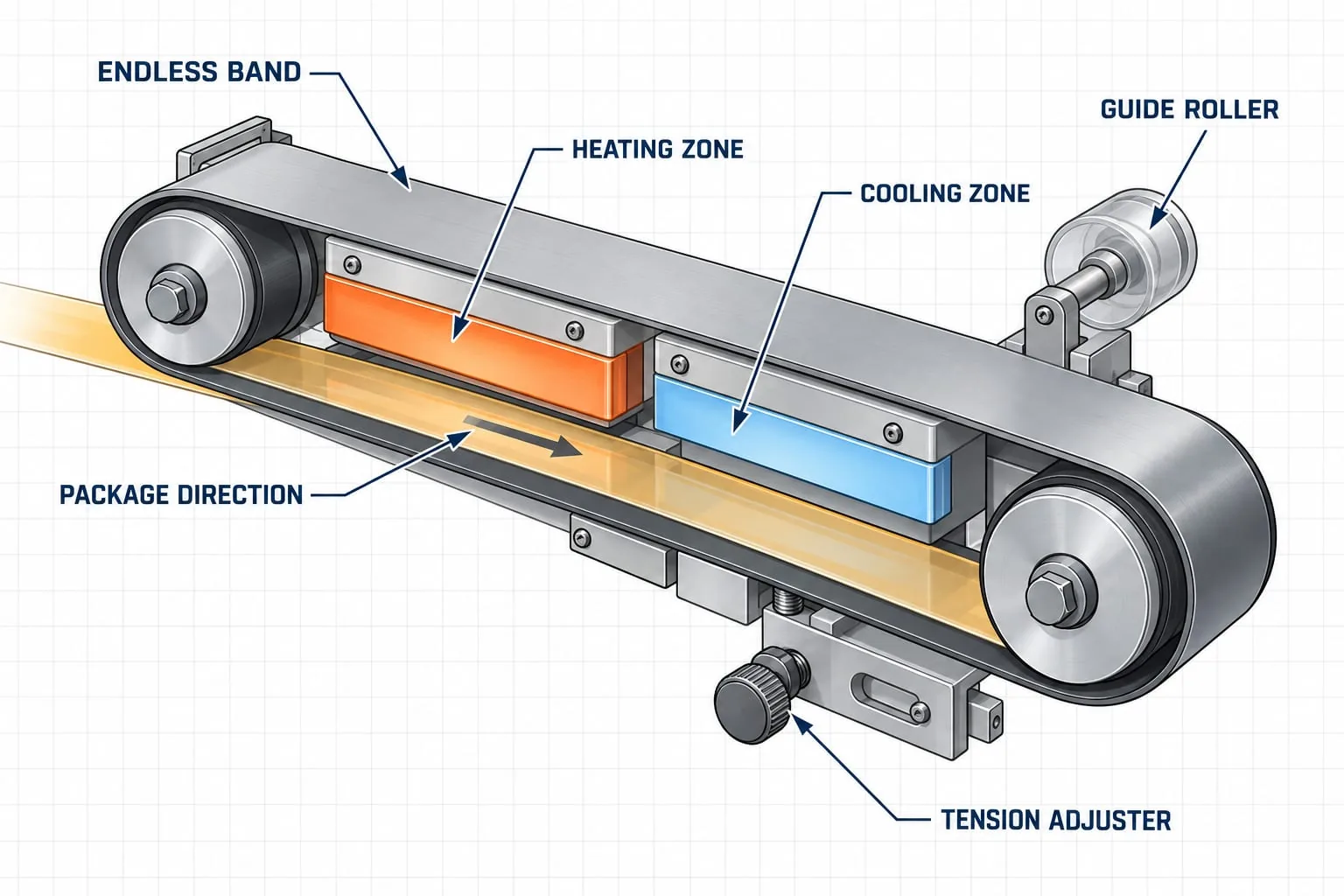
The useful distinction is between the endless band and the parts that support it. The band may be stainless steel, high-carbon steel, nichrome or a coated construction, depending on the application and the required heat transfer. The guide rollers, tension adjuster and heating or cooling surfaces remain part of the compatibility picture, even when only the band is being replaced. Heat Seal Components describes its endless heat-seal bands by the component details needed to assess fit, rather than by a machine name alone.
Where the route is unfamiliar, compare the physical loop with the machine layout and the band dimensions and machine details in this compatibility guide. That check helps separate a sealing band from a drive belt, support belt or another internal part.
Record dimensions and machine details
Send enough information for a component review before asking for a quotation. The following checks are more useful than a photograph of the machine nameplate by itself:
- Record the machine manufacturer, model, orientation and the product or film being sealed.
- Measure the installed loop length or circumference, band width and thickness. If the loop has a joint, record the joint style and condition.
- Photograph the band route, edge profile, roller grooves, guides, tension adjustment and heating or cooling contact surfaces.
- Note any coating, surface texture, perforation or tracking feature. Do not assume that a black surface is PTFE or that a flat band is interchangeable with a profiled band.
- Record the symptoms and when they appear: edge movement, sticking, residue, uneven seals, visible scoring or repeated adjustment.
Use the old band as evidence, but do not copy a damaged or stretched measurement without checking the machine route. If a band has been shortened, distorted or installed with the wrong tension, its current length may not be the intended replacement length.
Check tracking, surface and adjacent components
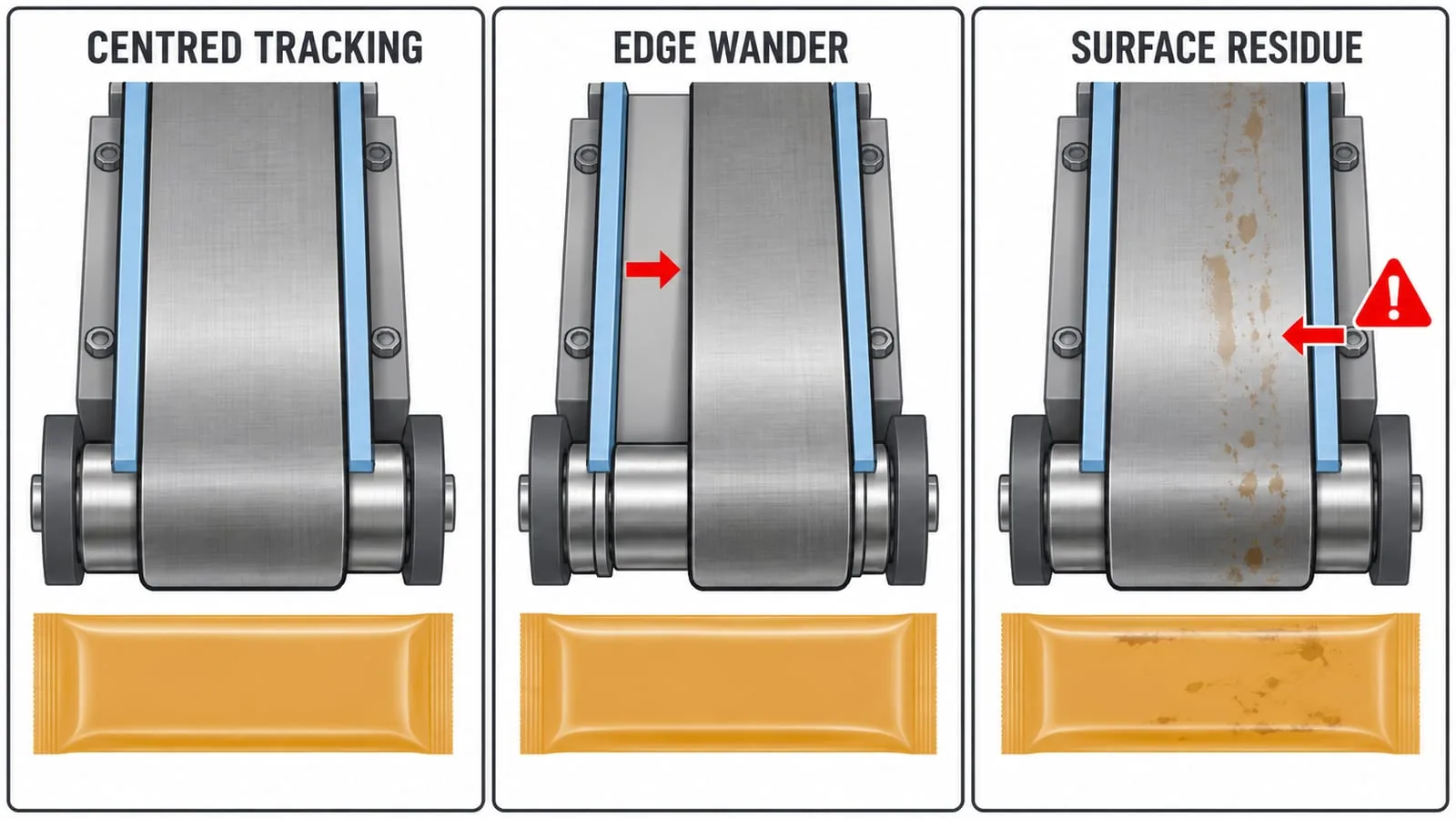
Tracking problems are often visible before a loop fails completely. Inspect the band and its working path together so that a replacement does not hide the cause of a repeat stoppage.
Read the warning signs
Look for edge wander, polishing on one side, scoring, cracking, distortion, coating loss or material stuck to the contact surface. A band that moves laterally may be showing a route, roller, guide or tension issue rather than a simple band-size problem. Residue or an uneven seal can also point to the interaction between the band, the heated surface and the packaging material.
If the application needs a non-stick or release surface, discuss the PTFE coating service with the component details. Coating choice is application-dependent. It should be checked against the working temperature, contact conditions, cleaning method and the material being sealed rather than assumed from a generic description.
Inspect what the band depends on
Check that guide rollers turn freely, grooves are clean and the tension adjustment is not at the end of its travel. Inspect the heating and cooling contact areas for damage or build-up. If the sealing assembly uses jaws or bars alongside the loop, compare them with the sealing jaws and bars service so the enquiry covers the relevant component rather than implying that a band will correct a separate alignment problem.
Replace the loop safely and verify the result
Follow the equipment manufacturer’s instructions and your site’s isolation procedure. Packaging machinery has in-running nip points and heated surfaces, and maintenance should be planned by a competent person. The HSE guidance on packaging machinery hazards highlights guarding and safe access around moving and sealing equipment. The HSE maintenance guidance also covers positive isolation, lock-off and allowing equipment to be made safe before work begins.
Before removing the old loop, photograph the route and note the original adjustment positions. Isolate the equipment, wait for hot parts to cool to a safe condition and confirm that stored movement or tension has been controlled. Fit the replacement without forcing it over a roller or stretching it beyond the specified route. Recheck the guides, groove engagement and tension adjustment before the guard is restored.
For the first controlled run, observe the band from the side and confirm that it stays centred through the heating and cooling areas. Check that the package enters and exits without catching, and inspect the seam for the result required by the process. Change one adjustment at a time and record what was changed. A supplier’s PTFE sealer belt data sheet is a useful reminder that belt construction, tracking details and thermal contact all matter, but it should not be treated as a substitute for the equipment-specific specification.
When to request a compatibility quote
Ask for a compatibility review when the band has an unusual profile, a specialised coating, a joint, a tracking feature or a route that cannot be measured confidently. Include the machine details, all measured dimensions, clear route photographs and the symptoms observed. If you need more than the band, list the guides, rollers, sealing elements, jaws or bars separately so the scope remains clear.
Heat Seal Components supplies heat-seal elements and wires, endless bands, custom impulse elements, PTFE coating and heat-seal tape, sealing jaws and bars, and component compatibility guidance for packaging equipment. It does not mean that every machine model or every adjacent part is automatically covered. For a documented review, contact Heat Seal Components with the measurements and photographs before ordering.